Business Agreement Signed to Establish a Rural Resource Recycling Renewable Energy Village in Hongseong County
Kia is partnering with the government, local authorities, and other organizations to promote greenhouse gas reduction and the spread of renewable energy in local communities by converting livestock manure into resources.
On September 2, Kia announced that it had signed a multilateral memorandum of understanding (MOU) at the Hongseong County Office in Chungcheongnam-do with Hongseong County, the Livestock Environment Management Institute, and the Global Vision Network to establish a rural resource recycling renewable energy village.
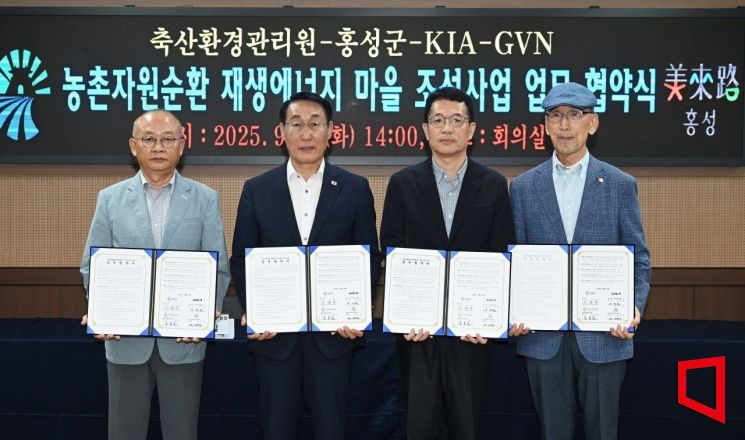 On the 2nd, at the Hongseong County Office in Chungcheongnam-do, a signing ceremony for a memorandum of understanding (MOU) to establish a rural resource recycling renewable energy village was held. Moon Honggil, Director of the Livestock Environment Management Institute (from the left), Lee Yongrok, Hongseong County Governor, Lee Deokhyun, Head of Kia's Sustainable Management Office, and Kim Kiyong, Chairman of the Global Vision Network, are posing for a commemorative photo. Photo by Kia
This agreement marks the first public-private-local government collaboration project in Korea to convert livestock manure into energy and create a renewable energy self-sufficient rural village. It is expected to contribute to solving local environmental and social issues.
Over the next three years, Kia plans to support the expansion of the capacity of livestock manure biogas processing facilities in Hongseong County and the installation of agricultural product drying facilities that utilize waste heat generated during the biogas production process. The production of livestock manure biogas involves storing manure in enclosed facilities and decomposing it using microorganisms, which helps reduce odor and greenhouse gas emissions, and enables the recycling of waste resources.
Kia aims to actively contribute to the development of a public-private partnership model for building a sustainable renewable energy eco-village by expanding livestock manure biogas production in Hongseong County.
In addition, the parties plan to continue cooperating on: expanding livestock manure treatment and utilization methods; establishing village infrastructure based on renewable energy using biogas and waste heat; conducting research and measurement of carbon reduction effects; and developing greenhouse gas reduction methodologies.
In 2023, Kia signed a business agreement with the Ministry of Agriculture, Food and Rural Affairs and others, and is also conducting Korea's first public-private pilot project for livestock manure biochar in Uiseong, aiming to contribute to ecosystem preservation through resource recycling and renewable energy conversion.
Lee Deokhyun, Head of Kia's Sustainable Management Office, stated, "With the goal of realizing our corporate vision as a sustainable mobility solutions provider, we will continue to collaborate with various partners to address major social and environmental issues. We will expand our efforts to solve key environmental challenges such as livestock manure treatment and tidal flat restoration, and to reduce greenhouse gas emissions."
© The Asia Business Daily(www.asiae.co.kr). All rights reserved.
![Clutching a Stolen Dior Bag, Saying "I Hate Being Poor but Real"... The Grotesque Con of a "Human Knockoff" [Slate]](https://cwcontent.asiae.co.kr/asiaresize/183/2026021902243444107_1771435474.jpg)















