Raw Material and Labor Costs Drive Up Prices
Monopolistic Structure and Collusion
Under Investigation by the Fair Trade Commission
Bread prices have continued to rise sharply for six consecutive months, increasing the burden on consumers.
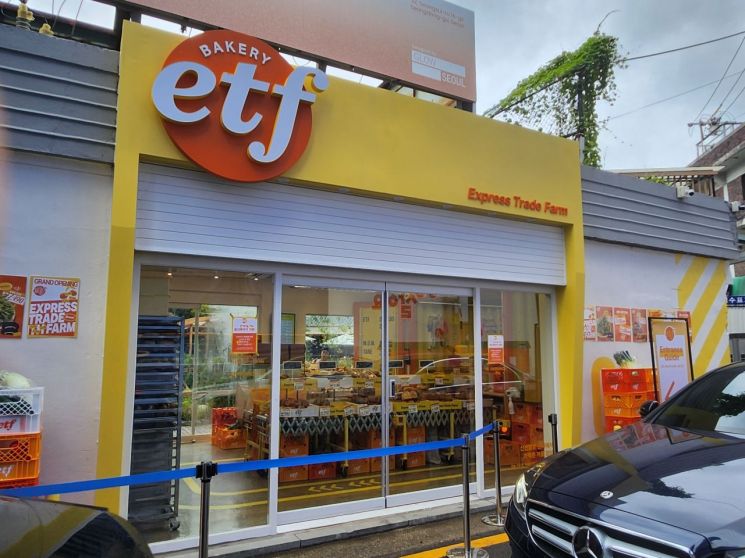 The pop-up store of Shuka's 'ETF Bakery' in Seongsu-dong, famous for its 990 won salt bread. Not related to the article. Photo by Heo Midam
According to the National Statistical Portal (KOSIS) of Statistics Korea on September 3, the bread price index for August was recorded at 138.61 (2020=100), a 6.5% increase compared to the same month last year. This is more than three times the overall consumer price inflation rate (1.7%) for the same period, and more than double the inflation rate (2.3%) when excluding the impact of SK Telecom's telecommunications fee reduction.
Bread prices showed an increase of less than 1% from April to November last year, but then jumped to 3.3% in December. The rate of increase continued to rise, reaching 3.2% in January and 4.9% in February this year. From March, the rate entered the 6% range and has maintained a high growth rate for six consecutive months. In March, it jumped to 6.3%, and from April to July, it was 6.4% each month.
Raw Material and Labor Costs Are the Main Causes
The main factors cited are the prices of raw materials and the burden of labor costs. Flour prices surged by 45.5% year-on-year in September 2023 due to the prolonged Russia-Ukraine war. Although prices have recently stabilized, they remain higher than pre-war levels. Egg prices have also steadily increased since April, rising by 8% year-on-year in August. Statistics Korea explained, "The increase in ex-factory prices since the end of last year, combined with the burden of raw material and labor costs, have acted together."
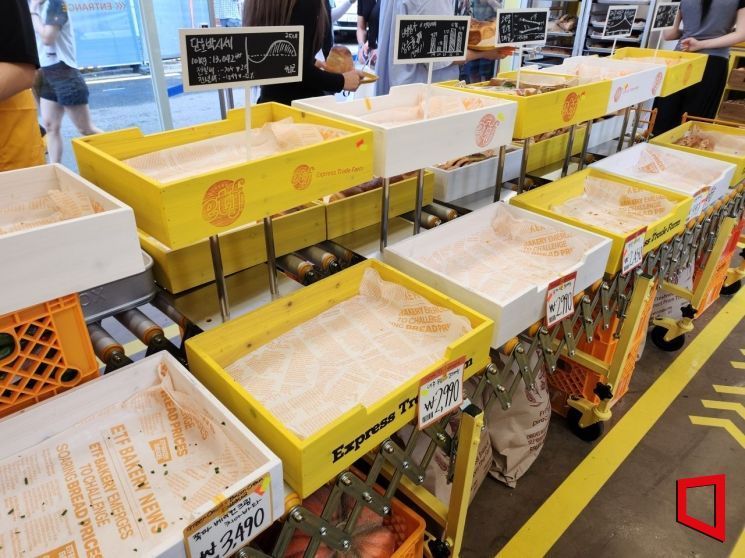 Interior view of Shuka's Seongsu-dong 'ETF Bakery' pop-up store, famous for its 990 won salt bread. Unrelated to the article. Photo by Midam He
Recently, a well-known economic YouTuber, Shuka, made headlines by selling salt bread for 990 won and promoting it as a response to 'breadflation.' However, some self-employed business owners criticized this move, arguing that it could give the impression that existing bakeries are making excessive profits. In response, Shuka clarified, "I have never criticized self-employed business owners. I intended to highlight the structural issues in bread pricing," adding, "I apologize if there was any misunderstanding."
In fact, bread prices in South Korea are analyzed to be higher than those in major countries. According to a report prepared by the Kongju National University Industry-Academic Cooperation Foundation at the request of the Fair Trade Commission, South Korea's bread consumer price index in 2023 was 129, higher than that of the United States (125), Japan (120), and France (118). The average price per 100 grams was also higher in South Korea at 703 won, compared to France (609 won), the United States (588 won), and Australia (566 won).
The profitability of the domestic bakery industry has also improved. Sales at specialty stores increased by 25.7%, from 6.024 trillion won in 2020 to 7.57 trillion won in 2022. During the same period, operating profit rose by 75.3%, from 270 billion won to 470 billion won. The packaged bread market also grew from 2.8372 trillion won in 2018 to 3.9589 trillion won in 2022, surpassing the average growth rate of the overall food market.
Monopolistic Structure and Collusion Under Fair Trade Commission Investigation
The report indicated that there are structural problems in the processing and distribution of raw materials such as sugar, eggs, and milk, where market competition does not function properly. In particular, it was pointed out that SPC Samlip may have a de facto monopoly, holding an 80% share of the packaged bread retail market.
In response, the Fair Trade Commission has been investigating major food companies such as Nongshim, Orion, Lotte Wellfood, Crown Confectionery, and Haitai Confectionery since April to determine whether there was collusion in the process of raising ex-factory prices for bread and confectionery. In June, the commission also began reviewing whether the pricing practices of the Korea Association of Layer Farmers for eggs constitute price collusion.
© The Asia Business Daily(www.asiae.co.kr). All rights reserved.
![Clutching a Stolen Dior Bag, Saying "I Hate Being Poor but Real"... The Grotesque Con of a "Human Knockoff" [Slate]](https://cwcontent.asiae.co.kr/asiaresize/183/2026021902243444107_1771435474.jpg)
















