Korea Employers Federation Voices Concerns Over Revised Trade Union Act
CHOs Call for Government Action to Prevent Labor-Management Instability
Uncertainty Grows in Industrial Sites Amid Expanding Employer Responsibilities
"Although the Trade Union Act has been amended, our companies are at a loss as to how to prepare for next year's collective bargaining."
Son Kyungshik, chairman of the Korea Employers Federation, voiced strong concerns regarding the recently passed amendments to Articles 2 and 3 of the Trade Union Act (the so-called Yellow Envelope Act).
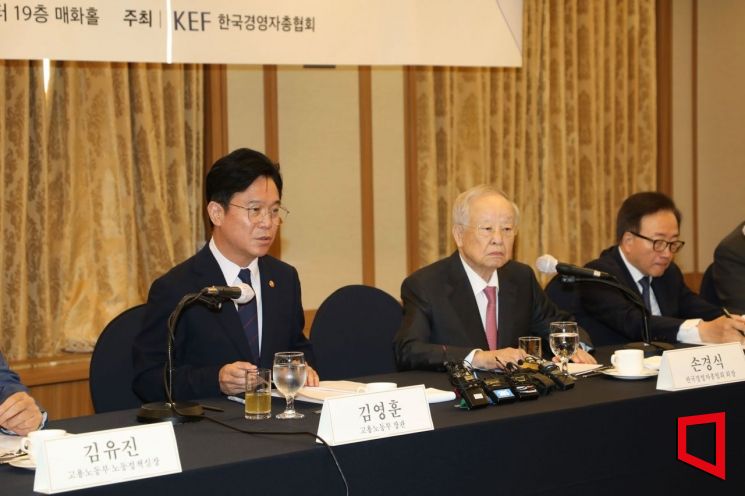 On the 3rd, Son Kyungshik, chairman of the Korea Employers Federation (right), and Kim Younghoon, Minister of Employment and Labor (left), attended the "Major Companies' Human Resources and Labor Officers (CHO) Meeting" held at the Korea Press Center in Seoul. Korea Employers Federation
At the "Major Companies' Chief Human Resources Officers (CHO) Meeting" held at the Korea Press Center in Taepyeong-ro, Seoul, on September 3, Chairman Son pointed out, "Everything is unclear, including whether there is actual control (under the amended Trade Union Act), whether negotiations must be held with multiple subcontractor unions, and what items should be discussed."
He went on to say, "The government's role is crucial," and requested, "Please closely examine the concerns of companies, prevent labor-management conflicts, and minimize management uncertainty."
At the meeting, Kim Younghun, Minister of Employment and Labor, explained the purpose of the amendments to Articles 2 and 3 of the Trade Union Act and outlined future policy directions. The chief human resources and labor executive officers (CHOs) of major companies shared their opinions on concerns arising in the industrial field following the law's revision.
The CHOs conveyed concerns about potential issues in the industrial field that may arise after the amendment of the Trade Union Act and called for the Ministry of Employment and Labor to take an active and reasonable role.
The CHOs commonly pointed out that, given the multi-layered structure of the primary contractor-subcontractor ecosystem, it is unclear to what extent employer status will be recognized and whether negotiations will be required with unions of subsidiaries or affiliates. They expressed significant concern about instability in labor-management relations at worksites due to the expanded definition of employer status.
They also expressed concern that if demands for negotiation extend to business or management decisions such as business division and mergers, relocation of workplaces, or overseas investment, it could inevitably have a negative impact on corporate competitiveness. They emphasized the role and responsibility of the Ministry of Employment and Labor in ensuring stable labor-management relations.
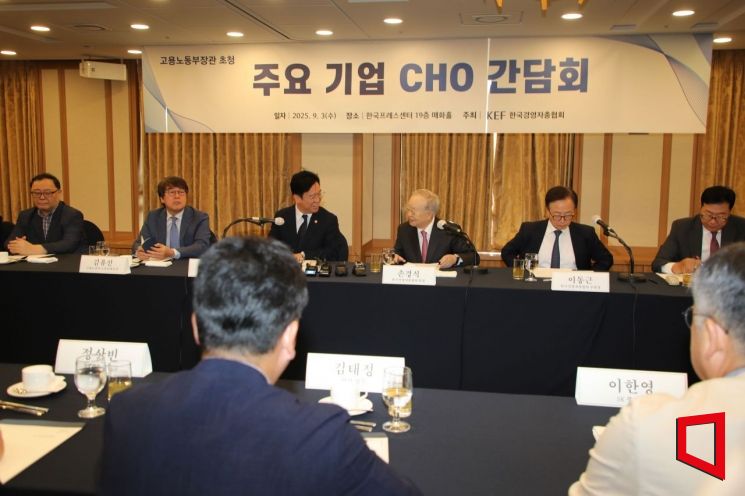 On the 3rd, Son Kyungshik, chairman of the Korea Employers Federation (third from the right), and Kim Younghoon, Minister of Employment and Labor (fourth from the right), attended the "Key Corporate Human Resources and Labor Executive Officers (CHO) Meeting" held at the Korea Press Center in Seoul. Korea Employers Federation
Chairman Son stated that the Korean economy is facing many difficulties, including low growth and external uncertainties, and emphasized, "Above all, stable labor-management relations are crucial for companies to protect jobs and secure growth momentum."
He added, "There are constant concerns that the amendment of the Trade Union Act will threaten the primary contractor-subcontractor industrial ecosystem and increase instability in labor-management relations across the industry." He continued, "The government must thoroughly examine the concerns of companies, prevent labor-management conflicts, and minimize uncertainty in the business environment."
© The Asia Business Daily(www.asiae.co.kr). All rights reserved.
![Clutching a Stolen Dior Bag, Saying "I Hate Being Poor but Real"... The Grotesque Con of a "Human Knockoff" [Slate]](https://cwcontent.asiae.co.kr/asiaresize/183/2026021902243444107_1771435474.jpg)
















