Participating in the Naju Policy Vision Tour on September 2
Presenting Visions Including the Yeongsangang Renaissance
Efforts for Additional Second-Phase Public Institution Relocation
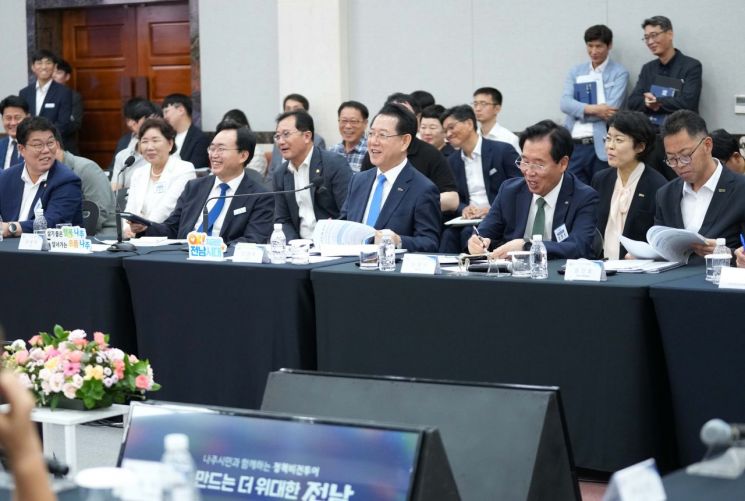 Jeollanam-do Governor Kim Youngrok is attending the "Naju City Policy Vision Tour" event held at Naju City Hall on the 2nd, presiding over the discussion and responding to questions about opinions and suggestions on future vision, policy issues, and regional development. Provided by Jeonnam Province
On September 2, Kim Youngrok, Governor of Jeollanam-do, stated, "Based on Naju City's limitless growth potential, we will accelerate the development of an energy hub and the Yeongsangang Renaissance to transform Naju into the leading energy capital of Korea."
Governor Kim made these remarks while attending the Naju City Policy Vision Tour held in the main conference room at Naju City Hall that day.
Over 100 local residents participated in this Policy Vision Tour, including Yoon Byungtae, Mayor of Naju, Lee Jaenam, Chairman of the Naju City Council, Lee Jaetae and Choi Myungsoo, members of the Jeollanam-do Provincial Council, as well as youth and representatives from vision industries.
In his welcome address, Mayor Yoon Byungtae said, "Naju is a city with 2,000 years of history and culture, and is emerging as Korea's energy capital. We will usher in a new era of the Yeongsangang Renaissance by having the Yeongsangang designated as the nation's largest national garden," adding, "In line with the second phase of public institution relocations, we will work closely with Jeollanam-do Province to ensure that additional agriculture and energy-related institutions are relocated to Naju."
In response, Governor Kim said, "I am pleased to hold the Policy Vision Tour in Naju at a time when the city is making great strides as a true hub for advanced industries and energy. Historically, Naju has played a central role, and now, leveraging this strength, it is confidently growing into a future innovation city and a future energy hub that will lead both Honam and Korea."
He continued, "We will accelerate the leap toward a global energy hub and the Yeongsangang Renaissance, and foster Bitgaram Innovation City as a model for balanced regional development. We will make Naju the best future city in Korea, where the energy industry and a new Yeongsangang Renaissance flourish."
Following this, under the slogan "A Prosperous Land, a Millennium City of Innovation," the Jeonnam Research Institute presented on Naju's development potential and core future vision.
Based on Naju's potential, the Jeonnam Research Institute proposed nine key visions: ▲ creating a "Korean Silicon Valley" centered on KENTECH, ▲ completing the nation's largest K-Energy Valley, ▲ realizing Yeongsangang Renaissance 2.0, ▲ building a 2,000-year history and culture city connecting Mahan and the millennium-old capital, ▲ establishing a Moksa-gol premium agri-food ecosystem, ▲ leading the advanced green bio industry, ▲ achieving a planned city population of 50,000 through the second relocation of public institutions, ▲ creating a "Naju-style education city," and ▲ building a transportation network connecting the southwestern region of Jeollanam-do and the entire Honam area.
For each vision: The "Korean Silicon Valley" initiative includes launching 300 energy startups in the KENTECH cluster, leading K-microgrid demonstration through the establishment of an AI data center, and attracting a 1.2 trillion won "artificial sun research facility."
To complete the nation's largest K-Energy Valley, the proposals include supplying customized industrial sites for energy and power companies to attract 1,000 firms, and raising the city's brand value by hosting the "Energy Olympics (World Energy Congress)" in 2030.
For the creation of a tourism destination attracting 10 million visitors, the strategies presented include seeking UNESCO World Heritage status for Mahan culture, promoting workation in the Naju Eupseong area, and making the Namdo Volunteer History Park a landmark attraction.
During the policy issues discussion, there was a request to expand support for micro-sprinkler systems to reduce fruit crop disaster damage.
Lee Donghee, head of the Fruit and Vegetable Cooperative, said, "Recently, the frequency of abnormal weather events due to climate change has increased, causing significant damage to farms such as fruit growth disorders, premature fruit drop, and quality degradation. Support for micro-sprinkler systems, which are highly effective in preventing damage from low temperatures and heat waves, is necessary." In response, Governor Kim Youngrok said he would consider countermeasures such as frost prevention using existing agrivoltaic research, and promised to reflect this in next year's budget.
Other proposals included: ▲ support for replacing outdated bus information terminals, ▲ support for installing permanent rice paddy embankments (water management PE film), ▲ improving age restrictions for the Women's Farmer and Fisher's Happiness Voucher, ▲ support for low-cost customized smart farm pilot projects, and ▲ improving the bidding system for companies based in the province.
© The Asia Business Daily(www.asiae.co.kr). All rights reserved.
![Clutching a Stolen Dior Bag, Saying "I Hate Being Poor but Real"... The Grotesque Con of a "Human Knockoff" [Slate]](https://cwcontent.asiae.co.kr/asiaresize/183/2026021902243444107_1771435474.jpg)















