Fire Safety Upgrades for Vulnerable Pilotis Multi-Family Housing
Government to Fund Performance Enhancements and Disclose Building Safety Information
220,000 Buildings at Risk Nationwide Identified for Priority Action
Plans are underway to enhance fire prevention equipment in pilotis-type multi-family housing. Following the parking lot fire in Gwangmyeong last July, which exposed the vulnerability of pilotis-structured buildings to fire, authorities have decided to pursue both performance upgrades and regulatory improvements.
On September 3, during a Cabinet Ministers' Meeting on State Affairs chaired by the Prime Minister, the Ministry of Land, Infrastructure and Transport announced the finalization of the "Fire Safety Improvement Plan for Pilotis Multi-Family Housing." According to a survey by the Ministry, as of July this year, there are approximately 350,000 buildings nationwide with pilotis structures. Of these, 280,000 are residential buildings, 40,000 are commercial facilities, and about 9,000 are educational facilities. Among residential pilotis buildings, 220,000 have combustible exterior materials, and of these, 116,000 are multi-family dwellings such as apartments and multiplex housing.
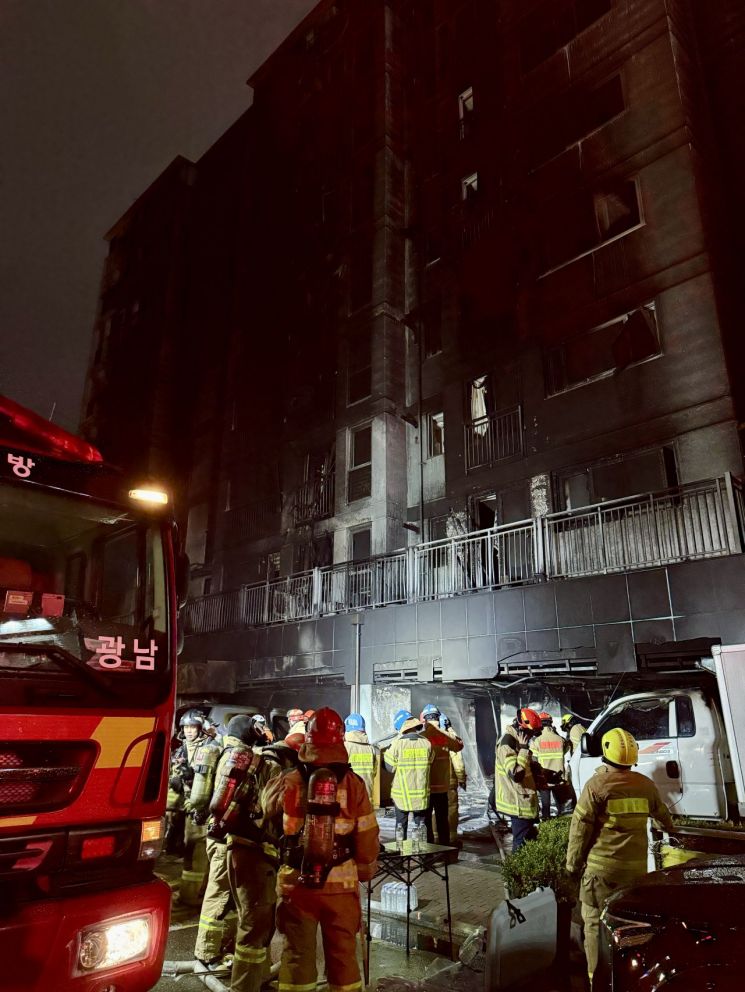 The pilotis parking lot in Gwangmyeong that caught fire last July. Provided by Gyeonggi-do Fire and Disaster Headquarters, Yonhap News Agency
First, the government will provide funding for the installation of arc arresters, which detect electric sparks and cut off power to prevent fires, and automatic diffusion-type fire extinguishers, which automatically spray extinguishing agents when a fire is detected, in 30,000 pilotis multi-family houses identified as particularly vulnerable to fire. The average support per building is set at around 2 million won, jointly funded by the central and local governments. The selection of eligible buildings will be based on safety factors such as the area of the pilotis parking lot and the presence of fire partitions on the first floor. The government plans to propose a legislative amendment within this month and launch a pilot project in the first half of next year.
Additionally, important fire safety information such as exterior materials and sprinkler systems will be required to be recorded in the building register, and the use of long-term repair reserves will be promoted. This measure is intended to enable residents to have accurate information about their buildings and to strengthen fire prevention performance. Making building register information available in the multi-family housing information system will only require a revision of the relevant rules.
The process for adjusting long-term repair plans will also be simplified. The long-term repair plan, which provides the basis for using reserves for the maintenance of common areas, is reviewed every three years. Currently, a written majority consent from owners is required to amend the plan, but this will be changed so that a resolution by the residents' representative meeting will suffice. While replacing exterior materials with semi-noncombustible materials currently requires resident consent and local government approval, this will also be streamlined to require only a resolution by the residents' representative meeting and notification to the local government.
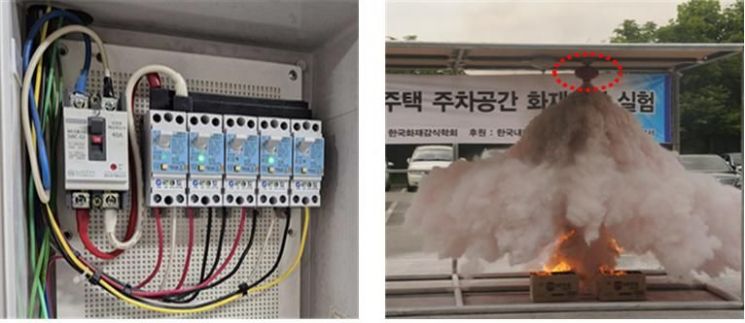 An arc arrester that detects electric sparks and cuts off power (left in the photo), and an automatic diffusion-type fire extinguisher that automatically sprays extinguishing agents when a fire is detected. Provided by the Ministry of Land, Infrastructure and Transport
Furthermore, the government will develop and distribute safety management guidelines for pilotis spaces to local governments and multi-family housing complexes. Pilotis safety management will be included in the mandatory training for apartment management entities. In the long term, a performance verification system will be introduced to evaluate the key functions and performance of buildings, which can be used in transactions such as sales, rentals, financing, and insurance. The government plans to establish detailed measures for this system, which will involve assessments by certified professionals, by the first half of next year.
In the United Kingdom, the submission of such assessments and related documents is mandatory when applying for secured loans. If the rating is low, loans may be denied or the amount reduced. In the United States, property prices may be adjusted or contracts terminated based on inspector evaluations. The government is also considering making it mandatory to upgrade fire safety performance in multi-family housing. Minister of Land, Infrastructure and Transport Kim Yoonduk stated, "The government will act responsibly to promptly reinforce pilotis multi-family housing and address the root causes step by step to prevent casualties from fires."
© The Asia Business Daily(www.asiae.co.kr). All rights reserved.


















