Disruptions in Research Projects Due to Leadership Vacancies
Concerns Over Declining Efficiency in National R&D Initiatives
The prolonged vacancies in leadership positions at major science and technology institutions are disrupting their operations.
According to the science and technology community on September 2, the appointments of heads for major research institutions such as the Korea Advanced Institute of Science and Technology (KAIST), the Institute for Basic Science (IBS), and the Korea Brain Research Institute (KBRI) have been delayed for several months. The Korea Institute of Oriental Medicine (KIOM) has been without a leader for one year and five months.
In this situation, the term of Choi Yanghee, Vice Chair of the National Science and Technology Advisory Council and President of Hallym University, expired on September 1, leaving the vice chair position, which is at the ministerial level, vacant.
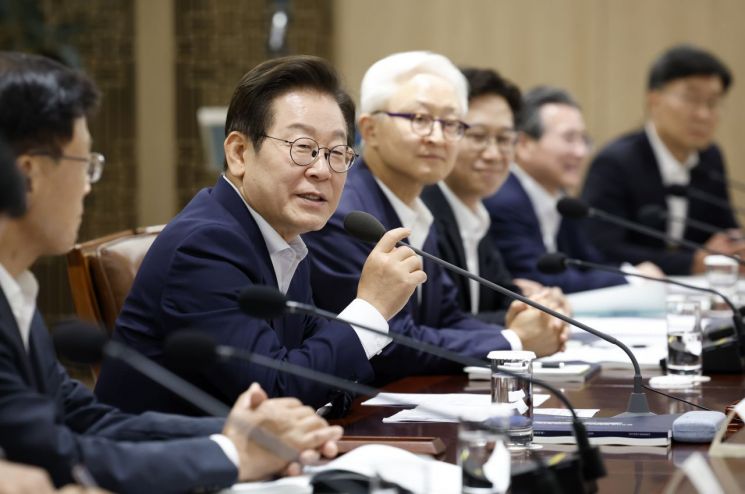 President Lee Jae Myung is presiding over the 1st plenary meeting of the National Science and Technology Advisory Council at the Yongsan Presidential Office on the 22nd of last month. Photo by Yonhap News
Lee Kwanghyung, President of KAIST, completed his term on February 22, but has been performing the duties of president for six months.
The KAIST Presidential Nomination Committee selected three candidates-President Lee, Professor Kim Jungho, and Professor Lee Yonghoon-in March and requested a personnel review by the government, but there has been no progress in the vetting process by the Presidential Office.
Based on the results of the Presidential Office's personnel review, the KAIST Board of Trustees will select the final candidate by vote. The candidate who receives a majority of votes will be recommended to the Minister of Science and ICT, and upon receiving consent from the Minister of Education, will be approved as president.
A KAIST official stated, "We have no way of knowing what issues may exist in the personnel review process," adding, "A regular board meeting to decide on the presidential appointment is scheduled for December, so it is difficult to hold an interim board meeting before then. For now, all we can do is wait."
Noh Doyoung, President of IBS, has continued in his role for ten months since his term ended in November last year. The process for appointing a new IBS president involves a recommendation committee selecting three candidates and reporting them to the Ministry of Science and ICT, after which the minister recommends a candidate to the President for appointment.
Although the pool of new candidates was finalized in March, it is reported that the review process has not proceeded at all. An IBS official commented, "As the appointment is delayed, even the staff have recently lost interest in the selection of a new president," adding, "However, there seems to be some hesitation when approval is needed for important matters."
The Korea Brain Research Institute (KBRI) has been without a president since the term of former president Seo Pangil expired in December last year. While the process of appointing a new president is underway, the prolonged leadership vacuum has led to issues such as poor attendance management among employees and other problems have surfaced.
The Korea Institute of Oriental Medicine (KIOM), a government-funded research institute under the National Research Council of Science & Technology (NST), has also experienced a delay of one year and five months in appointing a new head since the term of former president Lee Jinyong ended in April last year.
The KIOM Presidential Candidate Review Committee recommended three candidates to the board in July 2024. However, at the board meeting held by NST in February, no candidate met the majority vote requirement, so a new president was not appointed. Furthermore, the labor union has raised allegations of management interference in the selection process, and the controversy continues.
The vacancy in the vice chair position of the National Science and Technology Advisory Council, which is at the ministerial level, is also a concern. The chair of the council is the President, while the vice chair is nominated from the private sector by the President. The council serves as the highest advisory body on science and technology in the country, directly advising the President and deliberating on major national science and technology policies.
Therefore, if a successor is not appointed soon, science and technology policy deliberations will proceed without a vice chair, who holds decision-making authority. The recent live broadcast of President Lee Jae Myung presiding over the plenary meeting of the council drew attention for this very reason.
An official in the science and technology community expressed concern, saying, "Appointments of institution heads in the science and technology field are crucial to continue the policy direction of the new administration. The absence of leadership at major institutions hampers the establishment of long-term visions and the pursuit of new research projects, ultimately reducing the efficiency of national R&D initiatives."
© The Asia Business Daily(www.asiae.co.kr). All rights reserved.
![Clutching a Stolen Dior Bag, Saying "I Hate Being Poor but Real"... The Grotesque Con of a "Human Knockoff" [Slate]](https://cwcontent.asiae.co.kr/asiaresize/183/2026021902243444107_1771435474.jpg)
















