Next Year's Government Budget Proposal Allocates 1.7279 Trillion Won to Sejong
Increase of 147.8 Billion Won Compared to This Year
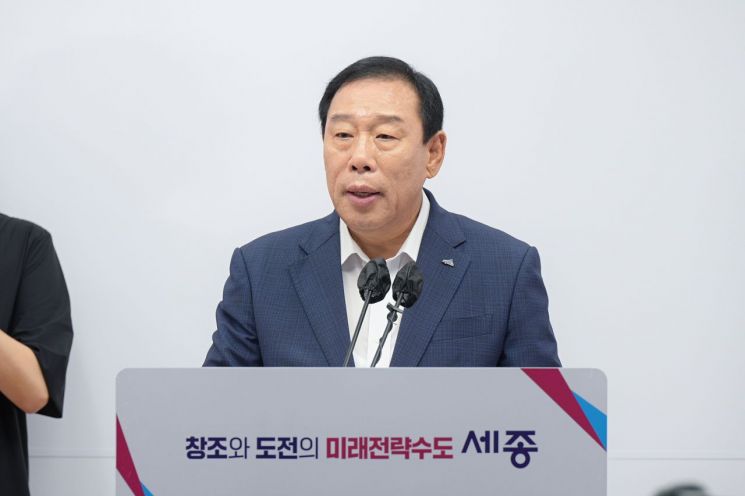 Minho Choi, Mayor of Sejong City, is explaining the regional budget included in next year's government budget proposal. / Photo by Budget Officer, Planning and Coordination Office
Numerous key projects for Sejong City have been included in next year's government budget proposal. Of the 728 trillion won government budget passed by the Cabinet on August 29, the budget allocated to Sejong City amounts to 1.7279 trillion won. This represents an increase of 147.8 billion won (9.4%) compared to this year's government budget. This is expected to provide momentum for the fourth administration's flagship initiatives, including the completion of the administrative capital, the creation of a Hangeul cultural city, the expansion of self-sufficiency functions, and the enhancement of citizen safety.
On September 1, Minho Choi, Mayor of Sejong City, held a press conference to explain the major pending projects reflected in next year's government budget proposal.
According to Sejong City, the construction budgets for the National Assembly Sejong Office and the Presidential Sejong Office have been significantly increased to 95.6 billion won and 24 billion won, respectively, compared to this year. This decision is based on the premise of expanding the scale of construction in preparation for a complete relocation to Sejong.
The total amount of national funds allocated so far for the construction of the National Assembly Sejong Office is 215.3 billion won, while the total national budget for the Presidential Sejong Office stands at 29.8 billion won. The city plans to actively cooperate with relevant agencies to ensure that the design competition for the National Assembly Sejong Office can begin within this year.
In addition, 300 million won in government research funding has been allocated to establish Sejong as a true "Hangeul Cultural City." The city interprets this as recognition of its commitment to create a comprehensive Hangeul cultural complex encompassing education, research, culture, arts, tourism, experience, policy, and industry.
With the explosive global popularity of the Korean Wave, international interest in Hangeul is higher than ever. Mayor Choi believes that the government has also recognized the need to actively utilize Hangeul as a core element of President Lee Jaemyung's pledge to globalize the K-Culture brand. As a pilot project to unify Hangeul education, which is currently dispersed across various ministries and functions, 500 million won in operational funding for the Hangeul Cultural Education Center has been newly allocated, along with 4 billion won to continue the Hangeul Cultural City project. This will provide a stable foundation for the city to pursue these initiatives. The city plans to establish itself as a true Hangeul Cultural City and contribute to the national agenda of making K-Culture a leading global industry.
In particular, many projects aimed at improving citizen safety and convenience have also been included in next year's government budget proposal.
First, 300 million won has been allocated for the design of the "Eco-friendly Integrated Town" project. The plan is to create a regional landmark that goes beyond a simple waste treatment facility by including amenities and cultural and experiential facilities for residents.
Additionally, 900 million won has been allocated for the design of a driver's license test center, paving the way for the full-scale launch of the construction project next year. This is expected to alleviate the inconvenience experienced by citizens who previously had to travel outside the city to obtain a driver's license.
Furthermore, 600 million won has been newly allocated for the design of three sewer pipeline projects to improve public health and hygiene by reducing water pollution and addressing odor and sanitation issues resulting from the construction of new public sewers. The city has also secured budget allocations for key projects to foster future growth industries. For the advancement of Level 4 autonomous buses, 1.5 billion won has been newly allocated, while 1.8 billion won has been set aside for new smart village development and distribution projects, such as AI-based automated civil complaint processing and ICT-based livestock odor reduction. In addition, 2 billion won has been allocated for the establishment of a regional information security cluster to strengthen cybersecurity.
Mayor Choi stated, "The inclusion of a large number of pending and new projects in next year's government budget proposal is the result of continuous efforts, including repeated meetings with the Minister and Vice Minister of Economy and Finance to request national funding for major projects, as well as the support of citizens, local politicians, and the dedication of public officials." He added, "We will thoroughly prepare by meeting with party leaders and building a cooperative system with local lawmakers to ensure that the projects reflected in the government budget proposal are not reduced during the National Assembly's review process."
He continued, "For projects requiring preliminary procedures, such as the Sejong District Court and Prosecutor's Office, we will support the swift implementation of relevant steps. We will also do our utmost to identify new projects essential for regional development and improving the quality of life for citizens. During the National Assembly's review process, we will actively respond by refining project plans, emphasizing the necessity of each project and the rationale for national support."
© The Asia Business Daily(www.asiae.co.kr). All rights reserved.
![Clutching a Stolen Dior Bag, Saying "I Hate Being Poor but Real"... The Grotesque Con of a "Human Knockoff" [Slate]](https://cwcontent.asiae.co.kr/asiaresize/183/2026021902243444107_1771435474.jpg)















