The Importance of Strategic Tax Planning
Developing Expertise and Staying Current with Tax Law Amendments are Key for Corporate Tax Professionals
"From a corporate perspective, it is nearly impossible to respond to tax issues after they have occurred. Tax planning must be done in advance at the operational level to prevent problems from arising. At this stage, the most important factor is the expertise of the company's tax professionals."
Asia Economy met with Shim Taeseop, Dean of the Graduate School of Taxation at the University of Seoul, on the 28th of last month. Dr. Shim, who holds a Ph.D. in Business Administration and is a certified public accountant, has been leading the Graduate School of Taxation since September of last year.
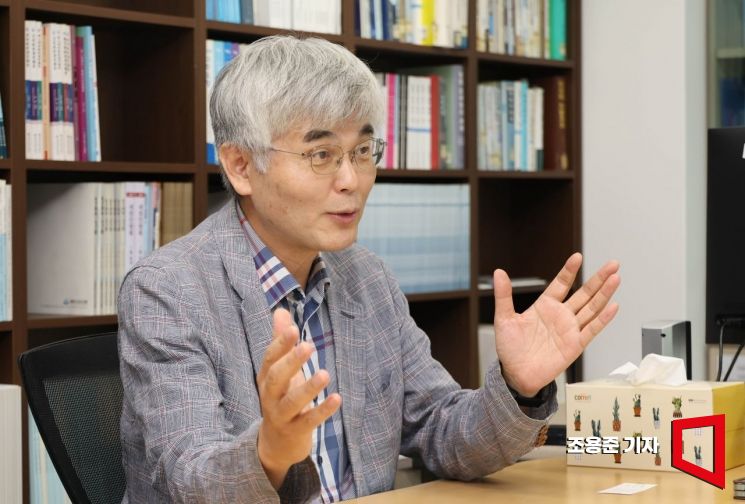 Shim Taeseop, Dean of the Graduate School of Taxation at the University of Seoul, is being interviewed by Asia Economy on the 28th of last month at the University of Seoul in Dongdaemun-gu, Seoul. Photo by Jo Yongjun
Throughout the interview with Asia Economy, Dean Shim emphasized the importance of proactive tax planning. He illustrated his point by recalling the tissues that used to be given out at gas stations in the past. "Although it has almost disappeared now, gas stations used to give tissues after refueling. If these tissues are classified as promotional expenses for advertising, they can be fully deducted as expenses without limit," he explained. "However, if they are considered gifts to customers-entertainment expenses-it becomes difficult to deduct them, increasing the tax burden. Therefore, the headquarters must provide unified tax guidelines to all branches (each gas station) so that future taxes can be minimized."
Dean Shim advised that, in order to reduce such tax issues, it is essential for companies to enhance the expertise of their internal tax professionals and to stay current with recent tax law amendments. He noted, "While corporate tax practitioners are not lacking in knowledge of tax law, they tend to stick to the methods they are used to and are often unfamiliar with new approaches. In addition, tax laws are revised every year, so it is more important than ever for corporate tax professionals to develop the capabilities and knowledge needed to establish and execute effective tax strategies."
In response, the University of Seoul's Graduate School of Taxation, the nation's leading institution for tax education, launched an "Educational Program for Nurturing Tax Strategy Experts" last year. This year, starting from the 4th, the school will offer a 13-week "Tax Litigation and Tax Expert Program."
Dean Shim explained, "This Tax Litigation and Tax Expert Program covers all types of tax appeals, including objections and tax trials. It offers both theoretical and practical training on tax appeals from a corporate perspective, including examination requests, trial requests, and tax lawsuits."
The Tax Litigation and Tax Expert Program begins with the Basic National Tax Act, followed by lectures from field experts on major precedents and litigation cases. The curriculum includes: ▲Corporate Tax and Tax Accounting ▲Case Studies in Tax Criminal Law ▲Tax Audits and Practical Examination Requests to the National Tax Service ▲Overview of Customs Law Focused on Case Studies ▲Practical Trial Requests to the Tax Tribunal ▲Case Studies on Local Tax Appeals ▲Tax Litigation Practice in the Courts (Administrative Court and Supreme Court) ▲Constitutional Tax Litigation ▲Practical Tax Litigation (Practice in Drafting Complaints) ▲Current Status and Challenges of Tax Litigation. The program is designed to enhance expertise across the tax field and provide practical training for actual tax litigation.
The main target audience for this program includes attorneys, tax accountants, certified public accountants, customs brokers, public officials, and accounting, tax, and finance professionals at corporations and public institutions, as well as chief executive officers (CEOs) and chief financial officers (CFOs). Dean Shim stated, "The curriculum is designed to fill gaps for professionals who may be well-versed in accounting but lack tax knowledge, or vice versa, as well as those who are unfamiliar with law. In particular, CEOs and CFOs facing important business decisions will find that the tax knowledge gained from this course will help them make critical decisions."
© The Asia Business Daily(www.asiae.co.kr). All rights reserved.

















