As the loan limit for the Tourism Promotion and Development Fund (Tourism Fund), which is used for facility expansion and operating capital by tourism companies, has been exhausted early again this year, difficulties are expected for the tourism industry. There are also growing calls within the industry to raise the departure tax, which was lowered last year, back to its previous level.
According to the tourism industry on September 1, the Korea Tourism Association Central Committee closed applications for the second half of this year's Tourism Fund loans early on August 14. This was because the loan limit had already been reached just as the second half of the year began. An official from the Korea Tourism Association Central Committee stated, "In the past, we accepted applications until around November, but following last year, we have again had to close applications early in August this year."
The Tourism Fund loan program is a flagship financial support project of the Ministry of Culture, Sports and Tourism, implemented since 1973. It enables tourism businesses to borrow at lower interest rates than the market, helping them with facility expansion and operating capital.
Surge in Demand for Facility and Operating Capital... Loan Applications Close Early in Second Half
The reason for the early closure of applications last year and this year is twofold: early execution of funds in the first half of the year to respond to economic downturns, and a significant increase in loan demand from tourism companies.
In 2023, the loan amount was 246.5 billion won for the first half and 200 billion won for the second half, with similar scales for both periods. However, last year, the government increased the loan fund by about 90 billion won to respond to the economic downturn and executed it early in the first half. While 350 billion won was executed in the first half, the amount decreased to 186.5 billion won in the second half. The same situation is occurring this year. Due to continued economic instability following the December 3 Martial Law crisis and the December 29 airliner disaster last year, 350 billion won was executed early in the first half, and the limit for the second half was set at 171.5 billion won, a decrease of 15 billion won from the previous year.
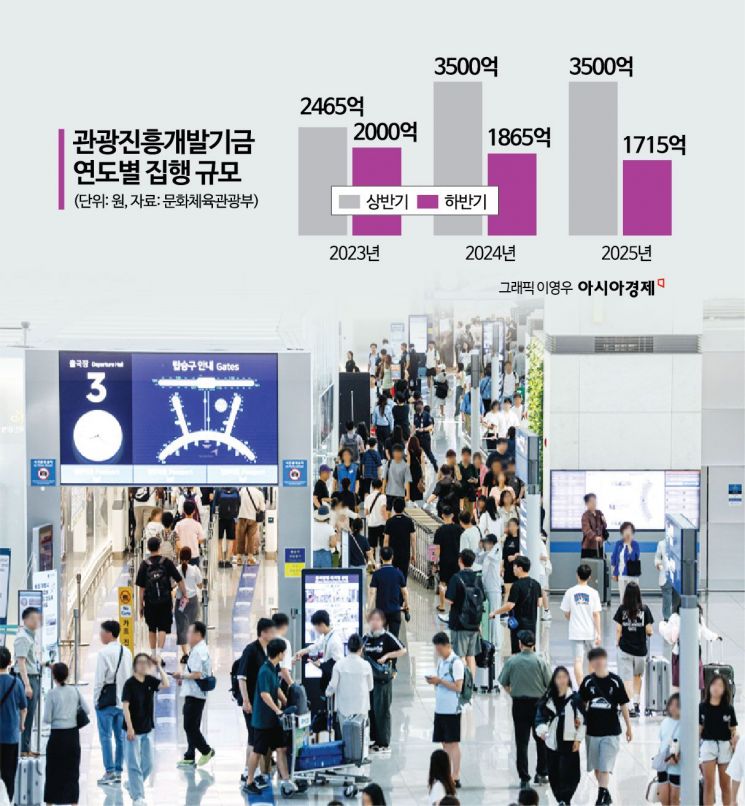
An industry representative stated, "Demand for facility and operating capital has surged due to a significant increase in prices compared to before COVID-19," adding, "The situation of early exhaustion of the loan limit in the second half is repeating itself as the limit has been reduced."
The problem is that securing resources for the Tourism Fund is not easy. The Tourism Fund is financed by contributions from casino operators and the departure tax.
The Yoon Suk Yeol administration abolished or reduced 32 types of levies to ease the burden on the public and businesses. The departure tax, which is automatically imposed when purchasing airline tickets, was among those reduced. From July 1 last year, the departure tax was lowered by 3,000 won from 10,000 won to 7,000 won, and the exemption age was expanded from under 2 years old to under 12 years old. As the departure tax decreased, securing resources for the Tourism Fund has become an urgent issue.
"Tax Reduced When It Should Have Been Raised... Tourism Industry's Difficulties Worsen"
The tourism industry opposed the reduction of the departure tax from the beginning, arguing that a decrease in the Tourism Fund could hinder the development of the industry. With the loan limit for the Tourism Fund being exhausted early in succession, these concerns are becoming a reality. Consequently, there are growing calls to raise the departure tax again. There is also criticism that, while countries such as Japan, Thailand, and Malaysia are considering raising tourism-related taxes, only Korea has lowered its departure tax.
Choi Hwi Young, Minister of Culture, Sports and Tourism, also expressed agreement with the idea of raising the departure tax again during a confirmation hearing on July 29. When Lim Oh Kyung, secretary of the National Assembly's Culture, Sports and Tourism Committee from the Democratic Party, mentioned the difficulties faced by the tourism industry and asked whether the departure tax should be restored, Minister Choi replied, "We need to examine whether it is realistically possible to restore it immediately, but I agree with the direction."
Seo Won Seok, Dean of the College of Hotel and Tourism Management at Kyung Hee University and President of the Korea Tourism Association, emphasized, "Given the difficulties faced by the tourism industry, it is time to discuss raising the departure tax, but the government has instead implemented a reduction," adding, "The departure tax should be restored to its original level, and discussions on increasing it must take place."
© The Asia Business Daily(www.asiae.co.kr). All rights reserved.


















