Maintaining High-Quality Ingredients While Lowering Prices
Eliminating Unnecessary Steps and Fixing Margin Amounts
Why Is Bread So Expensive in Korea?
"Raw Materials, Labor, and SG&A Expenses Are to Blame"
Jungsoo Yoo, CEO of Glow Seoul, who is currently running the "Bakery Project" with economic YouTuber "Shuka World," who has 3.6 million subscribers, has revealed the secret behind the much lower bread prices compared to the market.
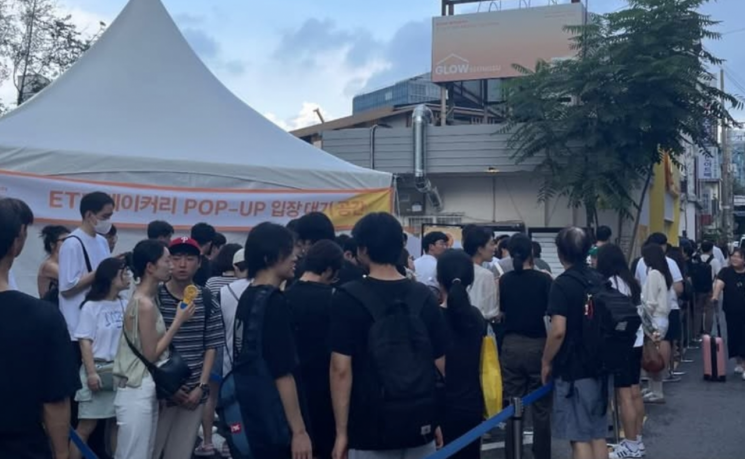 A long queue formed at the ETF Bakery pop-up store of the economic YouTuber "Shuka World," who has 3.6 million subscribers. Instagram
Recently, CEO Yoo shared detailed stories about ETF Bakery on his YouTube channel "Banjia Jungsoo Yoo." He explained that the concept behind ETF Bakery is "to deliver the highest-quality, freshest bread to consumers at the lowest possible price by purchasing directly from farms and minimizing distribution processes." He added, "It's not just about making cheap bread, but about selling the best bread at a low price, without any compromise in quality, which is a core belief of ours."
ETF Bakery is currently operating as a bakery pop-up store at Glow Seongsu in Seongdong-gu, Seoul. It has garnered significant attention thanks to the fame of the YouTuber with millions of subscribers and the affordable bread prices. The main bread prices at the Glow Seongsu pop-up store are as follows: salt bread, plain bagel, and baguette for 990 won each; loaf bread and fig bagel for 1,990 won; pollack roe baguette for 2,450 won; Omegi red bean bread for 2,930 won; shiitake mushroom truffle ciabatta for 3,490 won; and peach cake (No. 2) for 18,900 won.
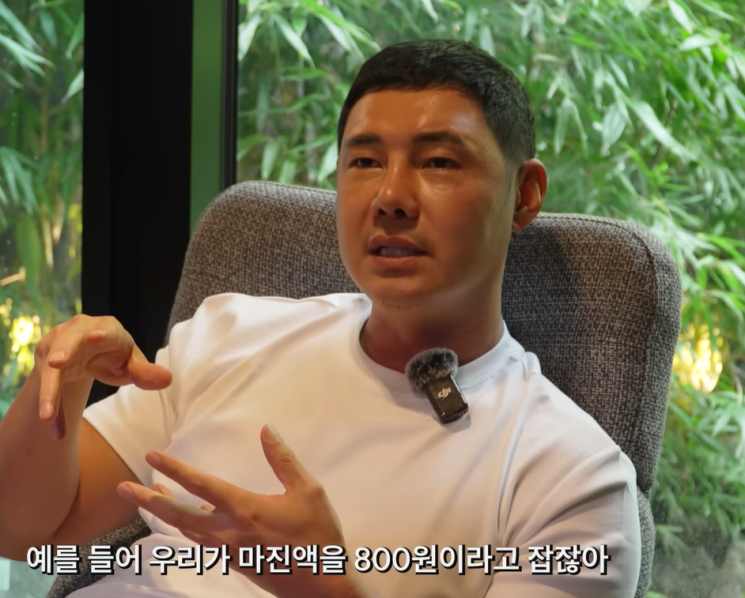
He stated, "We didn't significantly cut raw material costs, and the key to lowering prices while maintaining ingredient quality was reducing labor costs." He continued, "We simplified the complex bread shaping process and minimized packaging costs."
In particular, ETF Bakery set prices based on absolute margin amounts rather than margin rates, which is different from the conventional practices in the bakery industry. For example, if the margin amount is fixed at 800 won, a product with a cost of 200 won is sold for 1,000 won, and a product with a cost of 1,200 won is sold for 2,000 won. CEO Yoo explained, "Even if we use more expensive ingredients, the price only increases by the additional cost of those ingredients, so the cost-effectiveness naturally feels higher." He added, "I was able to try this kind of experiment only because I was working with Shuka World. Otherwise, I wouldn't have even considered such an attempt."
Exceptionally High Bread Prices in Korea... The Reasons: Raw Materials, SG&A, and Labor Costs
CEO Yoo pointed out that the main reasons for high bread prices in Korea are ingredient costs, labor costs, and marketing expenses. He said, "Among major raw materials such as flour, sugar, milk, eggs, and butter, the prices of milk and eggs are particularly high. For example, the price of milk is more than twice as expensive as in advanced countries." He explained that the domestic dairy industry is structured as a protected industry, where suppliers set the prices and the government prohibits sales below a certain price, making it difficult for prices to decrease according to free market principles.
Regarding the characteristics of the domestic bakery industry, CEO Yoo explained, "Bread in Korea is mainly considered a dessert, so a lot of advertising and marketing expenses are needed to stimulate consumption. In addition, the need to produce a wide variety of products in small quantities, along with different dough and fermentation processes each time, leads to a high labor cost burden."
He added, "Most franchise bakeries do not bring in finished bread from factories, but rather bring in dough and bake it in-store. When the production process is split in this way, costs increase, and delivering products in a frozen state also incurs significant expenses." He continued, "Neighborhood bakeries also produce a wide variety of products in small batches, making it difficult to lower prices."
Glow Seoul, led by CEO Yoo, is a space and brand planning company with annual sales reaching 70 billion won. Among self-employed business owners, he is known as the "God of Cafes." It is also known that actor Lee Donggun, who recently opened a cafe in Jeju Island, received menu consulting from CEO Yoo.
© The Asia Business Daily(www.asiae.co.kr). All rights reserved.
![Clutching a Stolen Dior Bag, Saying "I Hate Being Poor but Real"... The Grotesque Con of a "Human Knockoff" [Slate]](https://cwcontent.asiae.co.kr/asiaresize/183/2026021902243444107_1771435474.jpg)
















