Chinese Government and Top Firms Lead Price Controls and Industry Restructuring
Policy Impact? Polysilicon Prices Surge at the End of August
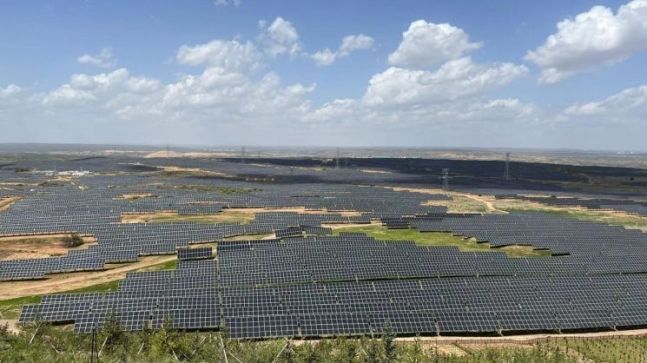
Driven by increases in data centers, electric vehicles, and air conditioners, China's electricity demand growth rate reached 7-8% year-on-year in 2023 and 2024. This figure surpasses the country's gross domestic product growth rate of around 5%. Notably, the industrial sector accounts for about 60% of total electricity consumption, which is double the OECD average of 32%. The electricity used solely by electric vehicle, battery, and solar panel factories amounts to approximately 320 TWh (terawatt-hours), which is comparable to Italy's annual electricity consumption.
In response to this surging electricity demand, China has rapidly expanded solar and wind power generation. Currently, solar and wind account for 18% of the country's total power generation mix. China is accelerating the expansion of renewable energy to reduce the still-dominant share of coal-fired power, which stands at 61%. As a result, the Levelized Cost of Energy (LCOE) for solar power has achieved overwhelming competitiveness.
However, with the bright side comes a dark side. China’s solar industry is facing severe oversupply due to excessive competition. As the foundation of the solar industry becomes unstable and concerns arise about potential disruptions to the national electricity supply and demand, the Chinese government has officially begun restructuring the solar sector.
Chinese Government and Leading Companies Drive Price Regulation and Restructuring
According to the September 1 report "Let's Look at China's Solar Power" by Hana Securities, China's annual production capacity for polysilicon, a key material for solar panels, is about 3.25 million tons. The top three companies hold more than half of the market share. However, annual demand remains below 2 million tons, resulting in a persistent and severe oversupply. In fact, Tongwei, the industry leader, posted an operating margin of -11% in the second quarter.
In late July, the National Development and Reform Commission (NDRC), China's economic planning body, announced that, except for legitimate reasons, selling polysilicon below cost would be prohibited and penalties for price labeling violations would be increased. On August 1, it was reported that China's top six polysilicon producers would establish an acquisition entity for restructuring production facilities, creating a fund of approximately 50 billion yuan (7 billion dollars). Starting in the fourth quarter, they are expected to purchase surplus production facilities and inventory, aiming to reduce at least 1 million tons annually.
Are Policies Working? Polysilicon Prices Rise
Hana Securities estimated the industry-wide cash cost for polysilicon (excluding capital investment and financial costs, considering only variable costs such as raw materials, energy, and labor) at about 6 to 6.5 dollars per kilogram. Considering Chinese government policies, this is the minimum price required by the industry. Daqo, the third-largest company, reported a second-quarter cash cost of 5.12 dollars per kilogram. However, possibly due to the government's measures, the price of polysilicon in China surged by 26% week-on-week on August 29, reaching 6.2 dollars per kilogram.
Yoon Jaesung, an analyst at Hana Securities, commented, "From the perspective of energy security, China is likely sincere about saving and restructuring its solar industry," adding, "After restructuring led by the top polysilicon companies, not only is a price increase expected, but also a clear rise in their operating rates."
© The Asia Business Daily(www.asiae.co.kr). All rights reserved.
![Clutching a Stolen Dior Bag, Saying "I Hate Being Poor but Real"... The Grotesque Con of a "Human Knockoff" [Slate]](https://cwcontent.asiae.co.kr/asiaresize/183/2026021902243444107_1771435474.jpg)















