Ministry of Trade, Industry and Energy Releases August Trade Data
Exports to U.S. Continue to Fall in Automobiles, Machinery, and Steel
Tariffs Remain at 50% for Steel and 25% for Automobiles
Last month, exports to the United States fell sharply by 12%. The decline was particularly pronounced in automobiles, general machinery, and steel-sectors subject to U.S. tariffs. Despite the drop in exports to the United States, South Korea’s monthly exports in August increased by over 1%, marking the third consecutive month of export growth, largely thanks to strong performance in semiconductors, the country’s main export item.
According to the Ministry of Trade, Industry and Energy on September 1, exports to the United States in August amounted to $8.74 billion, down 12% from the same period last year. This is the largest decrease since May 2020 (-29.4%) during the COVID-19 pandemic.
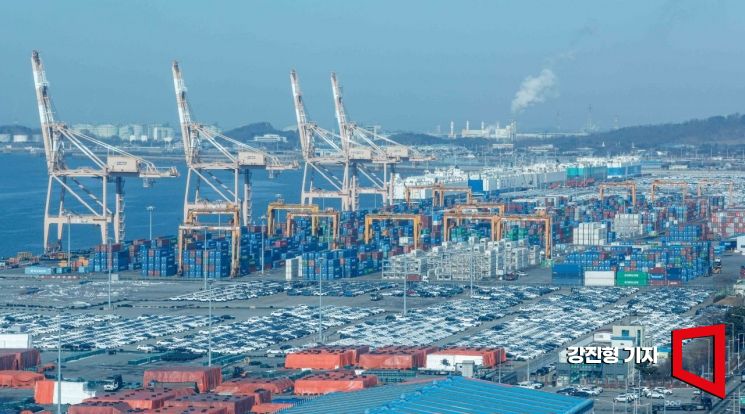
A ministry official stated, "Exports to the United States declined significantly, especially for items subject to U.S. tariffs," adding, "Automobiles, auto parts, general machinery, and steel all saw decreases, whereas exports of semiconductors and petroleum products-which are not subject to tariffs-increased."
In fact, according to the ministry, as of August 1-25, exports to the United States by item showed a 3.5% year-on-year decrease in automobiles. Auto parts (-14.4%), general machinery (-12.7%), and steel products (-32.1%) also continued to perform poorly.
The second Trump administration is imposing a 25% tariff on automobiles and a 50% tariff on steel. Although South Korea and the United States agreed on July 30 this year to lower mutual tariffs from the previously announced 25% to 15% and to reduce tariffs on automobiles and auto parts to 15%, tariffs on automobiles and auto parts remain at 25%. Tariffs on steel, aluminum, and related products are still set at 50%.
Despite sluggish exports to the United States, total exports increased by 1.3% year-on-year to $58.4 billion. A ministry official explained, "Even though the number of working days in August was 22.5, one day less than last year, monthly exports continued to rise," adding, "This export performance is the highest ever for August, and it marks the third consecutive month since June that monthly export records have been broken."
In August, exports of three out of the 15 major export items increased. Semiconductor exports rose by 27.1% to $15.1 billion, hitting an all-time monthly high just two months after the previous record. This was driven by continued strong demand for server applications and stable memory contract prices.
Automobile exports reached $5.5 billion (up 8.6%), the highest ever for August, marking three consecutive months of growth. This was due to increased exports of eco-friendly vehicles such as pure electric vehicles and hybrids, as well as an expansion in used car exports. Ship exports also maintained positive momentum for the sixth consecutive month, rising 11.8% to $3.14 billion, as vessels ordered at high prices in 2022-2023 continued to be delivered. On the other hand, exports of petroleum products ($4.17 billion, down 4.7%) and petrochemicals ($3.38 billion, down 18.7%) continued to decline due to falling oil prices and a global supply glut, which led to lower export prices.
In August, exports increased in three of the nine major regions. Exports to ASEAN reached a record $10.89 billion (up 11.9%) for August, driven by strong performance in semiconductors and ships, marking three consecutive months of growth. Exports to the Middle East rose 1.0% to $1.4 billion, returning to positive growth after one month, while exports to the Commonwealth of Independent States (CIS) rose 9.2% to $1.12 billion, marking six consecutive months of increases.
Exports to China declined in most categories, but the increase in semiconductor exports-the largest export item-resulted in $11.01 billion (down 2.9%) in exports, remaining above $11 billion for the second consecutive month.
Imports in August fell 4.0% to $51.89 billion. Energy imports ($11.02 billion) dropped 12.2%, while non-energy imports ($40.86 billion) declined 1.5%. Last month, the trade surplus increased by $2.93 billion to $6.51 billion, marking seven consecutive months of surplus. The cumulative surplus from January to August this year was $40.97 billion, up $10.8 billion.
Minister of Trade, Industry and Energy Ahn Dukgeun stated, "We will develop reliable and tangible policies based on the voices of South Korean exporters on the ground," adding, "In particular, to minimize the impact of U.S. tariff measures on small and medium-sized enterprises, we plan to announce and implement support measures in early September focusing on three main pillars: short-term business support and domestic demand creation to ease burdens, support for market diversification to maintain export momentum, and strengthening the fundamental competitiveness of key and promising industries."
© The Asia Business Daily(www.asiae.co.kr). All rights reserved.

















