Selective Support for Routes in Need
Significant Cost Savings Through Targeted Funding
Enhanced Public Transportation Services for Citizens
Seongnam City in Gyeonggi Province (Mayor Shin Sangjin) announced on September 1 that it is implementing the "Seongnam-Type Semi-Public Bus System," achieving both a reduction of 90 billion won in taxpayer spending and an enhancement of public transportation services.
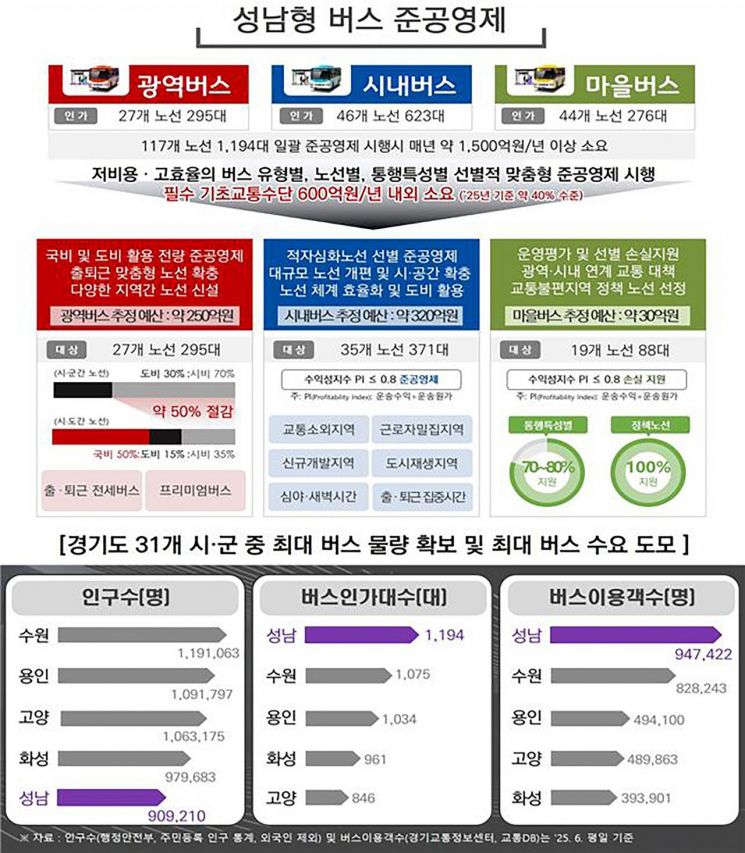
The Seongnam-Type Semi-Public Bus System differs from the previous method, which injected tax funds into all routes indiscriminately. Instead, profitable routes are operated by the private sector, while the city only provides support for routes in transportation blind spots or those running at a deficit. The core of the system is to categorize metropolitan, city, and village buses by type and selectively support them, thereby reducing costs while strengthening services.
While the previous system required over 150 billion won annually, Seongnam City is now able to operate with about 60 billion won per year through tailored support, resulting in an annual budget saving of approximately 90 billion won.
The city operates 295 buses on 27 metropolitan routes, securing funding from both the national and provincial governments. Of these, 162 buses on 15 routes have, for the first time in Gyeonggi Province, been transferred to the jurisdiction of the Metropolitan Transport Commission under the Ministry of Land, Infrastructure and Transport, and now receive 50% of their funding from the national government. As a result, the city's share of the funding burden has dropped significantly from 70% to 35%, saving hundreds of billions of won in taxpayer money.
Additionally, the city has deployed 48 customized commuter charter buses and 21 premium deluxe buses at major hubs to alleviate congestion. The annual cost per charter bus is 62 million won, which is about 64% less than the cost of a regular metropolitan bus (174 million won), resulting in significant cost savings.
For city buses, support is focused solely on 35 deficit routes (371 buses) with a profitability rate of 80% or less, out of a total of 46 routes (623 buses). The targeted support is concentrated in areas with significant inconvenience for residents, such as transportation blind spots, late-night and early-morning hours, newly developed areas, urban regeneration zones, and regions with high concentrations of workers.
Village buses are evaluated annually, and loss compensation is provided only to 19 unprofitable routes (88 buses) out of 44 routes (276 buses). Of these, nine essential routes (51 buses) that are vital for residents' daily lives receive 100% full support, guaranteeing basic transportation rights for citizens even when demand is low.
The working conditions for bus operators have also improved significantly, with a shift from an alternate-day system to a two-shift system per day. As a result, the number of Seongnam City route bus operators increased from 2,132 in 2022 to 2,643 in 2025, an increase of 511 people.
Mayor Shin Sangjin stated, "The Seongnam-Type Semi-Public Bus System is a low-cost, high-efficiency policy that saves taxpayer money while expanding transportation services that citizens can truly feel." He added, "We will continue to reinvest the saved budget into expanding citizen-oriented routes to further increase satisfaction with public transportation."
© The Asia Business Daily(www.asiae.co.kr). All rights reserved.
![Clutching a Stolen Dior Bag, Saying "I Hate Being Poor but Real"... The Grotesque Con of a "Human Knockoff" [Slate]](https://cwcontent.asiae.co.kr/asiaresize/183/2026021902243444107_1771435474.jpg)















