Bridging Transportation Gaps Across Korea
NUMA Alliance Launches to Guarantee Mobility Rights and Foster Future Mobility Innovation
The Ministry of Land, Infrastructure and Transport announced that the public-private "K-Transport Alliance" will be launched on September 1. This consultative body aims to bridge transportation gaps between the Seoul metropolitan area and other regions, as well as within the metropolitan area itself, while fostering the future mobility industry.
The alliance’s slogan is "Mobility Rights for All Citizens." Its subtitle is NUMA (Next Urban Mobility Alliance). The Ministry of Land, Infrastructure and Transport and Hyundai Motor Company are jointly leading the initiative, with participation from more than 30 organizations, including central government ministries, local governments, public institutions, and companies. As an open consultative body, there is the possibility of expanding the number of participating organizations as needed in the future.
The alliance has set four main objectives: bridging transportation gaps, strengthening transportation safety, enhancing cooperation on transportation data, and fostering the future mobility industry. Through this consultative body, the private sector and government will work together to identify and address issues experienced in the field, turning them into policy tasks for joint resolution.
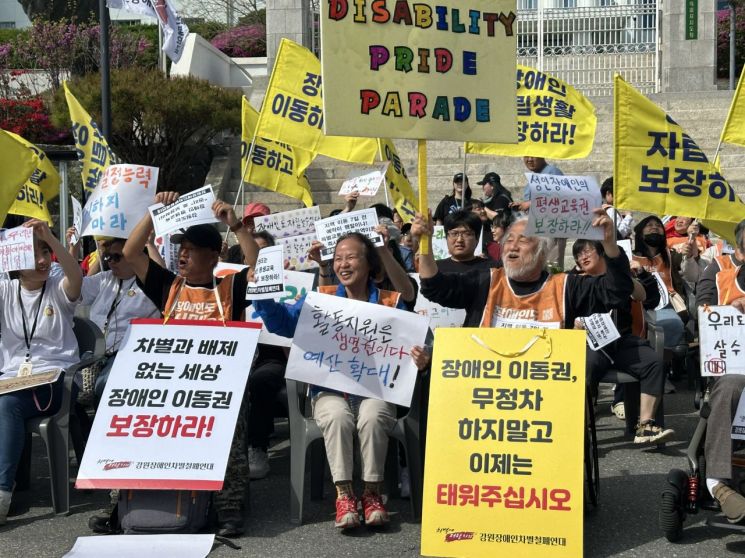 In front of the Gangwon Provincial Government Office last April, disability organizations in the Gangwon region, including the Gangwon Coalition for the Elimination of Disability Discrimination and the Gangwon Independent Living Center Council, held a Disability Rights Policy Festival. Photo by Yonhap News
Specifically, the alliance will pursue various initiatives by sector, such as expanding infrastructure, developing transportation safety policies and technologies, standardizing transportation data from different stakeholders, and conducting various pilot programs. The Ministry of Land, Infrastructure and Transport explained, "To meet public expectations regarding the elimination of transportation gaps between the metropolitan and non-metropolitan areas, and to address mobility inconveniences for transportation-vulnerable groups and residents of underserved regions, it is essential to shift government policy direction and ensure collaboration with private companies and relevant institutions that will drive technological innovation."
The new administration has made it clear that it will actively guarantee mobility rights. President Lee Jaemyung pledged to enact the Basic Mobility Act as a key campaign promise. He has also openly expressed his intention to foster advanced industries in the mobility sector, such as autonomous driving. At the alliance level, there are plans to announce a mobility innovation growth strategy (tentative name) within this year and to hold a results presentation around August next year.
Kang Heeup, the Second Vice Minister of the Ministry of Land, Infrastructure and Transport, stated, "Transportation is no longer just simple infrastructure; it is an essential service that connects people’s daily lives. Every citizen should be able to move safely and freely to their desired destination at their preferred time. I hope that by joining forces between the public and private sectors, we can move toward a Korea without transportation gaps and a society where everyone enjoys safe and free mobility."
© The Asia Business Daily(www.asiae.co.kr). All rights reserved.
![Clutching a Stolen Dior Bag, Saying "I Hate Being Poor but Real"... The Grotesque Con of a "Human Knockoff" [Slate]](https://cwcontent.asiae.co.kr/asiaresize/183/2026021902243444107_1771435474.jpg)















