Unethical Practices of Some Network Law Firms Cross the Line
1,000 New Lawyers Per Year Is the Proper Limit
Criminal Contingency Fees Must Be Reinstated
to Ensure Access to Legal Help for Ordinary People Facing False Accusations or Victimiz
 On the 26th of last month, Cho Sunyeol, president of the Seoul Bar Association, is being interviewed by Asia Economy at the Seoul Bar Association office in Seocho-gu, Seoul. Photo by Yoon Dongju
"After my wife died from excessive bleeding following childbirth, I was told it was a medical malpractice case. I entrusted the case to a network-type law firm A, paying a retainer of 24 million won for both civil and criminal proceedings. Even during the funeral, law firm A kept demanding the retainer, and when I said I only had 8 million won in my account, they told me to deposit one-third, or 7.6 million won, first, so I did. After the funeral, I found out it was difficult to classify the incident as medical malpractice and requested a refund of the retainer, but law firm A refused, saying several days had passed since the appointment. Now, I have hired another lawyer and am in litigation to get the retainer back. I feel more wronged by being deceived by the lawyer than by the loss of my wife."
"When I filed a criminal complaint, I paid a retainer of 18 million won to law firm A under a special agreement that a former chief prosecutor would handle my case. Six days later, at a meeting, a different lawyer was in charge. The former prosecutor, who was supposed to contact me later, never did. After eight days, I requested a refund, but they refused to return the retainer."
"I paid a retainer of 6.6 million won to law firm A for a divorce case, but the case ended without proceeding because the parties reached an agreement. Still, law firm A refused to refund the retainer, citing that more than seven days had passed since the appointment. The client claims the hurt caused by the lawyer was greater than the pain from the divorce itself."
"It is said that law firm A's contract states, 'If more than three days (72 hours) have passed since taking the case, the retainer will not be refunded.' In some cases, only 10-20% of the retainer was refunded during the Seoul Bar Association's complaint process, and the complaint was withdrawn. I am conflicted about whether to grant leniency in such complaint cases. I believe such settlements constitute secondary harm against vulnerable clients."
Cho Sunyeol, the 98th president of the Seoul Bar Association (age 53, Judicial Research and Training Institute graduate), recently submitted a statement to the Ministry of Justice proposing institutional reforms to regulate the illegal and abnormal business practices of some network law firms. The proposals include significantly raising the current 30 million won maximum fine under the Attorney-at-Law Act to 1 billion won or 10% of annual revenue, allowing the suspension of problematic law firms' business operations rather than just individual lawyers, and introducing a system to pre-designate law firms that clients should be cautious of when seeking legal representation.
President Cho expressed deep regret over the current situation, where the number of lawyers has increased so dramatically that some now work with nothing more than a locker in someone else's office, known as "locker lawyers." Nicknamed the "village chief of Seocho-dong," he has spent the past seven months tirelessly visiting various places to publicize these industry realities and to create an environment where member lawyers can work without being disregarded.
On August 26, at the Seoul Bar Association office in Seocho-gu, Seoul, we met with President Cho to hear his views on key issues facing the legal profession and the judiciary.
The following is a Q&A with President Cho.
 On the 26th of last month, Cho Sunyeol, president of the Seoul Bar Association, is being interviewed by Asia Economy at the Seoul Bar Association office in Seocho-gu, Seoul. Photo by Yoon Dongju
-How do you feel about serving as president of the Seoul Bar Association since the beginning of this year?
▲I have been personally visiting related organizations such as the National Assembly, courts, prosecution, police, and points of contact with our member lawyers' work to promote the role of lawyers. Although it is physically demanding, I find it rewarding. My heart aches when I think of struggling members, but I am comforted by the hope we are pursuing together.
-Despite your busy schedule, is there a particular reason you meet with so many people, including the Chief Justice, Prosecutor General, head of the Corruption Investigation Office, various court presidents, and police chiefs?
▲I am meeting many people to raise awareness of the lawyer's role and to ensure the effective guarantee of the constitutionally protected right to counsel. The courts, prosecution, Corruption Investigation Office, and police are directly related to our lawyers' work and are the institutions we interact with most frequently. My goal is to prevent our lawyers from being ignored or marginalized there. I also want to accurately convey the realities of the legal profession and guide the development of judicial policies based on these facts.
-You pledged to reduce the number of new lawyers. Law schools, however, are pushing for an increase. What is your view?
▲Our society is currently suffering from an oversupply of lawyers. Since 2022, the number of lawyers in Korea has already surpassed the OECD average, and with 1,745 and 1,744 new lawyers produced in recent years, it is no exaggeration to say the profession is on the brink of collapse. The situation is so dire that some lawyers are renting lockers for 100,000 to 150,000 won per month just to have a place to work. Considering the average monthly income of lawyers, it is truly heartbreaking. It pains me even more that lawyers, who are already struggling to make ends meet, are also burdened with the heavy responsibilities of public interest and duty.
-What do you think is the appropriate annual number of new lawyers?
▲When law schools were first introduced, the social consensus was to increase the number of successful candidates from 1,000 (under the bar exam) to 1,500 (from law school graduates), provided that similar legal professions would be consolidated. Consolidation meant keeping existing practitioners but stopping new entrants. If we eliminate new entrants to similar professions, 1,500 new lawyers per year is appropriate; if not, the previously agreed-upon 1,000 is suitable. Law schools' argument for increasing the number of graduates is also based on the premise of consolidating similar professions. Ultimately, the government is responsible for breaking this social consensus and neglecting lawyer supply policies. By leaving similar professions, which were supposed to be served by specialized lawyers, untouched, both the legal profession and law schools are struggling. Both are victims of the government's broken promises.
-Which similar professions do you think should be consolidated? Unlike the position of lawyer groups, practitioners in similar fields argue they should be granted litigation representation rights.
▲We must gradually reduce and eventually eliminate new entrants in similar professions such as judicial scriveners, patent attorneys, tax accountants, and labor consultants. These professions originated when there were very few lawyers, and government officials were granted these qualifications as a post-retirement benefit. Korea has the highest number of such practitioners in the world. In the United States, United Kingdom, and Germany, there are no equivalent professions like judicial scriveners or labor consultants. Patent attorneys and tax accountants in those countries only handle simple filings or tax representation, unlike in Korea. Compared to Japan, Korea has three times more similar professionals per capita.
Korea is now an advanced country, and citizens deserve quality service from specialized lawyers in all fields. Litigation is not something that can be handled lightly; it should be managed exclusively by lawyers with expertise. This is the foundation of the legal profession. I understand that as lawyers replace similar professions due to oversupply, practitioners in those fields are also struggling financially. However, that does not justify their unreasonable desire to encroach on the domain of litigation. This cannot be resolved by greed. Legal services for citizens should not be provided by non-experts, as this can cause significant harm. The legal profession operates similarly worldwide. The phenomenon we see in Korea is unprecedented globally.
 On the 26th of last month, Cho Sunyeol, the president, is giving an interview to Asia Economy at the Seoul Bar Association office in Seocho-gu, Seoul. Photo by Yoon Dongju
-Has the conflict with legal platforms like "LawTalk" been resolved?
▲Although the Ministry of Justice decided to cancel the disciplinary actions imposed by the Korean Bar Association, the decision clearly states that some services provided by LawTalk violate lawyer advertising regulations. The Ministry considered the fact that the constitutionality of the advertising regulations was still under review by the Constitutional Court and thus decided to clear or warn the disciplined lawyers. Although they violated advertising regulations through illegal services, the Ministry determined they were unaware of the illegality, so they were exempted from disciplinary action. In the future, if lawyers join and operate on illegal platforms, the violation and awareness of illegality will be presumed. Reckless interpretation and illegal conduct will result in disciplinary action. The corrective orders and penalty surcharges imposed on the Korean Bar Association and the Seoul Bar Association by the Fair Trade Commission were all overturned by the Seoul High Court, and the case is now pending before the Supreme Court.
-You submitted a statement to the Ministry of Justice proposing strong regulations on network law firms. Can you elaborate?
▲There is a proliferation of deceptive and unethical practices, such as using former judges, prosecutors, and high-ranking officials in advertisements, making it seem as if they will handle cases when they do not, refusing to refund retainers after a few days, and neglecting cases after being retained. These business practices, which focus solely on revenue and ignore disciplinary actions, are unprecedented. To address this, the Seoul Bar Association has proposed a system to pre-designate law firms that clients should be cautious of (so-called "bad law firm designation system") to prevent harm from the outset, and to introduce Japan's "law firm business suspension system," which allows the suspension of a problematic law firm's business, not just individual lawyers. We submitted a policy statement to the Ministry of Justice and requested active implementation. Lawyers and law firms that habitually break the law should be expelled from the profession. This protects ethical lawyers who abide by the law and professional standards.
-You have also advocated for the reinstatement of criminal contingency fees, the introduction of Attorney-Client Privilege (ACP), and the abolition of VAT on legal fees. Why?
▲Criminal contingency fees are a vital means for ordinary people to access legal representation. If a client, wrongfully accused or victimized in a criminal case, cannot afford a large retainer and agrees to pay a success fee if the lawyer clears their name, then the lawyer deserves appropriate compensation for their efforts. If success fees are prohibited, who would take on such cases without upfront payment? All legal professionals agree that only excessive portions of success fees should be invalid, not the entire arrangement. No one, lawyer or layperson, believes all success fees should be void. The Seoul Bar Association is assisting in lawsuits to overturn the unfair invalidation of success fees and is directly involved in litigation to restore them. It has been ten years since success fees were invalidated, and it is time for the Supreme Court to change its stance.
It is unacceptable for law offices holding client information to be subject to search and seizure. Attorney-client privilege is protected in most countries, both advanced and developing. Investigative agencies must have advanced systems and conduct investigations according to law and principle. When equality of arms is required, allowing investigative agencies to search a lawyer's office and seize information exchanged with clients violates the constitutional right to counsel. With the new administration, I expect attorney-client privilege to be introduced, and the Seoul Bar Association will push even harder for its adoption.
We are also advocating for the abolition of VAT on legal fees in small claims and criminal cases, which are mainly used by ordinary people and are not eligible for VAT deductions. Legislation has already been proposed, and we will work to ensure it passes in this session of the National Assembly.
-Recently, the Korean Bar Association created a rule to differentiate lawyer registration fees based on experience, which has sparked controversy.
▲Although the amendment that forms the basis for differentiated registration fees has passed, the specific details have not yet been finalized. Only the maximum fee has been raised, and the Korean Bar Association intends to take time to gather more public opinion before making a decision.
The intention behind differentiating registration fees for former high-ranking officials is not to collect higher fees but to discourage them from opening law practices. In Virginia, USA, although it is not illegal for former judges to practice law, if they submit a notice to the court to take on a case, the court immediately reports it. When I visited Japan's Ministry of Justice, I asked how they handled the situation where former high-ranking officials advertise their background and take on cases but do not actually handle them. They told me the premise of the question was flawed-retired judges simply do not open law practices in Japan. Even former prosecutors rarely do so, and it is considered a virtue not to. It is unimaginable in Japan for retired high-ranking judges or prosecutors to open law practices and boast about their backgrounds as is common in Korea. Most engage in law firm management or mentoring younger lawyers after retirement, rather than consulting on cases.
Ultimately, the idea is to create a hurdle for former high-ranking officials opening law practices. However, I question whether registration fees are the right or effective way to do this. This issue needs to be discussed with the media and carefully considered. I hope we can find ways to prevent former officials from distorting the legal market by leveraging their backgrounds and that we can form a public consensus through open discussion and various approaches.
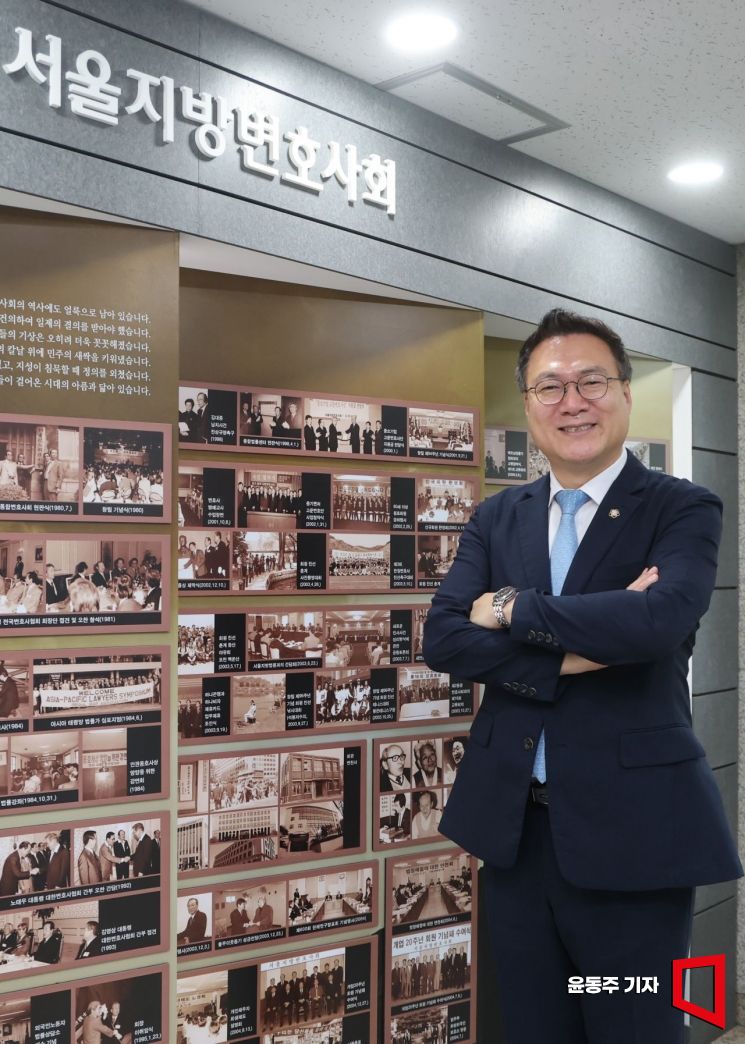 On the 26th of last month, Cho Sunyeol, the president of the Seoul Bar Association, explained the history of the Seoul Bar Association after finishing an interview with Asia Economy at the Seoul Bar Association in Seocho-gu, Seoul. Photo by Yoon Dongju
-How did you get the nickname "village chief of Seocho-dong"?
▲I originally earned the nickname "chief of Sillim 9-dong" while studying in Sillim-dong. I liked helping people, so I got involved in various things and took the initiative to help those in need, which earned me that nickname. After opening my law practice in Seocho-dong, I continued to play a role similar to a village chief-helping new lawyers find offices, buying office supplies together, and supporting colleagues with their cases. People often said I was like a village chief, and I am proud of that nickname. I truly feel like a village chief in a rural community.
-What are your plans after your term as president ends?
▲I do not have any specific plans yet, but I am a lawyer at heart. I completed my training at age 34 and opened my practice in Seocho-dong, growing up in a place that is like a jungle. I still want to return to the field and practice law. For now, I am focused on fulfilling my role and responsibilities for the next two years.
-Any final words?
▲Please see our lawyers in a positive light. Lawyers make many sacrifices compared to other professions. Although they may appear to be businesspeople from the outside, their hearts are filled with a constant effort to uphold the public good and their sense of duty. Lawyers are the last line of defense when society is on the verge of collapse, and they do their utmost to illuminate its darkest corners.
© The Asia Business Daily(www.asiae.co.kr). All rights reserved.
![Clutching a Stolen Dior Bag, Saying "I Hate Being Poor but Real"... The Grotesque Con of a "Human Knockoff" [Slate]](https://cwcontent.asiae.co.kr/asiaresize/183/2026021902243444107_1771435474.jpg)

















