First Approval Case Since Amendment of the Telecommunications Business Act
Largest Network in the Country with 34,000 Public Wi-Fi Units
13,000 Additional Public Wi-Fi Units to Be Installed in Five Years
Seoul City will install additional Wi-Fi in public spaces such as parks and traditional markets. This initiative aims to reduce the communication costs for citizens, with plans to install approximately 13,000 new public Wi-Fi units over the next five years.
According to Seoul City on August 31, the city has been designated as a "key telecommunications operator" for the first time among local governments. With this designation, it is expected that the installation of public Wi-Fi throughout Seoul will become smoother, eliminating coverage gaps and enabling the city to actively pursue communication services for the public good.
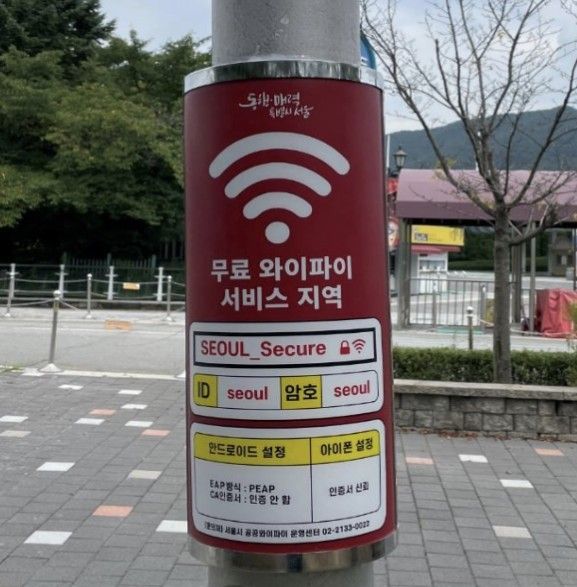
A key telecommunications operator refers to a government-authorized telecommunications provider that offers information and communication services to the general public without discrimination. Previously, the government restricted the establishment of independent communication networks by the state or local governments to provide Wi-Fi services. However, following the amendment of the Telecommunications Business Act in January last year, local governments can now register as key telecommunications operators. Seoul City has become the first local government to secure this institutional authority.
Currently, Seoul City provides high-quality service by operating approximately 34,000 public Wi-Fi units-the largest number among local governments-across major streets, traditional markets, parks, and public transportation, including bus stops. Last year, the number of users who accessed Seoul’s public Wi-Fi reached 1.287 billion, and data usage exceeded 36,000 terabytes (TB). In monetary terms, this equates to an annual savings of 207.2 billion won.
In particular, the mobile Wi-Fi installed on about 7,000 city buses is regarded as a leading example of public Wi-Fi usage, serving millions of users daily. With its designation as a key telecommunications operator, Seoul City plans to provide equitable "digital welfare" to citizens while also reinforcing Seoul’s image as a smart city for both domestic and international visitors.
To achieve this, the city will install an additional 13,000 public Wi-Fi units over five years to reduce coverage gaps and replace approximately 2,000 outdated devices to improve overall quality. In addition, Seoul will actively utilize its existing 5,298 kilometers of self-owned network infrastructure and newly construct a total of 777 kilometers of optical cable.
The city will further enhance both quality and security. Wi-Fi equipment will be gradually upgraded to high-performance Wi-Fi 6 and Wi-Fi 7, which are faster than LTE, and the WPA3 authentication method will be introduced to strengthen security. Seoul City aims to bridge the information access gap and alleviate the annual household communication cost burden, which amounts to several hundred billion won, through the expansion of public Wi-Fi. By reducing reliance on private leased networks, the city plans to reinvest the resulting funds into projects that benefit citizens, creating a virtuous cycle.
Kang Okhyun, Director of Seoul City’s Digital City Bureau, stated, "With Seoul City’s registration as a key telecommunications operator, we now have the institutional authority to build and utilize our own network infrastructure without relying on the private sector. This empowers us to design and implement Wi-Fi in the locations citizens want." He added, "We will continue to expand and manage seamless, free Wi-Fi so that all citizens can conveniently use it without discrimination in their daily lives."
© The Asia Business Daily(www.asiae.co.kr). All rights reserved.

















