Mass Death of 80,000 Fish in Namhae and Hadong
Heatwaves and Localized Downpours Raise Concerns Over Frequent Red Tide Outbreaks
Recently, mass deaths of farmed fish have continued as heatwaves and localized heavy rainfall have overlapped. Fundamental measures are required to ensure the sustainability of aquaculture in the era of climate change.
On August 26, Namhae-gun and Hadong-gun in South Gyeongsang Province announced that approximately 78,000 fish, including flatfish, black sea bream, mullet, sea bass, and red sea bream, died en masse at seven fish farms in Seolcheon-myeon, Namhae-gun. Of these, 45,000 flatfish were confirmed to have died due to red tide.
On August 28, a report was filed that 3,800 mullets died at a sea cage farm in Geumnam-myeon, Hadong-gun. Authorities are investigating the connection to the red tide.
According to a survey by the National Institute of Fisheries Science, up to 3,000 cells per milliliter of the harmful red tide organism Cochlodinium have been detected recently in the waters off Namhae, Hadong, Sacheon, and Goseong. As a result, a red tide advisory was issued on August 27 for the western coast of South Gyeongsang Province, and preliminary warnings were issued for Goseong, Tongyeong, and Geoje.
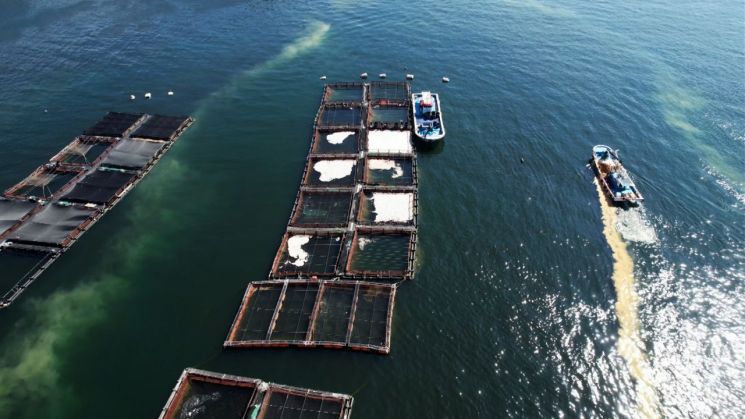 On the 29th, fishermen are collecting a group of dead fish at a sea cage farm on Mijo Road, Mijo-myeon, Namhae-gun, Gyeongnam. Photo by Yonhap News
Red tide is a phenomenon in which microscopic plankton rapidly multiply, turning the seawater red. Cochlodinium attaches to fish gills, secreting mucus that blocks respiration and threatens survival with toxic substances. Its growth is especially active at water temperatures between 24 and 27 degrees Celsius.
This summer, the southern coast of Korea experienced prolonged heatwaves along with repeated localized heavy rainfall. Experts explain that these conditions created an optimal environment for red tide outbreaks. Nutrients such as nitrogen and phosphorus contained in rainwater flowed into the sea, further accelerating plankton proliferation.
The South Gyeongsang provincial government is currently operating 20 pieces of control equipment, such as loess sprayers, and has deployed 62,000 tons of loess to respond. However, high water temperatures alone have already caused significant damage. In Tongyeong, 2.39 million fish have died from high temperatures this year alone, and last year, a record-breaking heatwave killed 28 million fish in the province.
According to the National Institute of Fisheries Science, the surface water temperature in Korean waters has risen by 1.44 degrees Celsius over the past 56 years, and this trend is expected to continue until 2100. If high water temperatures and localized heavy rainfall persist during the summer, red tides and mass fish deaths could become a regular occurrence.
In May, the government announced the '2025 Comprehensive Countermeasures for High Water Temperatures and Red Tides,' taking preemptive actions such as supporting aquaculture facility equipment, encouraging early shipment of vulnerable species, and streamlining emergency release procedures. An official from the Ministry of Oceans and Fisheries stated, "We will strengthen on-site response and recovery efforts and also focus on supporting fishermen by promoting consumption."
© The Asia Business Daily(www.asiae.co.kr). All rights reserved.
![Clutching a Stolen Dior Bag, Saying "I Hate Being Poor but Real"... The Grotesque Con of a "Human Knockoff" [Slate]](https://cwcontent.asiae.co.kr/asiaresize/183/2026021902243444107_1771435474.jpg)















