Ulsan, the 'Home of SK'...Laying the Groundwork for a Quantum Leap
Server Cooling and Power Supply...
Enabled by SK's Proprietary Technology
"I have committed the sin of proposing to build a data center in Seoul. I am a turncoat!" (Yu Youngsang, CEO of SK Telecom)
On the 29th, at the groundbreaking ceremony for the artificial intelligence (AI) data center held in Ulsan, CEO Yu Youngsang half-jokingly, half-seriously confessed to being a "turncoat" and having "committed a sin." Why did he make such a remark at this meaningful event marking the start of construction for what will be the largest AI data center in Korea? The comment was prompted by the congratulatory speech delivered just before by Choi Changwon, Chairman of the SK SUPEX Council.
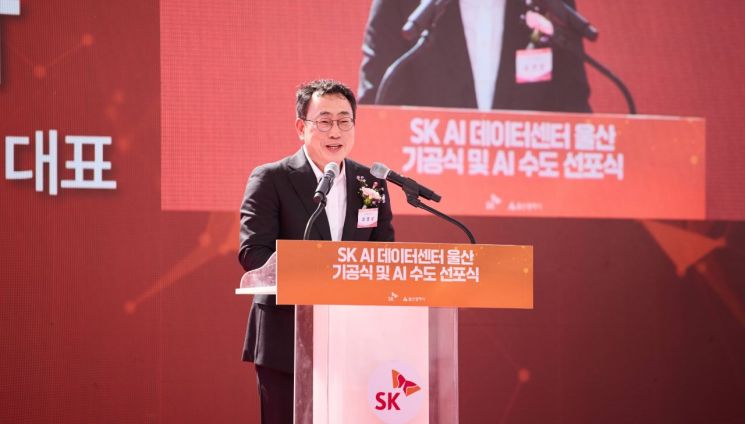 Yu Youngsang, CEO of SK Telecom, is delivering a commemorative speech at the groundbreaking ceremony of the SK AI Data Center Ulsan on the 29th. Photo by SKT
Chairman Choi shared some behind-the-scenes stories, saying, "President Yu Youngsang insisted that data centers should absolutely be built in the Seoul metropolitan area, but I told him, 'Trust me and let's go to Ulsan. You won't regret it.'" From the perspective of a data center operator, areas like Seoul and the metropolitan region are typically preferred due to higher demand. However, considering the overconcentration in the metropolitan area and challenges in power supply, there is a need to relocate to non-metropolitan regions. Chairman Choi praised Ulsan as the optimal site, saying, "Its understanding and passion for industry, administrative capabilities, comprehensive support, and ecosystem are superior to any other region."
At the event, which brought together key figures from Ulsan including Ulsan Mayor Kim Dukyum and Assemblyman Kim Kihyun of the People Power Party (representing Ulsan Namgu-eul), CEO Yu took the stage with a somewhat sheepish expression, playfully referring to himself as a "turncoat" in a witty response to Chairman Choi's unexpected remarks.
Ulsan, the 'Hometown of SK'... A New Quantum Leap
SK Group has a long-standing connection with Ulsan. The late Chey Jonghyun, former chairman of SK Group, began his journey with Ulsan by establishing a refinery there in the 1960s. In the 1970s, he built a polyester fiber plant, and in the 1980s, SK acquired Yukong in Ulsan, completing the group's vertical integration "from petroleum to fiber." This laid the foundation for Korea, which previously had no industrial base, to take its first steps toward industrialization.
Chairman Choi emphasized, "If you haven't done business in Ulsan, you can't truly evaluate the city's administrative capabilities," and added, "To usher in a new AI era, not only Ulsan but also the Korean government and the entire industrial ecosystem must work together."
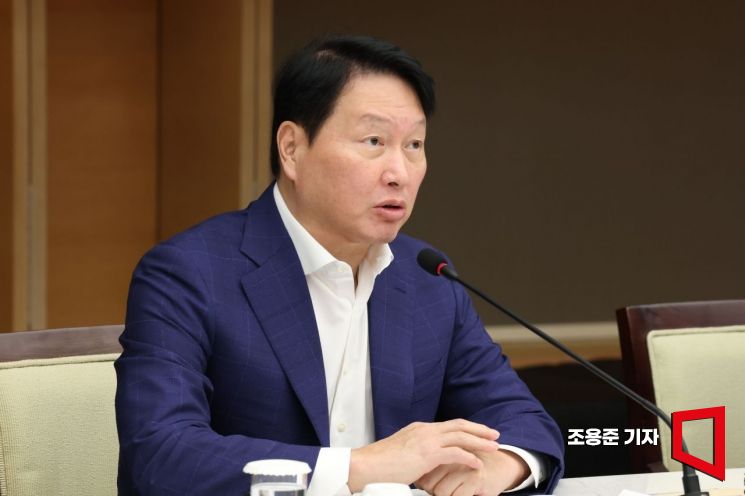
Now, SK Group is embarking on a new leap forward in Ulsan with the core infrastructure of the AI era: the AI data center. The 'SK AI Data Center Ulsan' project is being led directly by Chairman Chey Tae Won, mobilizing the capabilities of all group affiliates. He views this as the group's fourth quantum leap, following energy, information and communications, and semiconductors.
In particular, the integration of AI into Ulsan, the manufacturing hub of Korea, is expected to create various innovation cases such as smart factories and process automation, thereby revitalizing the local economy.
Server Cooling and Power Supply... Enabled by SK's Technology
To ensure the smooth operation of tens of thousands of GPUs, it is essential to establish a hybrid cooling system that uses both liquid and air, as well as high-capacity power facilities. To this end, SK Gas and SK Multi Utility (SKMU) are joining forces.
Prior to the groundbreaking ceremony, SK Gas, located near Ulsan Bukshin Port, announced plans to supply 'LNG cold energy' through pipelines to cool the heat generated by the data center servers. LNG cold energy refers to the ultra-low temperature cooling energy inherent in liquefied natural gas.
SKMU, a cogeneration plant subsidiary of SK Chemicals, will provide stable power. The close proximity between the power plant and the data center reduces both the cost and time required to establish power facilities. Additionally, electricity will be supplied directly from SKMU, a district electricity provider, rather than from Korea Electric Power Corporation (KEPCO). KEPCO will serve as a backup power source when SKMU is unable to supply electricity due to maintenance or other reasons. If Ulsan is designated as a distributed energy special zone in the future, a more flexible electricity pricing system can be implemented.
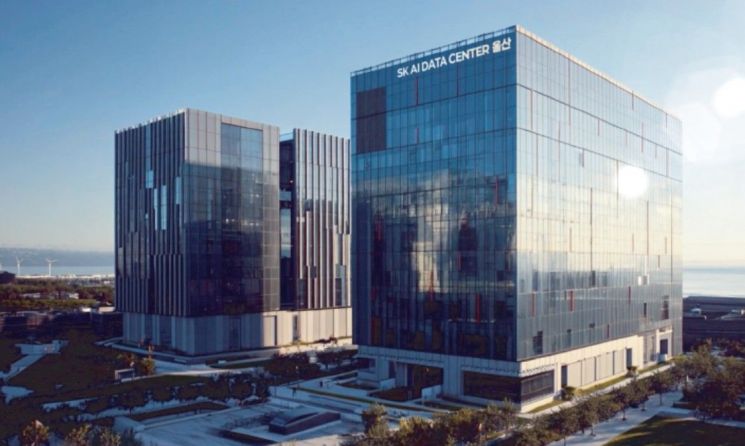 Virtual image of SK AI Data Center Ulsan. Provided by SKT (This image is for illustrative purposes and may differ from the actual construction).
The site for the SK AI Data Center Ulsan is located within the Ulsan industrial complex, on land previously owned by SK Chemicals and now acquired by SK Broadband for construction. The plan is to secure additional adjacent land and eventually establish a 1GW-class AI data center cloud. By the end of 2027, the first data center building with a capacity of 41MW will be operational. Additional buildings will be constructed, expanding the capacity to 100MW with 60,000 GPUs by 2029. Jo Jungmin, Head of SK Broadband, stated, "100MW is more than twice the electricity consumption of Wirye New Town," and added, "If it were only 100MW, we would not have come to Ulsan. We plan to expand up to 1GW in the future."
To achieve this, SK is pursuing a 6GW floating offshore wind power project near Ulsan and Ulsan Port, aiming to lead in the use of eco-friendly energy.
Meanwhile, Amazon Web Services (AWS), the world's largest cloud service provider, will be responsible for the construction and operation of the data center servers under a 15-year contract. Jo explained, "The top priority will be processing data generated by major domestic industries such as manufacturing, shipbuilding, and petrochemicals. If domestic demand is not sufficient, we will seek overseas clients."
© The Asia Business Daily(www.asiae.co.kr). All rights reserved.



















