Comprehensive Showcase of Ha Jonghyun's Artistic World
Ha Jonghyun Art Center Opens in Paju on September 1
"Aiming to Become a Hub for Contemporary Art Discourse"
Ha Jonghyun Art Award Ceremony to Be Held on Opening Day
The "Ha Jonghyun Art Center," which comprehensively showcases the artistic world of Ha Jonghyun, a pioneer of Korean modernism, has opened in Munbal-dong, Paju, Gyeonggi Province. Spanning four exhibition halls, the center presents works that embody the artist's philosophy and experimental spirit, which he has practiced since the 1960s.
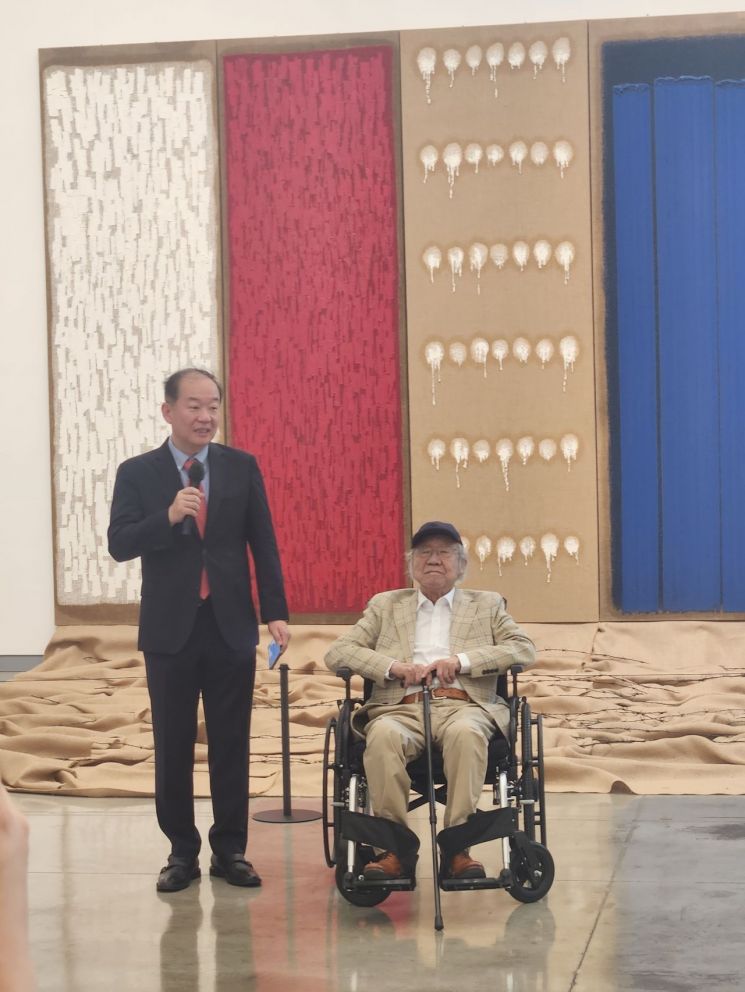 On the morning of the 29th, artist Ha Jonghyun (right) and his son Ha Yoon, chairman of the Ha Jonghyun Arts and Culture Foundation, are speaking at the Ha Jonghyun Art Center in Paju. Photo by Seo Mideum
Over the past half-century, Ha Jonghyun has been a symbolic figure in the history of modern and contemporary Korean art, dedicating himself to continuous exploration and experimentation with materiality under the theme of "What is painting?" and pioneering a new chapter in abstract painting. The Ha Jonghyun Art Center offers a panoramic view of the artist's entire life, during which he expanded the definition and concept of painting through a fierce spirit of the times and earnest inquiry. The center comprehensively covers the Informel movement, which was the main trend in Korean art in the 1960s, the period of the Korean Avant-Garde Association (AG)-an experimental art group led by Ha in the 1970s-and the era of Dansaekhwa, which dominated Korean art history from the 1970s onward.
The exhibition space, covering a total area of approximately 2,967 square meters (about 897 pyeong), is organized chronologically, featuring representative works from each period and archival materials. Upon entering the first exhibition hall, visitors are greeted by a large-scale "Conjunction" piece displayed in a high-ceilinged space. Especially notable are the "Conjunction" works from the mid-2010s onward, where monochromatic and polychromatic pieces coexist, filling the spacious hall with a sense of gravity. The second exhibition hall showcases paintings from the 1960s and early 1970s based on Informel and geometric abstraction, as well as installation works from the AG period. The archive space on the same floor displays major exhibition catalogues, photographs, and videos. The third exhibition hall presents a variety of "Conjunction" series from different periods, while the fourth and final hall features the "Post-Conjunction" works, characterized by vertical and horizontal compositions.
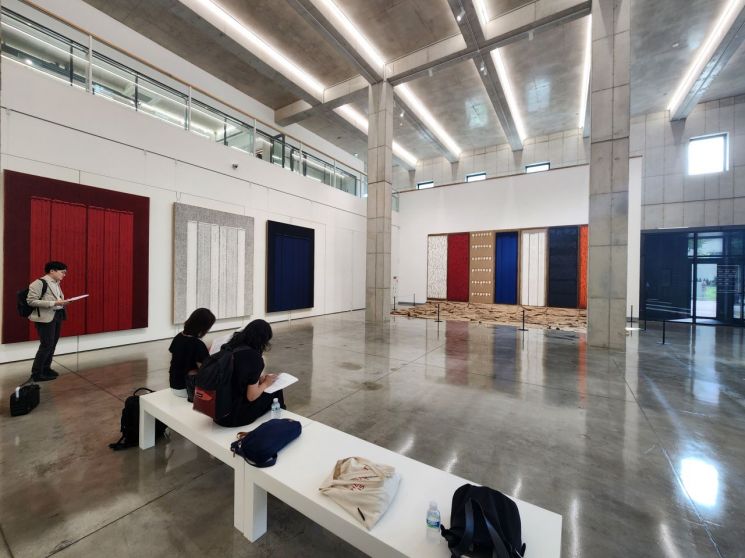
On one wall of the first-floor exhibition hall, the large-scale work "Conjunction 20-200" (2020) captures visitors' attention. As part of the "Conjunction" series, which combines multiple works, its three-dimensional barbed wire installation on the floor stands out. An official from the art center explained, "Ha Jonghyun is an experimentalist who has deconstructed and challenged the essence of painting, constantly pushing the boundaries not only of painting but also of Korean art as a whole," adding, "He placed great importance on expressing his identity as a Korean artist."
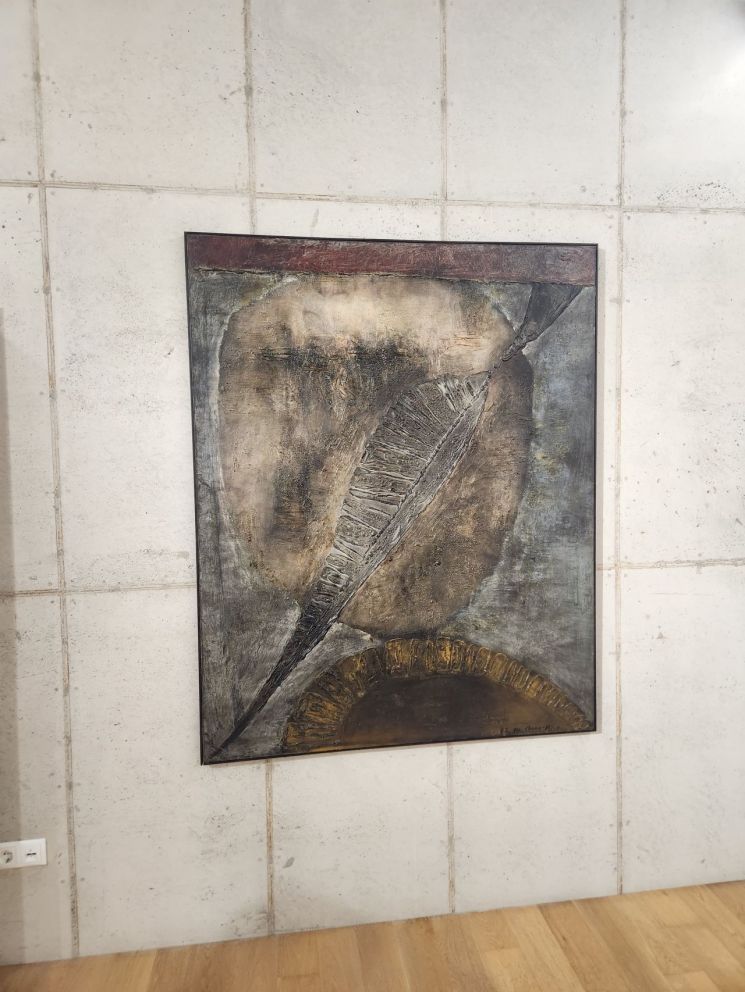 Janghyun Ha 'Work C' (1962), a piece where paint is applied and scorched with fire to prominently depict darkness. Photo by Seomideum
From the second floor onward, the exhibition delves deeper into the process of Ha's artistic contemplation. It closely examines works from the Informel and geometric abstraction period (1960-1969) and the AG period (1969-1975), which predate the "Conjunction" series. The works from the 1970s served as a silent protest and symbolic indictment against the military regime that dominated Korea at the time. Many pieces are notably dark in tone, such as "Work C" (1962), in which paint is applied and scorched with fire to bring out the darkness. There are also works symbolizing press censorship.
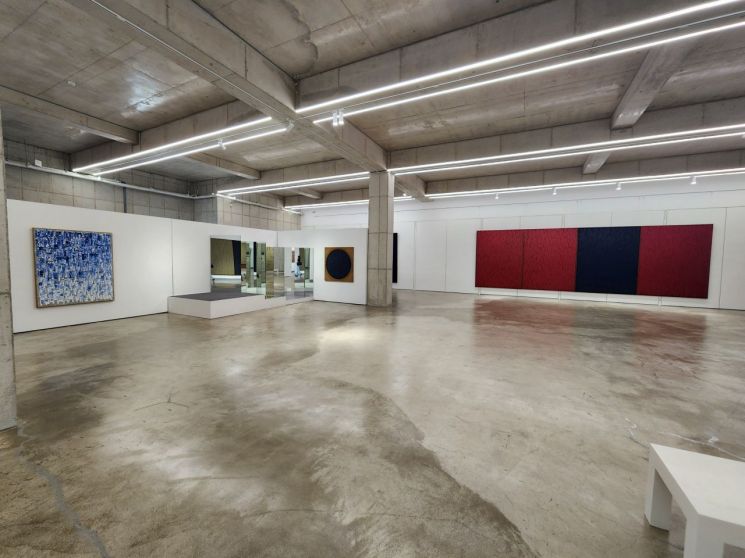
The "Conjunction" series, which began in 1974, continues to this day. The representative "Conjunction" series, created since 1974 using the labor-intensive and unique "baeapbeop" (back-pressure technique), which involves pushing pigment from the back to the front of a burlap canvas, and the "Post-Conjunction" series, which has expanded upon this approach since 2009, are regarded as unique reinterpretations of painting within the flow of Dansaekhwa.
The opening day on September 1 will also feature the 14th Ha Jonghyun Art Award ceremony. The Ha Jonghyun Art Award was established in 2001 by Ha Jonghyun, former director of the Seoul Museum of Art, after his retirement from teaching at Hongik University, as a way to give back to society and foster future generations. The award recognizes not only contemporary artists but also critics, curators, and other figures active in various fields of the domestic and international art world. To date, more than 20 recipients have been honored, including Lee Bae, Kwon Yuhyun, Seo Seongrok, Nam Chunmo, Yoo Geuntaek, Lee Sehyun, Kimsooja, Joan Kee, and Alexandra Munroe. This year, Kim Sunjung, artistic director of Art Sonje Center, and Ashley Rawlings, an art historian and curator, have been selected as awardees. In particular, Rawlings was recognized for her contributions to interpreting and introducing Korean Dansaekhwa to the international stage.
An official from the Ha Jonghyun Art Center stated, "In addition to the artist's personal archive and exhibitions, we will offer lectures, seminars, and research programs, establishing the center as a hub for contemporary art discourse," adding, "Just as the artist believes that 'art is not solely the property of the artist but is completed through communication with the audience,' we hope the Ha Jonghyun Art Center will become an important venue for future generations."
Present at the event, Ha Jonghyun remarked, "I have been preparing for this all my life," adding, "I believe today is the best day of my life."
▶Who is Ha Jonghyun?
Born in 1935 in Sancheong, Gyeongsangnam-do, Ha Jonghyun graduated from the Department of Painting at Hongik University in 1959. He served as dean of the College of Fine Arts at Hongik University (1990-1994) and as director of the Seoul Museum of Art (2001-2006). He currently lives and works in Ilsan. Ha has held solo exhibitions in major cities worldwide, including New York, Los Angeles, London, and Paris. His major solo exhibitions include Daejeon Museum of Art (2020), National Museum of Modern and Contemporary Art (2012), Gana Art Center (2008), Gyeongnam Art Museum (2004), and Fondazione Mudima in Milan (2003). Notable group exhibitions include the Hammer Museum in Los Angeles (2024), Solomon R. Guggenheim Museum in New York (2023), Denver Art Museum (2023), Museum of Modern Art in New York (2019), Powerlong Museum in Shanghai (2018), Brooklyn Museum (2017), Boghossian Foundation in Belgium (2016), Art Institute of Chicago (2016), and Prague Biennale (2009). His works are part of the collections of leading museums worldwide, including the Museum of Modern Art in New York, Solomon R. Guggenheim Museum in New York, Art Institute of Chicago, Museum of Contemporary Art Tokyo, Centre Pompidou in Paris, M+ in Hong Kong, National Museum of Modern and Contemporary Art, and Leeum Museum of Art.
© The Asia Business Daily(www.asiae.co.kr). All rights reserved.



















