Assemblyman Namgung Urges Dedicated Suin-Bundang Line Track
Cites Severe Inconvenience for Residents Due to Limited Service
Calls for Seoul City to Cooperate with Ministry and Reflect Citizens' Voices
Lower Project Cost Increases Feasibility of New Railway Section
Connection Expected to Boost Access, Commuting, and Local Markets
Namgung Yeok, a member of the Seoul Metropolitan Council (People Power Party, Dongdaemun District 3), strongly demanded the establishment of a dedicated single-track railway on the Suin-Bundang Line section between Wangsimni and Cheongnyangni during a policy inquiry at the temporary session on August 29.
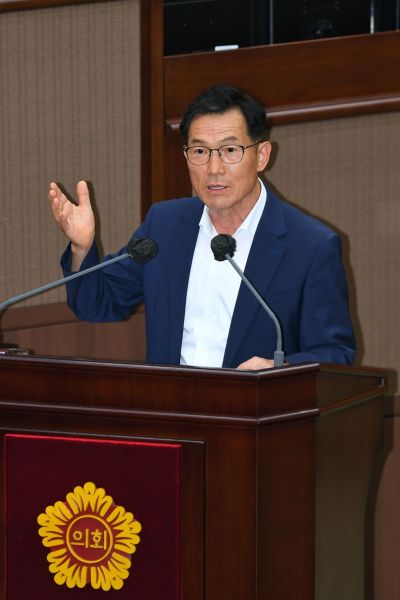 Namgung Yeok, a city council member, urged that "since Seoul City bears part of the budget, cooperation with the Ministry of Land, Infrastructure and Transport is necessary, and the voices of citizens should be directly conveyed" regarding the establishment of a dedicated single-track railway on the Suin-Bundang Line section between Wangsimni and Cheongnyangni. Provided by Seoul Metropolitan Council.
Assemblyman Namgung pointed out, "Currently, most Suin-Bundang Line trains only operate up to Wangsimni Station, and service to Cheongnyangni Station is limited to just nine times a day on weekdays and five times a day on weekends and holidays, causing severe inconvenience for residents."
Although Cheongnyangni Station is a key hub in the northeastern region, serving as an interchange for Line 1, Gyeongui-Jungang Line, Gyeongchun Line, KTX, and ITX, the Suin-Bundang Line shares tracks with the Gyeongui-Jungang Line, making it structurally impossible to increase service frequency. As a result, residents are forced to make transfers or use alternative transportation. Assemblyman Namgung criticized, "The original plan to directly connect the Seoul metropolitan area and the city center has effectively ended up only half-fulfilled."
Residents of Dongdaemun District formed a Suin-Bundang Line Promotion Committee and have been actively working to resolve the issue through signature campaigns, rallies, and visits to relevant agencies, submitting a total of 17,729 signatures to the Ministry of Land, Infrastructure and Transport. Assemblyman Namgung also emphasized that a feasibility study conducted by the Dongdaemun District Office estimated the project cost at approximately 4.95 billion won, significantly lower than the previous estimate of 9.5 billion won, thereby increasing the likelihood of the project's implementation.
He also criticized Seoul City's passive attitude, which cited the matter as being under the jurisdiction of the Ministry of Land, Infrastructure and Transport. Assemblyman Namgung urged, "Since the city bears part of the budget, it must cooperate with the Ministry and directly convey the voices of citizens." In response, the head of the Seoul Metropolitan Government's transportation office stated that they would visit the Ministry to relay residents' opinions and take active measures, while Mayor Oh Sehoon also expressed empathy for the residents' inconvenience and pledged to pay close attention to the issue.
Assemblyman Namgung stated, "With the designation of the Ministry of Land, Infrastructure and Transport's spatial innovation zone and redevelopment, transportation demand in the Cheongnyangni area is expected to surge. The connection of the Suin-Bundang Line will greatly improve access to Gangnam, enhance educational and commuting environments, and revitalize traditional markets," adding, "I hope Seoul City will take a responsible approach to this matter."
© The Asia Business Daily(www.asiae.co.kr). All rights reserved.

















