Intel CFO: "Received $5.7 Billion in Semiconductor Subsidies on the 27th"
White House: "Intel Deal Still Being Coordinated by the Commerce Department"
David Zinsner, Chief Financial Officer (CFO) of Intel, stated that the U.S. administration under Donald Trump structured its acquisition of Intel shares in a way that restricts the sale of Intel's foundry (semiconductor contract manufacturing) business.
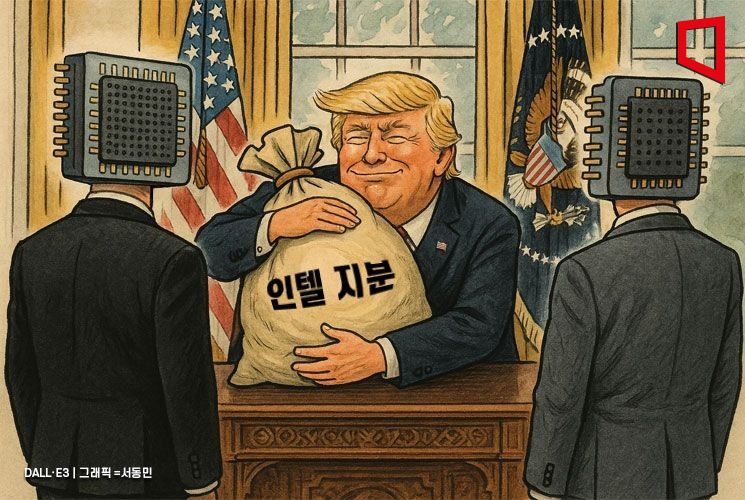
Previously, the Trump administration agreed to purchase 433.3 million new common shares of Intel at $20.47 per share, securing a 9.9% stake in the company. The $8.9 billion for the share purchase will be funded from two sources: $5.7 billion from the $7.9 billion in subsidies approved under the CHIPS Act that have not yet been paid, and $3.2 billion allocated by the Department of Defense under the Secure Enclave program for semiconductor independence.
The U.S. government will also receive a five-year warrant to acquire an additional 5% stake at $20 per share. However, this warrant can only be exercised if Intel's ownership in its foundry business falls below 51%.
According to the Financial Times (FT) and other sources, CFO Zinsner said at a Deutsche Bank-hosted conference on the 28th (local time), "I don't think it's very likely that we will reduce our foundry stake below 50%. Therefore, I expect the warrant will ultimately expire unexercised."
He added, "From the government's perspective, I believe they agreed on this point as well. They did not want us to spin off and sell the foundry to someone else." He further commented that the warrant serves as "a bit of friction to prevent us from moving in a direction that the government ultimately prefers we do not take."
However, CFO Zinsner noted that the government's equity acquisition could incentivize potential customers to view Intel "on a different level." He also stated that on the 27th, Intel received $5.7 billion in government funding. The remaining $3.2 billion is a conditional amount that will only be paid upon achieving objectives agreed with the Department of Defense, and has not yet been received.
The CHIPS Act subsidies are structured to be paid out sequentially, depending on the actual implementation of promised U.S. investment projects such as manufacturing facilities. Therefore, Zinsner's remarks suggest that Intel has received all remaining subsidies even though the investments have not yet been completed.
He said, "From a cash perspective, this was an excellent quarter," noting that Intel recently sold $1 billion worth of its Mobileye stake and is set to complete the sale of a 51% stake in its specialized chip division, Altera, to private equity firm Silver Lake within the next few weeks.
Regarding speculation that Japanese company SoftBank's $20 investment in Intel was coordinated with the Trump administration, Zinsner denied it, stating that the timing was merely a coincidence.
© The Asia Business Daily(www.asiae.co.kr). All rights reserved.
![Clutching a Stolen Dior Bag, Saying "I Hate Being Poor but Real"... The Grotesque Con of a "Human Knockoff" [Slate]](https://cwcontent.asiae.co.kr/asiaresize/183/2026021902243444107_1771435474.jpg)















