First in Asia, Setting a Global Record
Yonsei Cancer Hospital recently became the first in the world to surpass 1,000 cases of robotic breast surgery.
On August 29, the hospital announced that Professors Hyungseok Park, Jiye Kim, and Jihyun Ahn of the Robotic Surgery Team at the Breast Cancer Center had achieved the world’s first 1,000 robotic breast surgeries as of August 1.
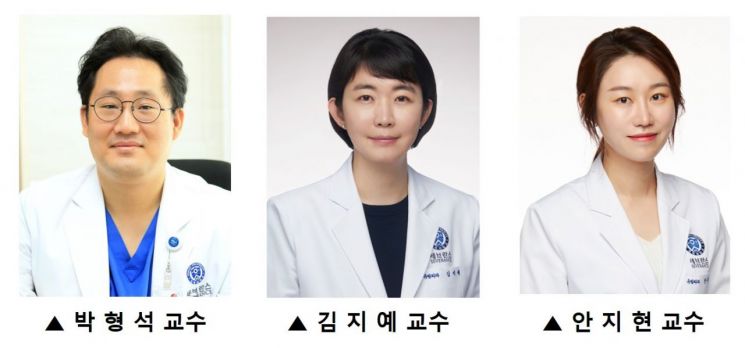 Breast Cancer Center Robotic Surgery Team Professors Hyungseok Park, Jiye Kim, and Jihyun Ahn, Yonsei Cancer Hospital. Yonsei Medical Center
After introducing robotic surgery for breast cancer treatment for the first time in Asia in 2016, Yonsei Cancer Hospital has set a global record for the highest number of procedures in just nine years.
Previously, the hospital set a world record with 500 cases in July 2023 and has now broken its own record in just two years, making this achievement even more significant. According to the 2023 National Cancer Registry statistics, there were a total of 277,523 cancer cases in Korea in 2021, with breast cancer accounting for 28,861 cases, or 10% of all cancer patients.
Breast cancer, one of the most common cancers among women, is treated primarily with surgery, alongside chemotherapy and adjuvant therapies. Surgical options include total mastectomy, which removes the entire breast, and partial mastectomy (breast-conserving surgery), which removes only the tumor and some surrounding tissue.
Before the introduction of robotic surgery, traditional procedures involved direct incisions in the breast, leaving visible scars on the front of the chest. In contrast, robotic breast surgery creates a 2 to 6 cm incision in the armpit or side, areas covered by the arm, and uses robotic endoscopic equipment to remove cancer cells.
Patients are often concerned about visible surgical scars on the breast, but robotic breast surgery uses slender robotic arms inserted through the armpit or side to operate inside the chest, leaving almost no scars on the breast itself. This approach also reduces skin necrosis around the nipple and other areas, resulting in higher patient satisfaction compared to conventional surgery.
Additionally, robotic surgery is well suited for preventive procedures. It enables safe prophylactic bilateral mastectomy for patients with BRCA gene mutations, which significantly increase the risk of developing breast cancer.
Thus, robotic breast surgery offers both preventive benefits and cosmetic satisfaction for patients undergoing prophylactic procedures, making it the optimal surgical method.
Following its distinction as the first hospital in Asia to perform robotic breast surgery, Yonsei Cancer Hospital has achieved several other milestones. Professor Hyungseok Park, who recently introduced a surgery guide model incorporating artificial intelligence (AI), also became the first in the world to perform breast cancer surgery using the latest Da Vinci SP (Single Port) robotic system, solidifying the hospital’s leadership in this field.
The Breast Cancer Center at Yonsei Cancer Hospital not only improves surgical precision through robotic breast surgery but also enhances patient satisfaction through multidisciplinary care involving departments such as plastic surgery.
After the Robotic Surgery Team completes a total mastectomy, the plastic surgery team-Professors Dongwon Lee, Seungyong Song, and Eunjung Yang-immediately performs breast reconstruction using implants. This approach helps protect patients’ self-esteem after breast loss and focuses on improving patient satisfaction.
In this way, Yonsei Cancer Hospital’s robotic breast surgery has established itself as an integrated treatment strategy that encompasses therapeutic efficacy, safety, aesthetics, and a patient-centered approach.
Professor Hyungseok Park (Department of Breast Surgery) stated, "Achieving the world record of 1,000 robotic breast surgeries at Yonsei Cancer Hospital is more than just a number; it would not have been possible without the trust of our patients. By pursuing safety and precision through robotic breast surgery and enhancing aesthetics through multidisciplinary care, Yonsei Cancer Hospital will continue to strive for patient recovery and satisfaction."
Meanwhile, medical professionals from leading institutions around the world, including Harvard Medical School and Mayo Clinic in the United States, are visiting Yonsei Cancer Hospital to learn about its excellence in robotic surgery. The Severance Robotic Endoscopic Surgery Center developed its own robotic breast surgery technique using cadavers in 2013 and has since applied it in clinical practice. This outstanding research capability has been a foundation for Yonsei Cancer Hospital’s achievement of 1,000 robotic surgeries.
© The Asia Business Daily(www.asiae.co.kr). All rights reserved.
![Clutching a Stolen Dior Bag, Saying "I Hate Being Poor but Real"... The Grotesque Con of a "Human Knockoff" [Slate]](https://cwcontent.asiae.co.kr/asiaresize/183/2026021902243444107_1771435474.jpg)















