Last year, the total safety investment in the domestic aviation industry increased by 5.7%, surpassing 6 trillion won. However, Jeju Air's safety investment plummeted by 36.5% following the passenger plane accident in December last year.
On August 29, the Ministry of Land, Infrastructure and Transport announced that the combined safety investment of 16 air carriers and 2 airport operators for 2024 amounted to 6.177 trillion won. This represents a 5.7% increase compared to 5.845 trillion won in 2023. In 2022, the figure stood at 4.230 trillion won. The Ministry expects the upward trend to continue, projecting safety investment to reach 10.028 trillion won this year and 10.659 trillion won next year.
By company, full-service carriers Korean Air and Asiana Airlines accounted for 75% of the total, investing 3.224 trillion won (up 15.5%) and 1.409 trillion won (down 10.4%), respectively.
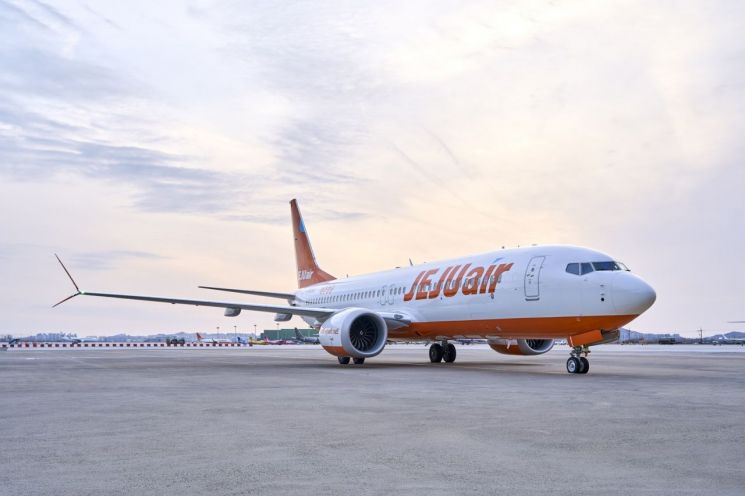
Low-cost carriers collectively invested 1.241 trillion won, a 2.2% increase from the previous year. Among them, only Jeju Air and Air Busan saw a decrease in safety investment. Jeju Air's investment dropped by 36.5% to 313.5 billion won, and Air Busan's fell by 23.3% to 175.9 billion won. Jeju Air explained that it had proactively made safety investments in 2023, and its preventive maintenance costs still increased by 2.7% last year.
By investment category, maintenance costs accounted for 3.61 trillion won (up 23%), representing 61.4% of the total investment. Preventive maintenance before flight operations amounted to 3.12 trillion won, while post-flight maintenance for breakdowns and defects was 490 billion won. Engine and parts purchases reached 1.57 trillion won, an 18.9% increase, while the replacement of aging aircraft over 20 years old dropped by 55.1% to 534.7 billion won.
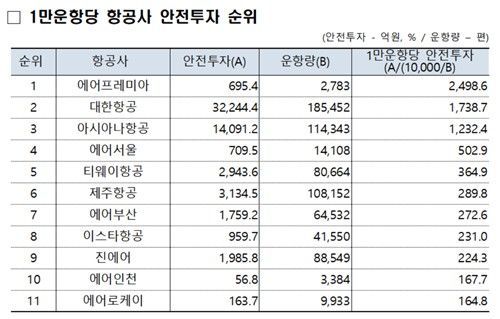
This year, a new indicator called "investment per 10,000 flights," which considers the scale differences among airlines, was introduced. This figure represents the average safety investment made for every 10,000 flights. Air Premia ranked first among the 11 domestic airlines, investing 249.9 billion won per 10,000 flights. Korean Air (173.9 billion won) and Asiana Airlines (123.2 billion won) ranked second and third, followed by Air Seoul (50.3 billion won), T'way Air (36.5 billion won), and Jeju Air (29 billion won).
In terms of safety investment per operating aircraft, Korean Air led with 19.8 billion won, followed by Asiana Airlines (17.2 billion won), Air Seoul (11.8 billion won), and Air Premia (11.6 billion won).
The Ministry of Land, Infrastructure and Transport plans to introduce a new category for "new aircraft introduction" to encourage the acquisition of newer aircraft. The scope of "recognized safety-related personnel expenses" will also be expanded to include flight and cabin crew, as well as flight operations management.
Yoo Kyungsoo, Director of Aviation Safety Policy at the Ministry, stated, "Through the disclosure of safety investments, we will encourage airlines to proactively identify areas for safety system improvements and make substantial investments, thereby fostering a culture of autonomous safety management through policy efforts."
© The Asia Business Daily(www.asiae.co.kr). All rights reserved.
![Clutching a Stolen Dior Bag, Saying "I Hate Being Poor but Real"... The Grotesque Con of a "Human Knockoff" [Slate]](https://cwcontent.asiae.co.kr/asiaresize/183/2026021902243444107_1771435474.jpg)
















