Corporate Investment Up 5.7%
Revised Sharply Higher from Initial 1.9% Estimate, Driving Growth
The U.S. economy achieved a growth rate well above 3% in the second quarter of this year. Following a decrease in imports and a recovery in consumer spending, a significant increase in corporate investment contributed to a much stronger economic expansion than previously expected.
According to the U.S. Bureau of Economic Analysis (BEA) under the Department of Commerce on August 28 (local time), the preliminary estimate for real gross domestic product (GDP) in the second quarter showed an annualized increase of 3.3% compared to the previous quarter.
This figure is 0.3 percentage points higher than the advance estimate (3.0%) announced earlier, and it also exceeded the Dow Jones forecast of 3.1%. The United States releases GDP growth rates in three stages: advance, preliminary, and final. This figure represents the second stage, the preliminary estimate.
The 'V-shaped rebound' from a 0.5% contraction in the first quarter to 3.3% growth in the second quarter was largely driven by improvements in the trade balance and increased consumer spending.
Real consumer spending, which accounts for about two-thirds of U.S. GDP, rose by 1.6%. This figure was revised upward from the initial 1.4% and shows a clear recovery compared to the first quarter (0.5%).
In particular, the growth rate of final sales to private domestic purchasers was significantly revised upward from 1.2% to 1.9%. The Federal Reserve closely monitors this indicator as a key measure of demand. The figure was adjusted to the same level as the first quarter (1.9%), easing concerns about an economic slowdown that had been raised when the advance estimate was released.
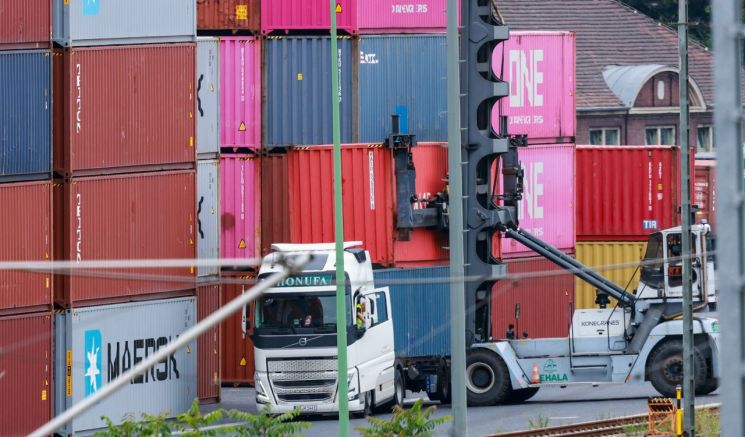
The sharp decline in imports also contributed to the rebound in growth. While exports fell by 1.2% in the second quarter, imports plummeted by 29.8%, leading to an improved trade balance. As a result, the contribution of net exports to GDP exceeded 5 percentage points. In the first quarter, imports had surged as companies stockpiled inventories ahead of the U.S. imposing reciprocal tariffs, widening the trade deficit. However, in the second quarter, after the U.S. implemented a 10% base tariff on goods from around the world, demand for inventory accumulation dropped sharply, resulting in a steep decline in imports.
Additionally, the upward revision of the preliminary GDP growth rate was mainly driven by increased corporate investment. Corporate investment rose by 5.7% in the second quarter, a significant increase from the initial estimate of 1.9%. Investment in transportation equipment expanded, and intellectual property products recorded their largest increase in four years.
The inflation rate, based on the core personal consumption expenditures (PCE) price index, which is the Federal Reserve's preferred measure, stood at 2.5%, unchanged from the advance estimate.
Bloomberg News predicted that the U.S. economy would continue its moderate growth as consumers and businesses adapt to President Donald Trump's trade policies.
However, some analysts emphasize the need to closely monitor future trends in consumer spending.
Heather Long, chief economist at Navy Federal Credit Union, stated, "It is fortunate that Americans have continued spending despite tariffs and uncertainty, resulting in higher-than-expected consumption, but compared to recent years, the pace has slowed." She added, "As U.S. consumers begin to visibly feel the effects of tariffs, both consumption and growth rates are likely to remain subdued at around 1.5% going forward."
© The Asia Business Daily(www.asiae.co.kr). All rights reserved.
![Clutching a Stolen Dior Bag, Saying "I Hate Being Poor but Real"... The Grotesque Con of a "Human Knockoff" [Slate]](https://cwcontent.asiae.co.kr/asiaresize/183/2026021902243444107_1771435474.jpg)















