On August 28, Korea Ratings Corporation assessed that POSCO Group is facing a "triple challenge" centered on its core steel business, including industry conditions, investment, and tariffs imposed by the United States. While the investment burden remains high compared to previous years, the company is expected to see little meaningful improvement in financial stability due to weak operating cash flow.
In a report analyzing credit-related issues of major domestic conglomerates, Korea Ratings Corporation stated that both the crisis and opportunity for POSCO Group depend on its two pillars: steel and secondary battery materials.
First, Korea Ratings Corporation pointed out that since 2020, POSCO Group has reorganized its business portfolio around steel and secondary battery materials, making the group’s overall performance highly susceptible to these sectors.
Korea Ratings Corporation explained, "Due to the sluggish steel market, the group’s operating performance has continued to deteriorate. Since 2022, the group’s operating profitability has declined, resulting in reduced operating cash flow. At the same time, capital expenditures for new business investments have increased, leading to a steady rise in net debt and a slight decrease in debt coverage indicators."
For the steel segment, profitability is expected to continue declining due to ongoing supply-demand imbalances and external uncertainties such as tariffs. For non-steel segments, profitability improvement is also expected to be limited due to the slowdown in key industries such as steel, electric vehicles, and construction.
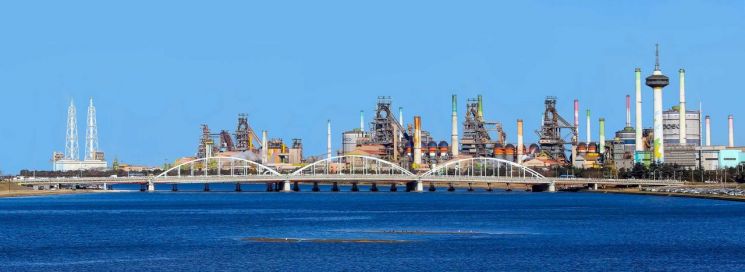
In particular, Korea Ratings Corporation focused on the impact of U.S. policy changes-such as tariffs under the Donald Trump administration and the OBBBA Act-on the group’s business stability and performance. Korea Ratings Corporation noted, "As of 2024, the United States accounts for less than 3% of POSCO’s regional sales, and the main export item is high-margin automotive electrical steel. Therefore, the direct impact of U.S. tariff policies on the profitability of the steel segment is limited." However, the agency also stated, "The U.S. decision to impose a 50% tariff on imported steel will create secondary ripple effects related to supply and demand, such as downward price pressure from downstream customers with weaker purchasing power, thereby placing a burden on profitability."
In the case of POSCO Future M, the United States accounted for 33% of its regional sales as of last year, which is relatively high. Korea Investors Service analyzed, "The significantly lower tariff rate compared to China, a major competitor in the U.S. secondary battery material market, is a positive factor." However, it added, "If automakers reduce their electric vehicle production and sales plans due to tariff imposition, the positive effect could be diminished."
Additionally, the early termination of electric vehicle subsidies following the implementation of the OBBBA Act is highly likely to slow the adoption of electric vehicles in the United States in the short term, exerting downward pressure on demand growth for secondary battery materials. However, Korea Ratings Corporation added that revisions to regulations such as AMPC could benefit POSCO Future M, which has low dependence on China.
Korea Ratings Corporation also commented on POSCO Group’s investment direction and performance over the past five years, stating, "Most investments, excluding routine capital expenditures, are planned in line with mid- to long-term goals such as strengthening future growth engines. It will take more time to generate meaningful results relative to the scale of investment." The agency added that the continued sluggishness in downstream industries and the unfavorable macroeconomic environment are likely to remain burdens on financial stability.
Korea Ratings Corporation stated, "While the investment burden remains high compared to previous years, meaningful improvement in financial stability will be limited due to weak operating cash flow." The agency added, "With operating cash flow declining compared to the past due to weak downstream industry conditions and intensifying global protectionism, and considering the trend of strengthening shareholder return policies, large-scale investment expenditures could further increase the financial burden."
In addition, regarding POSCO E&C, which has recently been embroiled in controversy due to a fatal accident, the agency predicted, "Operating losses are expected to increase, as it will be necessary to account for bad debt expenses related to unsold units, costs associated with re-construction and the accident, as well as additional costs from expedited construction to make up for delays." Korea Ratings Corporation added, "As the debt burden increases, we will review the levels of business and financial stability at the time when accident-related sanctions are specified and reflect these in the credit rating."
© The Asia Business Daily(www.asiae.co.kr). All rights reserved.

















