VN30 Surpasses KOSPI in Year-to-Date Gains
Robust Economic Growth and Eased External Risks Drive Rally
Individual Investors Urged to Beware of Short-Term Overheating
Recently, the Vietnamese stock market has been experiencing a steep upward trajectory, drawing increased attention from domestic individual investors. While the KOSPI has entered a sideways trend this month and lost momentum, the Vietnamese stock market has continued to hit record highs, taking over the title of "best year-to-date return" from the KOSPI.
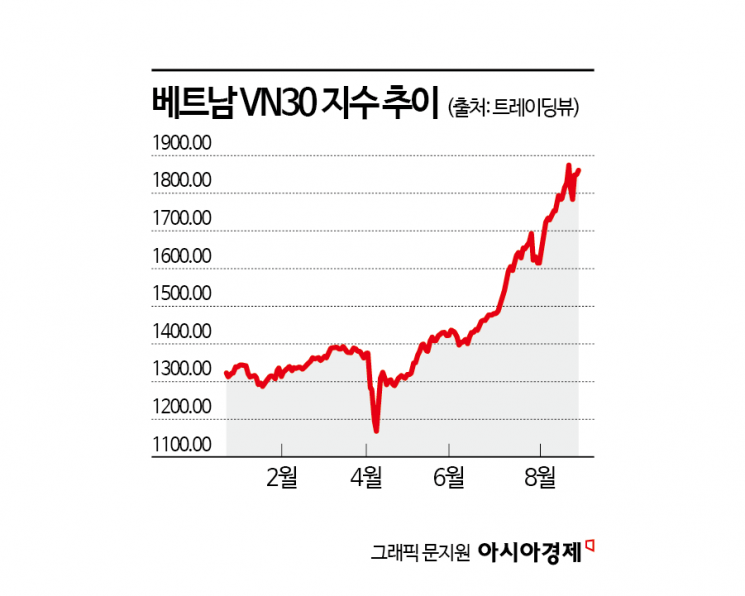
According to the financial investment industry on August 29, the VN30 Index closed at 1,865.83 the previous day, up 0.93%. Its year-to-date return stands at 37.76%, surpassing the KOSPI's 33.21% and ranking first among global indices. The VN30 Index is composed of 30 leading blue-chip companies listed on the Ho Chi Minh Stock Exchange (HOSE). As of July 31, when the KOSPI reached its 52-week high, it was leading major global stock markets in terms of growth rate for the year. However, due to a prolonged sideways trend this month, it has since lost the top spot.
Thanks to the strong performance of the VN30 Index, so-called "Vietnamese ants"-individual investors investing in the Vietnamese stock market-are reported to have reaped significant profits. The amount of Vietnamese stocks held by domestic individual investors during August (from the 1st to the 26th) reached approximately 301 million dollars (about 418.8 billion won), marking four consecutive months of increase since April. This is the highest level since August last year, when it reached 302.56 million dollars. In Korea, individual investors bought about 4.1 billion won worth of ACE Vietnam VN30 (Synthetic) Exchange-Traded Funds (ETF) from August 1 to 28, shifting to net buying for the first time in four months. The price of this ETF has surged more than 25% so far this year.
NH-Amundi Asset Management stated, "Market expectations are rising on the back of a high GDP growth rate in the 7% range and a consumer price index (CPI) forecast below 4%," adding, "Vietnam's attractiveness as a stock market has been highlighted by the resolution of external risks after it became the first Asian country to sign a tariff agreement with the United States." The Vietnamese government is also pushing to adopt International Financial Reporting Standards (IFRS) to enhance corporate information transparency and has increased infrastructure spending in the first half of this year by 40% compared to the previous year, showing strong support for the market.
In the second half of this year, another major positive catalyst is expected: the inclusion in the FTSE Emerging Markets Index. Previously, Vietnam had been on FTSE's watch list for emerging markets since 2018, but repeated upgrades were thwarted due to institutional shortcomings. However, with the Korea Exchange (KRX) introducing a next-generation securities system last May-improving technical requirements such as shortening the settlement cycle and simplifying the process for foreign investors to open accounts-Vietnam is now considered to have met most of the necessary conditions for an upgrade.
Kim Geuna, a researcher at Hana Securities, said, "The market sees a high possibility of Vietnam being upgraded in the regular review in the second half of the year, and this is the most decisive factor driving the current stock market rally." She added, "There is a high likelihood that the short-term upward momentum will continue until September or October, when expectations for the upgrade become more concrete." However, she also cautioned, "Given that the index has surged rapidly in a short period, investors should be mindful of the possibility of a correction. Even if the upgrade materializes, if the real economy does not support it, the potential for further gains may be limited, so caution is advised."
© The Asia Business Daily(www.asiae.co.kr). All rights reserved.



















