Submission of the 2025 Second Supplementary Budget Proposal to City Council
2.1% of the Original Budget; Local Bond Issuance Unavoidable
Financial Support Injected for Stable City Bus Operations
The Seoul Metropolitan Government has prepared its second supplementary budget proposal for this year, totaling 1.0799 trillion KRW. The focus is on covering the 350 billion KRW in local government costs resulting from the government’s livelihood recovery consumption coupon program and providing financial support for the stable operation of city buses.
On August 28, the Seoul Metropolitan Government announced that it had drawn up the “2025 2nd Supplementary Budget Proposal” and would submit it to the Seoul Metropolitan Council on August 29 for review. The proposed budget amounts to 1.0799 trillion KRW, which is 2.1% of the 2025 original budget. If passed as is, the city’s total budget for this year will reach 52.0193 trillion KRW.
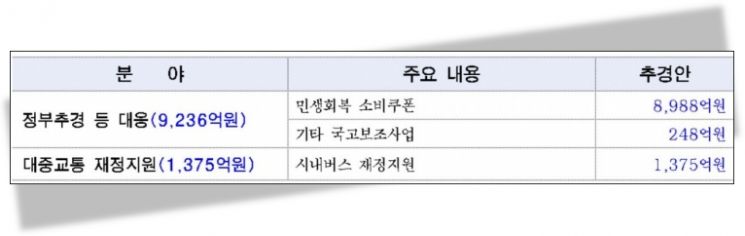 2025 Seoul Metropolitan Government 2nd Supplementary Budget Proposal Major Project Expense Details. Seoul Metropolitan Government
The core of the second supplementary budget is the city’s financial burden from issuing consumption coupons for livelihood recovery. Among the 17 metropolitan and provincial governments, Seoul is the only one where a 75% central government subsidy rate applies, resulting in a 350 billion KRW burden for the city. As a result, the city has found itself in a situation where it is inevitably forced to resort to the emergency measure of issuing local government bonds to secure the significant local funding required.
Previously, when preparing the first supplementary budget proposal in June, the Seoul Metropolitan Government stated that it had already used all available financial resources, including surplus funds and expenditure restructuring, leaving almost no fiscal capacity currently available. Despite challenging tax revenue conditions, the city has managed its finances to minimize bond issuance and prevent an increase in debt. However, with the issuance of consumption coupons, the city’s debt is expected to increase significantly, creating a considerable burden from a fiscal management perspective.
Another urgent issue is the city bus system, which has seen a sharp increase in operating deficits and a decline in passengers following COVID-19. By the end of this year, cumulative city bus debt is expected to reach about 1 trillion KRW. Therefore, the city will mobilize all available resources, including 137.5 billion KRW secured through expenditure restructuring and additional revenue, to provide financial support to the city bus association.
The city explained that, although the association is currently covering urgent operating expenses through loans from financial institutions, the resulting interest also adds to the city’s fiscal burden. To address this and because public transportation is an essential service directly linked to service quality and stable operation, the city has decided to provide additional financial support. In addition, the supplementary budget proposal includes 24.8 billion KRW in central government-subsidized projects aimed at strengthening care for vulnerable groups, in line with the city’s ongoing commitment to “accompanying the disadvantaged.”
Jung Sanghoon, Director General of Planning and Coordination for the Seoul Metropolitan Government, stated, “Despite difficult fiscal conditions, we have focused the supplementary budget on two major tasks: ensuring the stable provision of public transportation services, which are essential to citizens’ daily lives, and reliably delivering the benefits of government policies. We will continue our efforts to enhance the city’s fiscal soundness while safeguarding both citizen safety and convenience.”
© The Asia Business Daily(www.asiae.co.kr). All rights reserved.
![Clutching a Stolen Dior Bag, Saying "I Hate Being Poor but Real"... The Grotesque Con of a "Human Knockoff" [Slate]](https://cwcontent.asiae.co.kr/asiaresize/183/2026021902243444107_1771435474.jpg)
















