Laying the Groundwork for Personalized Treatments
Large-Scale Genomic Analysis Reveals Genetic Causes of Microcephaly in Over Half of Unexplained Cases
Discovery of 29 New Genes Deepens Understanding and Offers Hope for Family Planning
A team of Korean researchers has identified the genetic spectrum associated with microcephaly and uncovered genetic causes in 56.7% of previously unexplained cases.
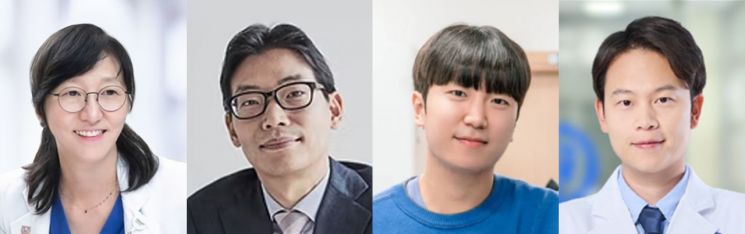 [From left] Jonghee Chae, Professor at Seoul National University Hospital; Kijun Yoon, Professor at KAIST; Hyunsoo Jang, Researcher at KAIST; Jihoon Yoon, Professor at Gangnam Severance Hospital. Seoul National University Hospital
The joint research team, led by Jonghee Chae, Professor at Seoul National University Hospital, Kijun Yoon, Professor at KAIST (with researcher Hyunsoo Jang), and Jihoon Yoon, Professor at Gangnam Severance Hospital, announced on August 28 that they had analyzed whole-exome genomic data from 418 patients with neurodevelopmental disorders accompanied by microcephaly and 632 of their family members, confirming these findings.
Microcephaly is defined as a head circumference more than two standard deviations below the average for age and sex, which can lead to delayed brain growth and development. It is classified into primary microcephaly, where the head is small at birth, and secondary microcephaly, where head growth stops during development. Approximately 1,300 genes are known to be associated with the onset of this condition.
However, the definitive genetic causes of microcephaly have not yet been clearly identified. It is important to pinpoint the key genes involved in the development of microcephaly to provide accurate diagnosis and treatment for patients with neurodevelopmental disorders and their families, as well as to assist with family planning.
The research team analyzed large-scale genomic data and identified 142 genes associated with the onset of microcephaly, and determined genetic causes in 56.7% of all patients (237 out of 418). Notably, 29 genes were newly discovered, furthering the genetic understanding of microcephaly. In one case, a family that had experienced repeated miscarriages and the birth of a child with developmental disabilities of unknown cause was able to discover the precise genetic cause (a deletion in the SMPD4 gene) through this analysis, enabling them to receive genetic counseling and preimplantation genetic diagnosis for future family planning.
Additionally, the team found that the genetic mechanisms involved in primary and secondary microcephaly differ. Primary microcephaly is mainly influenced by pathways involved in early brain development, while secondary microcephaly is associated with pathways related to later stages of neural maturation.
Furthermore, analysis of undiagnosed patient groups led to the identification of 12 additional candidate genes, among which the RTF1 and ASAP2 genes were found to play important roles in brain development. Experiments using brain organoids (artificial brain tissue) showed that the proliferation of neural progenitor cells, which are precursors to neural cells, decreased when these genes were deficient.
This study is recognized for laying the foundation for accurate and rapid genetic diagnosis for patients with neurodevelopmental disorders accompanied by microcephaly. In particular, the newly discovered microcephaly-related genes offer opportunities for disease diagnosis to patients and families who previously lacked answers, and are expected to assist with family planning for future generations.
Professor Jonghee Chae stated, "It is meaningful that, based on actual head circumference data from children with neurodevelopmental disorders, we were able to identify gene networks involved in brain size and functional development through extensive genomic analysis. As such genomic data accumulates, it will provide the basis for developing personalized treatments for children with neurodevelopmental disorders in the future."
Professor Kijun Yoon commented, "It is significant that we confirmed the newly discovered candidate genes actually contribute to the neurodevelopmental process using stem cell-derived brain organoid models. This represents a successful example of clinical and basic medical convergence, demonstrating the potential for future research on brain organoid-based functional studies and therapeutic technology development."
This research was supported by the Lee Kun-hee Pediatric Cancer and Rare Disease Overcoming Project, the National Research Foundation of Korea, and the Suh Kyung-bae Science Foundation, and was published in the latest issue of the authoritative genomics journal 'Genome Medicine' (Impact Factor: 11.2).
© The Asia Business Daily(www.asiae.co.kr). All rights reserved.
![Clutching a Stolen Dior Bag, Saying "I Hate Being Poor but Real"... The Grotesque Con of a "Human Knockoff" [Slate]](https://cwcontent.asiae.co.kr/asiaresize/183/2026021902243444107_1771435474.jpg)















