Agreements Signed with Six Bio Startups
One-Year Support for Joint Research and Commercialization
Notable Achievements in Investment Attraction and Equity Agreements
The Seoul Metropolitan Government is partnering with leading domestic pharmaceutical companies Daewon Pharmaceutical and Celltrion to support promising bio startups. This collaboration aims to foster these companies into global bio and pharmaceutical pre-unicorns-startups valued between 100 million and 1 billion dollars.
On August 28, the Seoul Metropolitan Government announced that it would sign agreements with a total of six promising bio startups over two days, August 28 and 29, in partnership with Daewon Pharmaceutical and Celltrion, and will commence joint research and commercialization efforts.
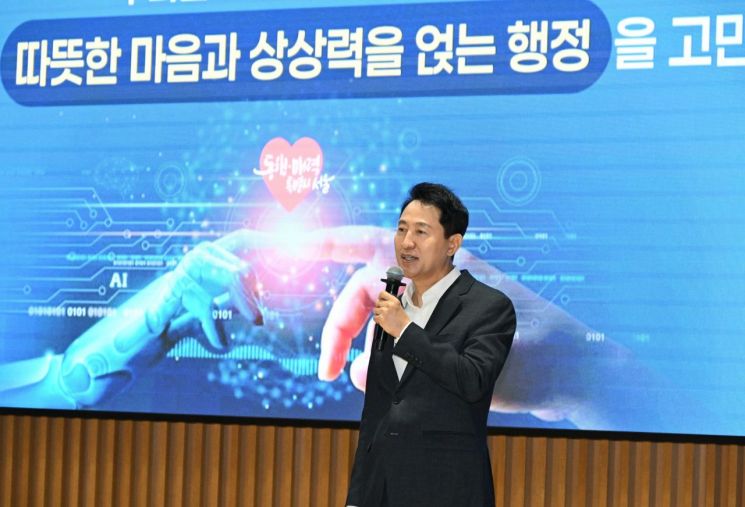
Previously, the Seoul Metropolitan Government collaborated with Celltrion in 2023 and with Daewon Pharmaceutical from 2024, discovering and nurturing a total of eight startups to date (two with Daewon Pharmaceutical and six with Celltrion). In particular, through the Seoul Bio Hub's open innovation program, participating companies have received customized support, while anchor companies such as Daewon Pharmaceutical and Celltrion have provided market validation and networking opportunities, driving the scaling up of startups. Open innovation is a win-win cooperation model in which large and mid-sized pharmaceutical companies develop or transfer bio technologies in partnership with startups.
Under this agreement, the Seoul Metropolitan Government and Daewon Pharmaceutical have selected two companies, Kitech Bio and Atomatrix, for this year's "Open Innovation 2nd Cohort."
Kitech Bio possesses a unique, original technology that represents a new paradigm, enabling drugs such as anticancer agents to bind to albumin. Atomatrix owns the world’s first commercialized platform for predicting pharmacological signals of membrane proteins, which increases the success rate of discovering initial candidate substances. It also has advanced artificial intelligence (AI)-based modeling technology for predicting the binding affinity of new drug candidates and drug targets. The Seoul Metropolitan Government and Celltrion have also selected four companies-Galux, MustBio, Therazine, and Portray-for this year's "Open Innovation 3rd Cohort."
Daewon Pharmaceutical and Celltrion will leverage their years of pharmaceutical development experience and industry insights to provide each startup with a tailored growth package over the next year. This includes joint research, technology advancement, investment linkage, and support for global expansion. Through a final evaluation, outstanding companies will be given additional opportunities for collaboration, such as joint research, investment, and the development of technologies or candidate substances.
The Seoul Metropolitan Government also plans to organically link its open innovation strategy with city-level policies to foster the bio industry. At the Seoul Bio Innovation Forum last March, Mayor Oh Sehoon emphasized, "The bio-medical industry, along with AI and semiconductors, will create Korea’s future," and added, "As the heart that will revive the economy, Seoul will boldly invest in and support the bio industry."
Joo Yongtae, Director General of Economic Policy at the Seoul Metropolitan Government, stated, "The open innovation program at Seoul Bio Hub is a model where large, mid-sized companies and startups co-exist and drive innovation together," and added, "We will actively support the selected promising bio companies in securing global competitiveness in partnership with leading domestic pharmaceutical firms Daewon Pharmaceutical and Celltrion."
Meanwhile, the Seoul Metropolitan Government launched the Hongneung Bio-Medical Cluster in 2017 and opened the Seoul Bio Hub Global Center in 2024. Looking ahead, it plans to establish a Digital Bio City in the Chang-dong and Sanggye areas and expand the "Seoul Bio Fund," which serves as the foundation for corporate research and development, to over 1 trillion won by 2026.
© The Asia Business Daily(www.asiae.co.kr). All rights reserved.

















