Porous MOF Achieves 268-Fold Improvement in Ortho-Xylene Separation
Reduces Energy Consumption and Simplifies Processes
Published in Angew. Chem. Int. Ed.
A porous material capable of separating the petrochemical feedstock 'xylene', used in plastic bottles, synthetic fibers, and air fresheners, at room temperature and with high purity, has been developed.
This advancement is expected to reduce both the energy consumption and costs associated with xylene purification.
The team of Professors Myungsoo Na and Seunggyu Min from the Department of Chemistry at UNIST, together with Professor Hyungpil Jeon's team from Hanyang University ERICA, announced on August 28 that they have developed a porous adsorbent material capable of separating xylene isomers at room temperature.
 Research team, (from left) Myungsoo Na, professor at UNIST; Hyungpil Jeon, professor at Hanyang University; Seunggyu Min, professor at UNIST; Sunghwan Lee, researcher; Amitosh Sharma, researcher; Jaehyuk Lee, researcher. Provided by UNIST
Xylene is a substance used in the production of water bottles, synthetic fibers, and air fresheners, and exists in three isomeric forms: ortho, meta, and para.
Isomers have the same constituent elements and number of atoms but differ in molecular structure, resulting in different uses. Ortho-xylene is used in the manufacture of pesticides and dye intermediates, while para-xylene serves as a raw material for water bottles and synthetic fibers. In actual petrochemical processes, these three isomers, along with a similar compound called ethylbenzene, are produced as a mixture of four components, necessitating additional high-temperature, high-pressure separation and purification processes.
The research team developed a porous MOF (metal-organic framework) capable of efficiently separating such mixtures even at room temperature. MOFs are materials composed of nanometer-scale pores formed by the connection of metal ions and organic molecules, and these pores can act as sieves to filter out isomer molecules.
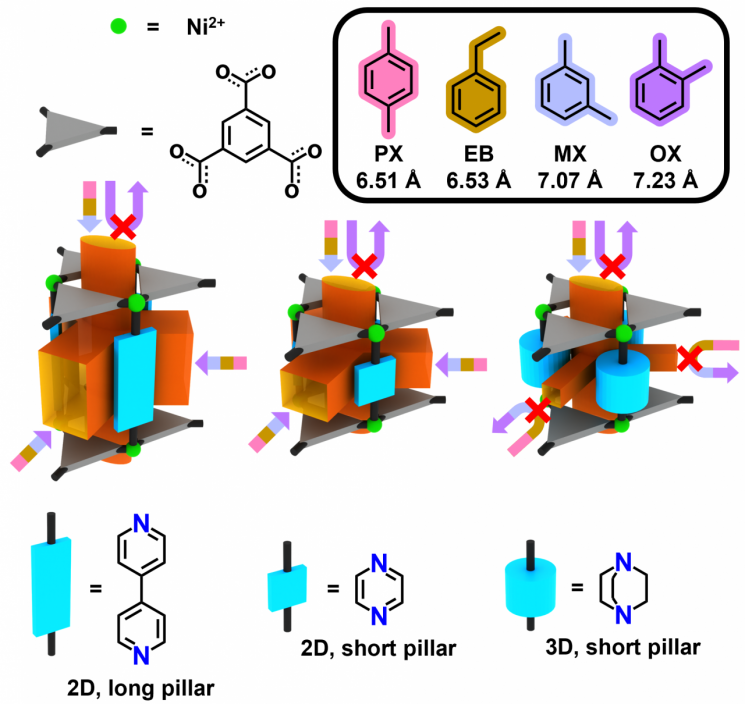
Unlike conventional MOFs, the newly developed MOF was designed with blocked side channels and only vertical channels open at the top and bottom. The framework consists of nickel (Ni) metal and an organic molecule called BTC, with large DABCO molecules added to block the side channels.
Because the side channels are blocked by the bulky DABCO molecules, only the vertical entrances are accessible to the isomers. As a result, the bent-shaped ortho-xylene is filtered out at the entrance, while the elongated para-xylene and ethylbenzene molecules can pass through the pores and be adsorbed inside.
This MOF achieved up to 268 times higher selectivity for ortho-xylene compared to conventional MOFs with open side channels. In addition, its structure and performance were maintained even after repeated reuse.
Professor Myungsoo Na explained, "The material we developed can spontaneously separate specific isomers even at room temperature and atmospheric pressure, overcoming the limitations of existing processes that rely on high temperature and high pressure. By reducing energy consumption and simplifying the process, this technology could lead to more eco-friendly and sustainable petrochemical separation methods."
This research was led by Sunghwan Lee, Amitosh Sharma, and Jaehyuk Lee of UNIST as first authors.
The results were published online on July 18 in Angewandte Chemie International Edition, a prestigious journal in the field of traditional chemistry, and have been selected as a cover article for the upcoming print edition.
The research was supported by the National Research Foundation of Korea under the Ministry of Science and ICT.
© The Asia Business Daily(www.asiae.co.kr). All rights reserved.
![Clutching a Stolen Dior Bag, Saying "I Hate Being Poor but Real"... The Grotesque Con of a "Human Knockoff" [Slate]](https://cwcontent.asiae.co.kr/asiaresize/183/2026021902243444107_1771435474.jpg)
















