People Power Party Walks Out in Protest Over Rejected Human Rights Commission Nominee
BDC Act and Osong Disaster Investigation Passed Under Democratic Party Leadership
On August 27, the National Assembly convened a plenary session to handle non-contentious bills. However, as all members of the People Power Party walked out in protest against the rejection of the proposal to appoint a National Human Rights Commission member allocated to the opposition, most bills were passed under the leadership of the Democratic Party.
During the session, proposals to appoint Lee Sanghyun, a professor at Soongsil University’s Department of International Legal Affairs, as a standing member, and Woo Insik, a lawyer at Healim Law Office, as a non-standing member, were put to a vote but both were rejected. Out of 270 members present, the proposal for Lee Sanghyun received 99 votes in favor, 168 against, and 3 abstentions. The proposal for Woo Insik received 99 votes in favor, 166 against, and 5 abstentions. Although the Democratic Party, which holds the majority, initially planned to allow a free vote, it effectively expressed its opposition after a party meeting.
Kim Byunggi, floor leader of the Democratic Party, stated at a party meeting prior to the plenary session, "The purpose of establishing the Human Rights Commission is to protect basic human rights and establish democratic order. I believe members should fit this purpose." He added, "At the very least, those who uphold the Constitution and democratic order should be appointed. If someone who defends insurrection is nominated, regardless of how many times they are recommended, we must carefully and seriously consider whether to approve or reject them."
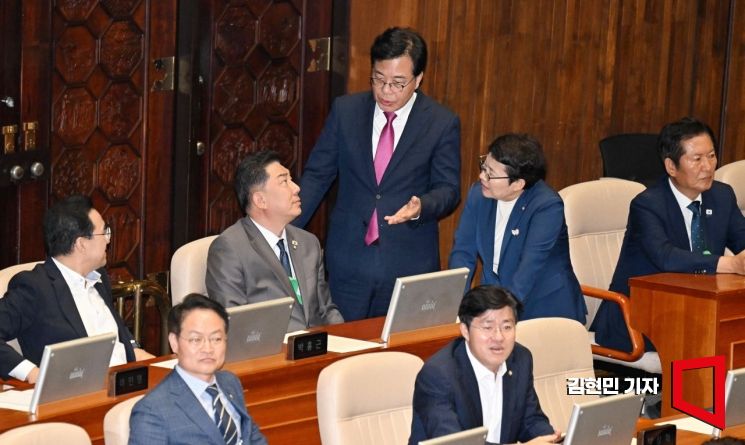 On the 27th, after the proposal to appoint National Human Rights Commission members (Sanghyun Lee, Insik Woo) was rejected in the National Assembly plenary session, Song Eonseok, floor leader of the People Power Party, and Imaja, a party member, protested to Kim Byunggi, floor leader of the Democratic Party. 2025.8.27 Photo by Kim Hyunmin
After the proposals were rejected, Yoo Sangbeom, deputy floor leader of the People Power Party, requested to speak and criticized, "The Democratic Party is conducting ideological censorship simply because the nominees do not align with their views, slandering and distorting the individuals without even knowing their actual lives." He continued, "If the Democratic Party does not agree, does that mean nothing can be done, even though the National Assembly Act rightfully recognizes each party's right to recommend nominees?" Yoo further pointed out, "While bills can be decided by majority vote, the right to recommend nominees being given to parties acknowledges party politics. The National Assembly has demonstrated that there is no longer an opposition party."
In response, Seo Mihwa, a Democratic Party lawmaker, stated, "I could no longer stand by as the People Power Party continued to recommend anti-human rights figures as Human Rights Commission members." She criticized, "They have nominated individuals who are unfit to wear the mantle of human rights for the National Human Rights Commission." Seo added, "The right to recommend nominees does not mean recommending anti-human rights figures. Whenever the People Power Party nominates such individuals, I will continue to voice my opposition."
After the People Power Party lawmakers walked out in protest, the remaining bills were processed without proposal explanations or related remarks, as the People Power Party lawmakers who were scheduled to present them had already left the chamber.
Non-contentious bills ultimately passed under the Democratic Party's leadership without the People Power Party
During the plenary session, the "Capital Markets and Financial Investment Services Act," which introduces the Business Development Company (BDC) system to focus investment on venture and innovative companies, was passed. A BDC is a collective investment vehicle (fund) that raises investor capital through an initial public offering (IPO) and lists on the stock market. More than 50 percent of its assets must be invested in ventures and unlisted companies. The "Act on Honoring and Supporting Veterans and Establishing Related Organizations," which provides a legal basis for granting living support payments to the spouses of deceased veterans, was also passed.
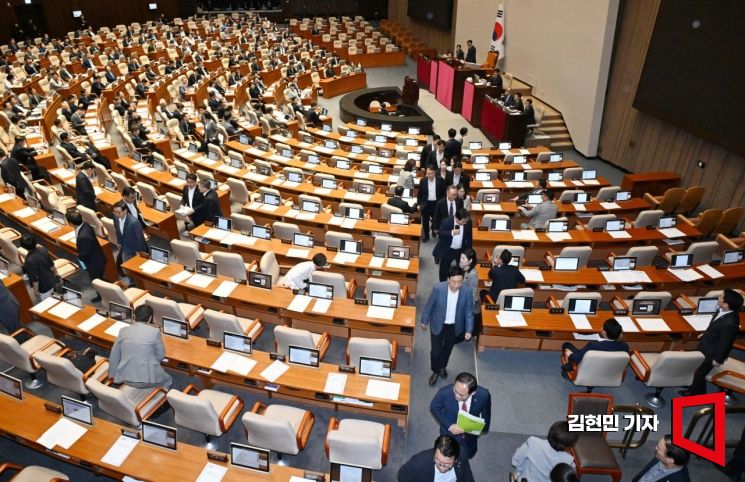 On the 27th, in the National Assembly plenary session, as the nomination for National Human Rights Commission member (Sanghyun Lee) and National Human Rights Commission member (Insik Woo) was rejected, People Power Party lawmakers protested and walked out. 2025.8.27 Photo by Hyunmin Kim
The plenary session also passed the revision of the Korea Development Bank Act, which raises the statutory capital ceiling of the Korea Development Bank to 45 trillion won and establishes a strategic industry fund for efficient financial support to advanced strategic industry companies. In addition, the amendment to the Elementary and Secondary Education Act was passed, providing grounds for restricting the use and possession of smart devices such as mobile phones during class, to protect students' right to learn and support teachers' educational activities. Notably, this law passed with 115 votes in favor, 31 against, and 17 abstentions, drawing attention as there were dissenting votes even within the ruling party.
Out of 163 members present, 161 voted in favor and 2 abstained in adopting the national investigation plan for the Osong underpass disaster. With the adoption of this plan, the National Assembly will proceed to investigate the causes and assign responsibility for the Osong underpass disaster, in which, on July 15 last year, a temporary embankment on the Mihocheon River collapsed due to heavy rain, flooding the Gungpyeong 2 underpass and resulting in 14 deaths and 16 injuries as people trapped in vehicles could not escape.
National Assembly Speaker Woo Wonsik stated, "It has taken 774 days since the disaster for the desperate pleas of the bereaved families to finally be addressed in the National Assembly." He continued, "I hope that uncovering the causes and responsibilities of the disaster will be the starting point for healing the ongoing pain of the bereaved families and survivors, and for building a safer society."
© The Asia Business Daily(www.asiae.co.kr). All rights reserved.


















