Korea Hosts the Meeting for the First Time in 20 Years
Representatives from 21 Member Economies Gather
Discussions Focus on Stable Electricity Supply and More
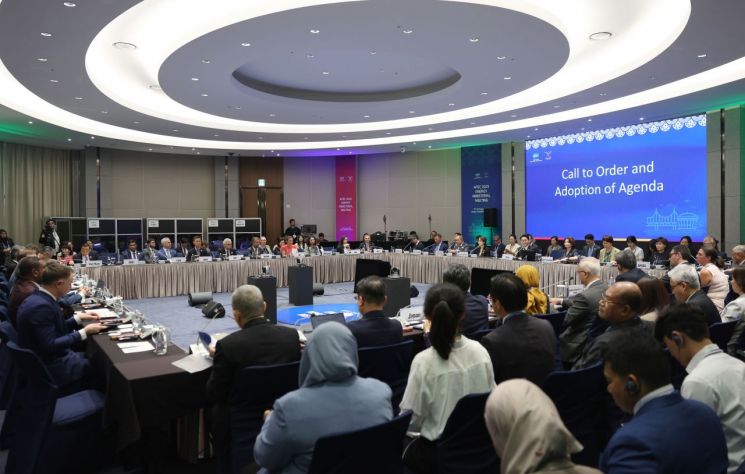 On the 27th, the opening ceremony of the Asia-Pacific Economic Cooperation (APEC) Energy Ministers' Meeting was held at the Nurimaru APEC House in Busan, attended by 21 APEC member economies, international organizations, and global companies. From the Korean side, Lee Hohyun, the 2nd Vice Minister of the Ministry of Trade, Industry and Energy, attended and declared the opening. Ministry of Trade, Industry and Energy
High-level officials, including Energy Ministers from the Asia-Pacific Economic Cooperation (APEC), have gathered in Busan. This meeting, attended by representatives from 21 member economies, began with the opening ceremony at the Nurimaru APEC House on the 27th and continues with themed sessions and the closing ceremony at the Paradise Hotel on the 28th. This is the first time in 20 years that Korea has hosted this meeting, following the 7th Energy Ministers' Meeting held in Gyeongju in 2005.
APEC, launched in 1989, is the world's largest regional economic cooperation body, accounting for 37% of the global population, 61% of global GDP, and 49% of global trade volume. It is also a key player in the global energy market, responsible for 56% of the world’s energy demand, 58% of energy supply, and 68% of electricity generation. APEC accounts for 74.7% of Korea’s exports and 67.5% of its imports. APEC refers to its members as economies, not countries.
The Energy Ministers' Meeting is one of APEC’s major ministerial gatherings, having discussed core agendas such as regional energy security, efficiency improvements, and the expansion of renewable energy. At this meeting, member economies will once again share their policies and experiences and explore directions for cooperation.
This year’s meeting centers on three main agendas: expanding stable power supply, strengthening power grid security and reliability, and driving energy innovation based on artificial intelligence (AI).
In the APEC region, the acceleration of electrification and the growth of AI data centers have made securing stable power supply more urgent. The meeting will discuss ways to build stable and innovative power systems through diversification of power sources, establishment of predictable regulations, and expansion of public-private investment.
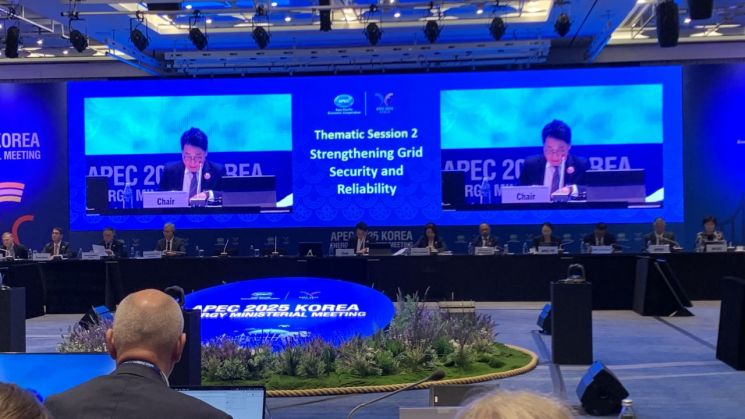
Alongside this, there is a growing need to strengthen existing power grids by expanding renewable energy and integrating diverse power sources. In response, the economies will share strategies such as expanding and modernizing transmission networks, deploying energy storage systems (ESS), implementing smart distribution grids, and establishing cross-border power interconnections to enhance grid stability.
AI opens new possibilities for predictive analytics, demand management, and efficiency, but at the same time, the proliferation of data centers increases power demand. This meeting will discuss responsible and reliable use of AI, share successful case studies, and explore ways to bridge the gap by supporting developing economies.
This meeting goes beyond simple policy exchange, serving as a platform to discuss both current issues such as energy security and power grid reinforcement, and future agendas like AI utilization, thus connecting the present and future of energy cooperation within APEC.
As the chair economy, Korea is expected to lead regional discussions and drive the establishment of a stable and innovative energy ecosystem through cooperation in the power grid, AI, and power generation sectors.
© The Asia Business Daily(www.asiae.co.kr). All rights reserved.
![Clutching a Stolen Dior Bag, Saying "I Hate Being Poor but Real"... The Grotesque Con of a "Human Knockoff" [Slate]](https://cwcontent.asiae.co.kr/asiaresize/183/2026021902243444107_1771435474.jpg)
















