Don Beyer, Chris Dodd, and 15 Other U.S. Leaders Attend
President Lee: "We Will Contribute More as a Member of the International Community"
Attendees Praise Successful Resumption of Summit Diplomacy After Hiatus
On the 25th (local time), President Lee Jaemyung stated, "The South Korea-U.S. alliance has been the foundation of our diplomatic policy for the past 70 years," and added, "Going forward, we will continue to develop the alliance into a 'future-oriented comprehensive strategic alliance' that adapts to changes in the global environment, based on national interests and practical benefits."
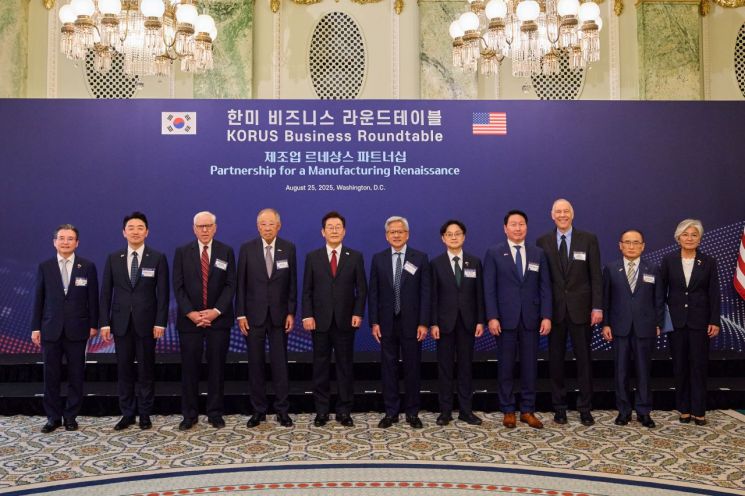
On this day, President Lee made these remarks during a dinner meeting with key U.S. opinion leaders in the fields of diplomacy, security, and trade-including current and former lawmakers, former defense secretaries, national security advisors, intelligence chiefs, and trade representatives-following his public policy address at the Center for Strategic and International Studies (CSIS). During the dinner, President Lee engaged in in-depth discussions on strengthening the South Korea-U.S. alliance, South Korea-Japan relations, North Korea issues, and the international situation.
President Lee also stated that the Republic of Korea, which has grown with the support of the South Korea-U.S. alliance and the international community, seeks to make greater contributions and play a larger role as a member of the global community. In particular, he noted, "The mutual support of the peoples of both countries, who share values such as democracy and human rights, has been the driving force sustaining the alliance regardless of changes in government." He emphasized the importance of strengthening people-to-people exchanges between the two countries and called on U.S. opinion leaders to actively contribute to these efforts.
Participants remarked that President Lee's visit to the United States not only demonstrated the resilience of Korean democracy but also marked the successful resumption of summit diplomacy, which had been on hold for some time. They expressed expectations that, based on the close bonds and trust between the leaders of both countries, the South Korea-U.S. alliance would continue to advance. Participants also noted the high potential for cooperation between South Korea and the United States in the shipbuilding sector and emphasized the importance of bilateral collaboration in responding to supply chain crises.
Participants further praised President Lee's commitment to improving South Korea-Japan relations and trilateral cooperation among South Korea, the United States, and Japan, as demonstrated by his prior visit to Japan for a summit with Prime Minister Shigeru Ishiba before arriving in the United States. They added that the South Korean government's efforts to strengthen cooperation with allied and partner countries based on the alliance could serve as a model for other U.S. allies and partners.
Additionally, President Lee introduced the South Korean government's efforts to ease tensions and restore trust for peace and stability on the Korean Peninsula, while emphasizing that close South Korea-U.S. cooperation would continue to generate momentum toward the denuclearization of the peninsula. President Lee and the participants also had candid discussions about the changing international order, regional and global affairs, and agreed to work together to further strengthen communication across all sectors, building on the recent increase in people-to-people and cultural exchanges and the growing closeness between the peoples of both countries.
Meanwhile, 17 U.S. participants attended the dinner meeting, including: Representative Don Beyer; former Senator Chris Dodd; former Senator Rob Portman; former Secretary of Defense William Cohen; former Secretary of Defense Chuck Hagel; former World Bank President Robert Zoellick; former U.S. Trade Representative Carla Hills; former Director of National Intelligence James Clapper; former National Security Advisor James Jones; former Deputy Secretary of State Kurt Campbell; former U.S. Ambassador to South Korea Kathleen Stephens; former U.S. Ambassador to South Korea Mark Lippert; former U.S. Ambassador to South Korea Sung Kim; former Commander of U.S. Forces Korea Walter Sharp; former Commander of U.S. Forces Korea Curtis Scaparrotti; CSIS President John Hamre; and Victor Cha, Korea Chair at CSIS.
© The Asia Business Daily(www.asiae.co.kr). All rights reserved.
![Clutching a Stolen Dior Bag, Saying "I Hate Being Poor but Real"... The Grotesque Con of a "Human Knockoff" [Slate]](https://cwcontent.asiae.co.kr/asiaresize/183/2026021902243444107_1771435474.jpg)















