A Mayor Who Runs to the Scene from Day One
Resolving Long-Standing Key Projects One by One
“My Principle for Communicating with Residents Is ‘Immediate Response’”
A civil complaint that had been unresolved for over a decade. Parents’ cries and pleas poured in, but there was no sign of a solution. In the summer three years ago, right after taking office, Oh Eunseok, the mayor of Dobong District in Seoul (54), immediately visited the “Chang 4-dong daycare center.”
Mayor Oh described the area in front of the daycare at the time as “an accident waiting to happen.” He explained, “There was an entrance to the Coupang logistics center right in front of the Chang 4-dong daycare center, with hundreds of trucks coming and going every day, yet there was not even a crosswalk or a traffic light.” He added, “Immediately after taking office, I visited the site and began discussions with the police, the Seoul Northern Road Management Office, and the logistics company.”
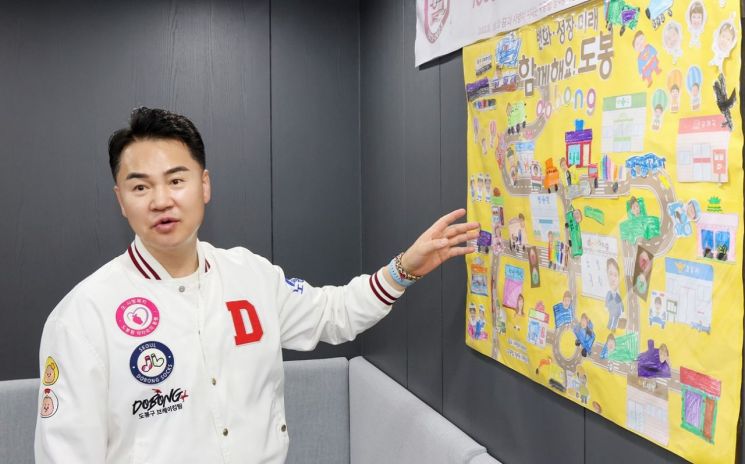 Oh Eunseok, the mayor of Dobong District, is explaining the drawing board hanging at the entrance of the mayor's office. The drawing board contains handwritten messages and thank-you notes from the children of Chang 4-dong daycare center. Provided by Dobong District.
The situation was so serious that one angry parent asked, “Will you only come to your senses if a child dies?” It was sheer luck that a major accident had not occurred. However, for over ten years, nothing had been resolved until he visited the site.
Once the mayor stepped in, the issues began to be resolved one by one. The entrance for trucks at the logistics center was relocated to the opposite side, away from the daycare entrance. The old wall was replaced, and a traffic light was installed. When Mayor Oh met with a reporter for an interview on the 21st, he explained these past events when asked about the drawing board hanging in front of his office.
He said, “My first action after taking office was to address children’s safety, and it is one of the most meaningful achievements. The plaques of appreciation, superhero drawings, and handwritten letters from the children give me great strength.”
Within the Changdong Donga Cheongsol Apartment complex, home to about 5,000 residents, the fastest route to Exit 1 of Changdong Station on Line 4 had been blocked by a wall and flowerbed for 25 years. Mayor Oh worked with the Seoul Metropolitan Government to open up this city-owned land and create a new path. This was accomplished just five months after he took office.
He also recalls tearing down and replacing a 30-year-old soundproof wall next to the railway, which not only failed to reduce noise but also scattered asbestos dust, threatening residents’ health. This issue had lingered for over a decade, with the district office, LH Corporation, and the Korea Rail Network Authority all shifting responsibility. The problem was both financial and a matter of will. After resolving the jurisdictional issues, he went further by widening the path and creating green space (the Gyeongwon Line Soundproof Wall Green Park Project), as well as building a walking trail.
As he resolved these long-standing civil complaints one after another, he earned nicknames such as “the Fixer,” “Dobong’s Mr. Oh,” and “the Salesman.” These nicknames reflect his meticulous and thorough drive, as well as his unique affability, sociability, and positive energy.
Mayor Oh shared some of his personal communication strategies. “When negotiating with related agencies such as the Seoul Metropolitan Government, the Ministry of Land, Infrastructure and Transport, or the Ministry of Environment, I don’t just send documents-I visit in person to deliver the voices of residents and vividly explain the needs on site. I prove the necessity of the project with on-site data and figures, and I show how it fits into the government’s or Seoul’s mid- to long-term plans. This is my sales strategy. It’s how I turn policy from a report on a desk into reality.”
He also said, “Who would want to meet with a district mayor?” and added, “I mobilize every connection I have to meet key officials or agency heads.” He follows up until results are achieved. This principle applies equally to communication with residents.
Mayor Oh summed up his principle for communicating with residents as “immediate response.” He said, “If someone files a complaint and doesn’t get a reply for weeks, distrust builds up. It’s best if the problem is solved, but even if it isn’t, I make sure to clearly explain the reason. Residents trust you just for responding quickly.”
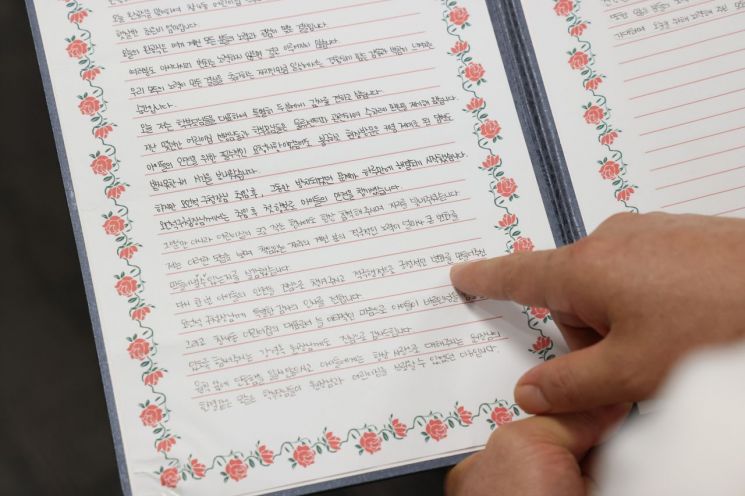 Oh Eonseok, mayor of Dobong District, said, "The plaques of appreciation and handwritten letters sent by residents give me greater strength than anything else." Mayor Oh is explaining the contents of a handwritten letter he received from a parent. Provided by Dobong District.
The same approach was behind the special promotions and rapid advancement of civil servants that caused a stir in the local government sector, as well as the decision to appoint women to 80% of senior positions at the director and department head level during regular personnel changes. On boldly implementing a system that was rarely used, he said, “What matters is empowering and rewarding capable and passionate employees.”
He also described himself as “lucky.” Dobong District’s long-awaited “Ui-Banghak Light Rail Extension” passed the Ministry of Economy and Finance’s total project cost review last year and received approval for the basic plan from the Ministry of Land, Infrastructure and Transport. The “Changdong Private Station Construction,” which had been stalled for over a decade, has also resumed and is nearing completion. Major projects that will shape Dobong’s future-all during his term-include the groundbreaking of “Seoul Arena” on a 50,000-square-meter site near Changdong Station, where the GTX-C line will be built; the “Dobong Hanok Village Project” on the former chemical unit site in Dobong-dong (35,859 square meters); the “Dobongsan Tourism Town Project”; the “Camping Arboretum Project”; and Dobong’s selection as a “Seoul New Growth Hub Project.”
Mayor Oh said, “Dobong District, which was unable to develop properly due to multiple layers of regulation, has now gained wings thanks to deregulation.” He continued, “With the easing of height restrictions on Bukhansan Mountain and the results of our efforts to relax regulations in quasi-industrial areas, the floor area ratio has increased significantly, making reconstruction and redevelopment projects much more active.” He explained, “I proposed to Mayor Oh Sehoon of Seoul that the mandatory park and green space ratio for housing complex redevelopment projects of more than 1,000 units be relaxed, and the city improved the regulations. As a result, not only Dobong District but all redevelopment complexes in Seoul have become more commercially viable.”
Before this regulation was improved, even if there was a park adjacent to or within a redevelopment complex, an additional park had to be donated to the city if more than 1,000 units were built. This rigid system held back redevelopment. However, with the recent changes, the park next to Banghak Shindonga 1st Apartment, which is currently undergoing redevelopment, is now recognized as part of the mandatory green space. The project will now be built up to 49 stories with 4,065 units, greatly improving its commercial viability.
Mayor Oh emphasized, “Dobong, which had been stagnant for a long time, has begun a major transformation over the past three years and is now on a growth trajectory. The remaining year of my term will be a period of full-scale preparation for Dobong’s future.” He identified further relaxation of military facility installation requirements on the top floors of apartment complexes, extension of the SRT line to Changdong Station, undergrounding of the Gyeongwon Line, and the development of the Jungnangcheon Riverside Vitality Hub as key tasks for the future-not only for Dobong District but for the entire northern region of Seoul.
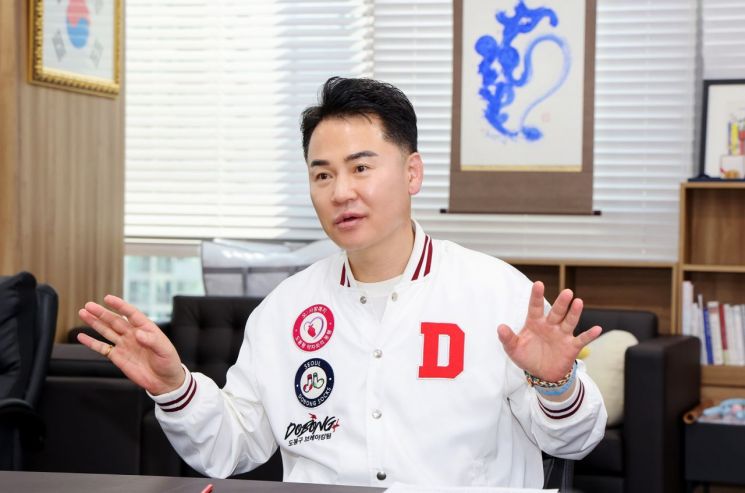 District Mayor Oh Eonseok said, "Dobong, which had been stagnant for a long time, has started a great transformation over the past three years and has entered a growth trajectory." Provided by Dobong District.
© The Asia Business Daily(www.asiae.co.kr). All rights reserved.
![Clutching a Stolen Dior Bag, Saying "I Hate Being Poor but Real"... The Grotesque Con of a "Human Knockoff" [Slate]](https://cwcontent.asiae.co.kr/asiaresize/183/2026021902243444107_1771435474.jpg)

















