Medical Radiation Examinations and Exposure Continue to Rise, Says KDCA
CT Scans Account for Only 3.8% of Tests,
But Make Up 67% of Total Radiation Exposure
Last year, it was found that Koreans underwent an average of eight medical radiation examinations per person, such as X-ray or computed tomography (CT) scans. In recent years, both the number of medical radiation examinations and the radiation exposure dose among the population have been steadily increasing. Since an increase in radiation exposure is generally associated with a higher risk of developing cancer, experts emphasize that medical radiation examinations should only be performed when absolutely necessary.
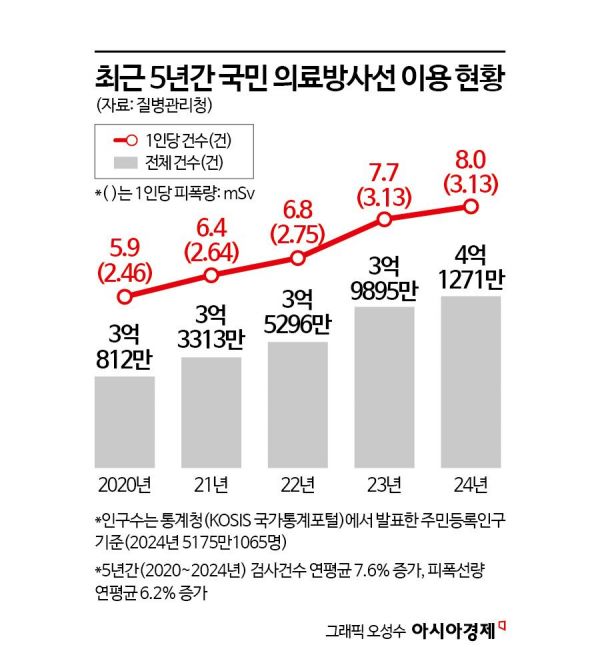
According to the "2024 National Status of Medical Radiation Utilization" released by the Korea Disease Control and Prevention Agency (KDCA) on August 26, 2025, Koreans underwent a total of approximately 412.7 million medical radiation examinations last year for disease diagnosis or health checkups. This amounts to an average of 8.0 examinations per person.
As a result, the total medical radiation exposure dose received by Koreans over the course of one year was calculated at 162,090 man·Sv (man-sievert), with the average exposure per person being 3.13 mSv (millisievert).
From 2020 to the most recent five years, both the number of medical radiation examinations and the exposure dose among Koreans have shown a steady increase. The number of examinations rose by an annual average of 7.6%, while the exposure dose increased by 6.2% per year. However, when looking at only last year, the rate of increase slowed compared to 2023; the number of examinations increased by 3.5%, but the exposure dose remained at a similar level.
In 2024, by type of medical radiation examination, general radiography accounted for 321 million cases (6.2 per person), representing 77.9% of the total. This was followed by dental radiography at 12.1%, mammography at 4.5%, and CT scans at 3.8%. In terms of exposure dose, CT scans accounted for 108,552 man·Sv (2.1 mSv per person), making up 67.0% of the total, followed by general radiography at 27.5%, angiography at 2.1%, and fluoroscopy at 1.6%.
Although CT scans accounted for only 3.8% of all examinations, they were responsible for 67.0% of the total exposure dose, indicating that CT scans have the highest radiation exposure per examination among imaging tests.
This report on the national status of medical radiation utilization was compiled by collecting the actual number of medical radiation examinations performed by the public from the Health Insurance Review and Assessment Service and the National Health Insurance Service, and applying the exposure dose (effective dose) information by examination type held by the KDCA.
Im Seungkwan, Commissioner of the KDCA, stated, "In general, as radiation exposure increases, the risk of developing cancer also rises. Therefore, medical radiation examinations should only be performed when the health benefits are significant, in order to prevent unnecessary radiation exposure." He added, "The KDCA will continue to make efforts to ensure the safe and appropriate use of medical radiation by providing medical professionals with the 'Guidelines for Justification of Medical Imaging Diagnosis' and 'Diagnostic Reference Levels' for imaging examinations."
© The Asia Business Daily(www.asiae.co.kr). All rights reserved.
![Clutching a Stolen Dior Bag, Saying "I Hate Being Poor but Real"... The Grotesque Con of a "Human Knockoff" [Slate]](https://cwcontent.asiae.co.kr/asiaresize/183/2026021902243444107_1771435474.jpg)
















