Trump's Remarks Likely Aimed at Future Defense Cost-Sharing Negotiations
Expansionist Rhetoric Seen as Strategic Leverage
Ownership Demands Raise Concerns Over U.S.-South Korea Alliance
On August 25 (local time), U.S. President Donald Trump mentioned during a summit with President Lee Jaemyung in Washington, D.C., that he could demand ownership of U.S. military bases in South Korea. This statement has drawn significant attention regarding its background and feasibility. Analysts interpret this as a strategic move in light of the United States' new expansionism, domestic public opinion, and calls for increased defense cost-sharing.
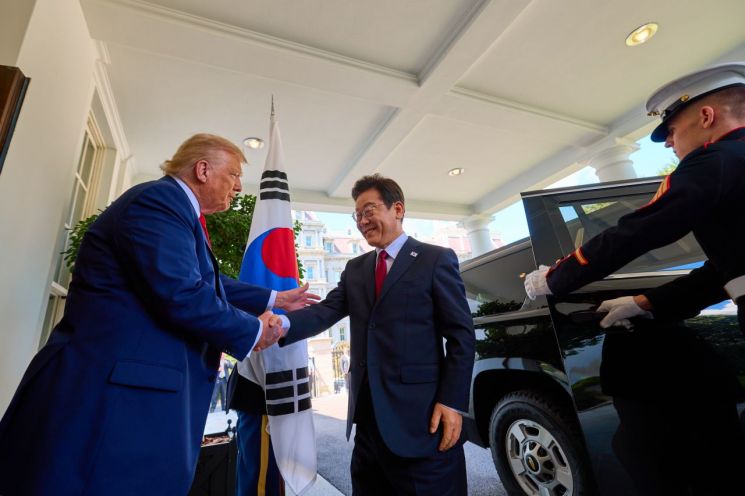
President Trump stated, "We spent an enormous amount of money building (U.S. military) bases, and while South Korea contributed, I want that (ownership of the base land). I want to see if we can eliminate the lease agreement and secure ownership of the land where we have these massive military bases."
Article 4 of the ROK-U.S. Mutual Defense Treaty and Article 2 of the Status of Forces Agreement (SOFA) stipulate that the land for U.S. military bases in South Korea must eventually be returned to South Korea. President Trump's claim not only undermines the fundamental agreements between the two countries but could also deal a significant blow to the U.S.-South Korea alliance. Nevertheless, his demand for ownership of the bases is interpreted as part of an expansionist agenda.
Since returning to office in January, President Trump has repeatedly demonstrated expansionist ambitions. He has expressed intentions to secure ownership or control over Greenland and the Panama Canal, and has even stated his desire to annex Canada as the 51st state of the United States. In February, he sparked major controversy by declaring that the United States would "own" the Gaza Strip, where Israel and Hamas are at war, and by outlining a U.S.-led development plan for the region. Regardless of feasibility, President Trump's expansionist rhetoric is seen as an effort to satisfy his domestic supporters. In fact, he has signed a "mineral agreement" with Ukraine, which has received U.S. military support, thereby securing rights related to the development of rare earth elements and other minerals.
This could also serve as leverage in negotiations over defense cost-sharing. With the Pentagon still reviewing global troop deployments and defense strategy, President Trump may use this as a means to push for higher defense contributions. His response to questions about reducing U.S. forces in South Korea-citing U.S.-South Korea friendship and saying, "I don't want to talk about it now"-should also be understood in this context.
Jung Sungjang, Deputy Director of the Sejong Institute, commented, "President Trump's remarks are part of his expansionist agenda and are not feasible in reality, but they could be used as a bargaining chip in future defense cost-sharing negotiations."
© The Asia Business Daily(www.asiae.co.kr). All rights reserved.
![Clutching a Stolen Dior Bag, Saying "I Hate Being Poor but Real"... The Grotesque Con of a "Human Knockoff" [Slate]](https://cwcontent.asiae.co.kr/asiaresize/183/2026021902243444107_1771435474.jpg)















