Hyundai Motor Group to Invest $26 Billion Over Four Years
$5 Billion Increase from March Announcement
New Robot Factory Planned; Joint Investment Under Review
Strengthening Competitiveness in the U.S. Robotics Market
Hyundai Motor Group will invest $5 billion (7 trillion won) in the United States to establish a robot factory with an annual capacity of 30,000 units. Including this, the group plans to invest a total of $26 billion over the next four years. This is $5 billion more than the $21 billion investment announced in March. The strategy is to secure a competitive edge in the growing robotics market by establishing a robot factory locally in the U.S. Notably, Hyundai Motor Group plans to deploy Boston Dynamics robots at its U.S. automobile production plants starting at the end of this year, and the use of robots is expected to increase further.
The core of Hyundai Motor Group’s "upgraded" investment plan in the U.S., announced on the 26th, is the establishment of a new robot factory. The company plans to locally produce 30,000 robots annually. It is expected that investment partners will participate jointly in the factory’s construction. The new factory is expected to produce Boston Dynamics’ flagship robots such as Atlas, Spot, and Stretch, but specific details regarding the timing and location of the factory have not yet been disclosed.
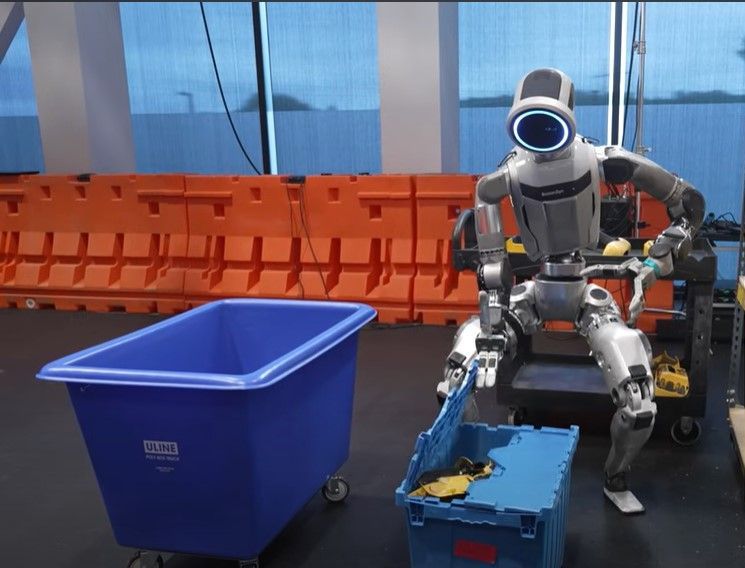 A humanoid robot Atlas developed by Boston Dynamics, a subsidiary of Hyundai Motor Group, performing tasks. Provided by Boston Dynamics
Previously, Chairman Chung Euisun of Hyundai Motor Group presented a vision to allocate the group’s future revenue as follows: 50% from automobiles, 30% from urban air mobility (UAM), and 20% from robotics. In line with this vision, Hyundai Motor Group acquired U.S. robotics company Boston Dynamics in 2021 and has since fully entered the robotics business.
The establishment of Hyundai Motor Group’s robot factory is seen as a proactive move to respond to anticipated demand for robots in the U.S. Since the launch of the Donald Trump administration, there has been a push for the revival of manufacturing, and considering the high labor costs, it is expected that the proportion of robots used in production processes will increase significantly. Industry insiders view Hyundai’s planned 30,000-unit factory as a realistic figure, taking into account the initial mass production scale. In comparison, competitor Tesla is targeting production of 50,000 units of its humanoid robot by 2026.
This also aligns with Hyundai Motor Group’s strategy to expand automobile production in the U.S. Last year, Hyundai announced plans to increase its annual U.S. automobile production capacity from 700,000 to 1.2 million units. The strategy is to aggressively expand its market share in the U.S. by producing a diverse lineup of vehicles, including electric vehicles, hybrids, and internal combustion engine vehicles. With continued investments, production capacity is expected to gradually increase. At the end of this year, Hyundai will deploy Boston Dynamics robots at its production sites. Hyundai Motor Group is also proceeding as planned with the construction of an electric arc furnace steel mill in Louisiana with a capacity of 2.7 million tons. The group aims to maximize manufacturing artificial intelligence (AI) capabilities in the U.S. through the use of robots.
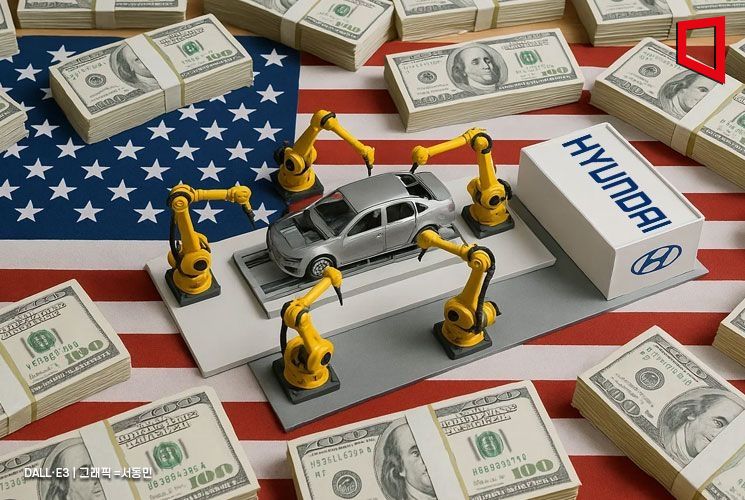
Parts and logistics affiliates such as Hyundai Mobis and Hyundai Glovis will also expand their facilities to increase the localization rate of parts. Efforts will be made to locally procure key electric vehicle components such as battery packs, thereby strengthening the supply chain between automakers and parts suppliers. With expanded local production capacity and a strengthened parts supply chain, Hyundai Motor Group will also be able to mitigate tariff risks.
Hyundai Motor Group will expand cooperation with leading U.S. companies in future technologies such as robotics, autonomous driving, artificial intelligence, and software-defined vehicles (SDVs). The group plans to accelerate the commercialization of its U.S. subsidiaries, including Boston Dynamics and Motional. A Hyundai Motor Group official stated, "Through this investment, we will respond to U.S. government policies, expand business opportunities in various fields, and strengthen our competitiveness in future businesses, including mobility. We expect economic cooperation between Korea and the U.S. to expand and economic revitalization in both countries to be promoted."
Hyundai Motor Group is also making large-scale investments in Korea to create a mobility innovation hub. This year, the group will invest a record 24.3 trillion won, an increase of more than 19% compared to 20.4 trillion won in 2024. This includes 11.5 trillion won for research and development (R&D), 12 trillion won for routine investments, and 800 billion won for strategic investments.

© The Asia Business Daily(www.asiae.co.kr). All rights reserved.
![Clutching a Stolen Dior Bag, Saying "I Hate Being Poor but Real"... The Grotesque Con of a "Human Knockoff" [Slate]](https://cwcontent.asiae.co.kr/asiaresize/183/2026021902243444107_1771435474.jpg)

















