HD Hyundai Signs Joint Investment MOU
Contributing to US Advanced Shipbuilding Technology Development
Samsung Heavy Industries Joins US Navy MRO Project
Aiming to Expand Participation in US Commercial Shipbuilding
Encouraging Progress
With President Lee Jaemyung's visit to the United States, the "MASGA Project," which aims to revitalize the American shipbuilding industry, has officially begun. HD Hyundai signed a Memorandum of Understanding (MOU) to establish a Korea-US shipbuilding industry joint investment program, while Samsung Heavy Industries announced its participation in the US Navy support ship maintenance, repair, and overhaul (MRO) business. Significant US-bound investments were also made in the aviation and strategic minerals sectors, bringing the total US investment announced during this summit to 150 billion dollars.
Ryu Jin, Chairman of the Federation of Korean Industries, stated during his opening remarks at the "Korea-US Business Roundtable" held at the Willard Hotel in Washington, D.C. on the 25th (local time), "Korean companies are planning large-scale US investments totaling 150 billion dollars," adding, "These investments aim to drive both the US and global markets forward, ushering in a new era of manufacturing renaissance."
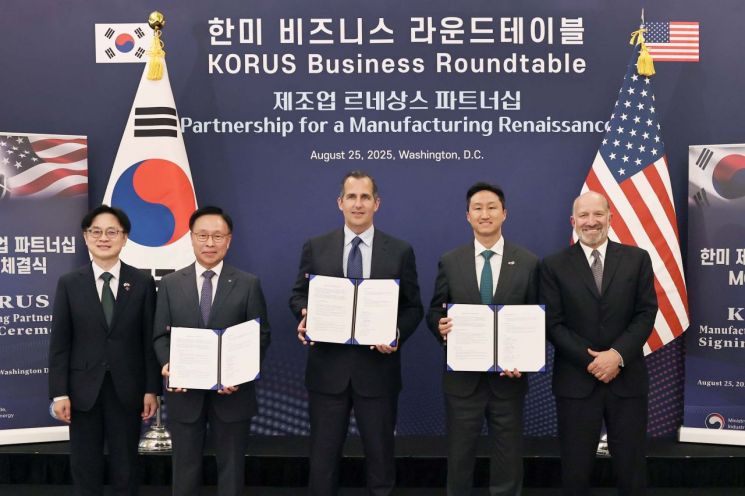 HD Hyundai signed a Memorandum of Understanding (MOU) for the establishment of the Korea-US shipbuilding industry joint investment program on the 25th (local time) at the Willard InterContinental Hotel in Washington DC, USA. From left to right in the photo: Jung Kwan Kim, Minister of Trade, Industry and Energy; Bokgyu Kim, Senior Vice President of Korea Development Bank; Frank Bruno, CEO of Cerberus Capital; Kiseon Jung, Senior Vice Chairman of HD Hyundai; Howard Lutnick, US Secretary of Commerce. Photo by HD Hyundai
HD Hyundai and Samsung Accelerate MASGA Investments
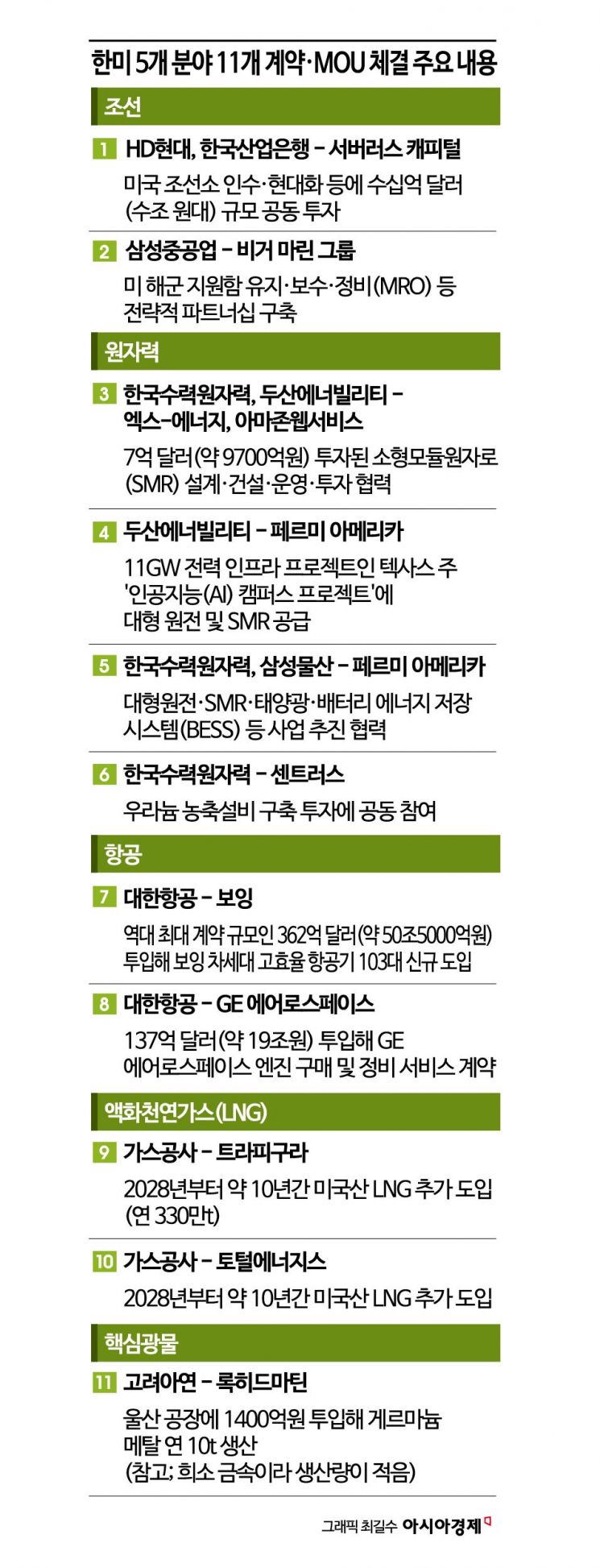
The most attention-grabbing announcement among the investments revealed that day was the MASGA Project. HD Hyundai, together with Cerberus Capital and Korea Development Bank, signed an MOU to establish a Korea-US shipbuilding industry joint investment program. This program encompasses the acquisition and modernization of US shipyards, investment in equipment manufacturers, and the development of advanced shipbuilding technologies based on autonomous navigation and artificial intelligence (AI). Kiseon Jung, Senior Vice Chairman of HD Hyundai, stated, "By joining the MASGA Project to rebuild the US shipbuilding industry, we aim to open new markets and help reshape the global shipbuilding landscape."
Industry experts describe this as a "signal flare" marking the practical implementation of the MASGA Project. Since the beginning of this year, HD Hyundai has taken a series of steps, including signing a defense cooperation MOU with Huntington Ingalls in the US, collaborating with Edison Chouest Offshore on commercial vessels, and securing an MRO contract for US Navy supply ships. The establishment of this fund is seen as a symbolic agreement institutionalizing these efforts.
On the same day, Samsung Heavy Industries also formed a strategic partnership with US-based Vigor Marine Group and announced its participation in the Navy support ship MRO business. Vigor Marine is an MRO specialist with Navy-certified shipyards and processing plants in four US states. Samsung Heavy Industries plans to provide its shipbuilding and marine engineering expertise and operational know-how, with the goal of expanding the partnership to include joint construction of commercial and specialized vessels based on performance. Choi Sungahn, CEO of Samsung Heavy Industries, stated, "We will use MRO cooperation as a stepping stone to lay the groundwork for expanding into commercial shipbuilding in the US."
An industry official commented, "A multidimensional framework has been established, encompassing MRO, funding, and technology support," adding, "This signifies that MASGA has moved beyond a slogan and entered the execution phase."
Korean Air and Korea Zinc Expand Cooperation in Aviation and Minerals
Beyond shipbuilding, large-scale investments were also made in the aviation and minerals sectors. Korean Air signed a contract with Boeing to purchase 103 next-generation high-efficiency aircraft (worth 36.2 billion dollars, approximately 50 trillion won) and a contract with GE Aerospace for engine and maintenance services (worth 13.7 billion dollars, approximately 19 trillion won). This marks the largest single contract in Korean Air's history. With these new additions, the fleet will be streamlined to five models: Boeing 777, 787, and 737, as well as Airbus A350 and A321neo.
Korea Zinc signed an MOU with Lockheed Martin, the world's largest defense contractor, for cooperation on the germanium supply chain. Germanium is a strategic mineral essential for night vision devices, thermal imaging cameras, solar cells, and semiconductors. As China accounts for 68% of global production and imposed export restrictions last year, supply chain instability has intensified. Korea Zinc plans to invest 140 billion won in its Onsan Smelter in Ulsan to produce 10 tons of high-purity germanium annually starting in 2028. Lockheed Martin is pursuing an offtake agreement to ensure stable procurement.
Industry observers noted that, "Korea-US cooperation, which had been concentrated on semiconductors and batteries, has now expanded to shipbuilding, nuclear power, aviation, liquefied natural gas (LNG), and minerals," adding, "This presents a new blueprint for the industrial and security alliance."
The event was attended by a large number of Korean and American business leaders who discussed investment and cooperation. In addition to President Lee and US Secretary of Commerce Howard Lutnick, attendees included Jung Kwan Kim, Minister of Trade, Industry and Energy; Lee Jaeyong, Chairman of Samsung Electronics; Chey Taewon, Chairman of SK; Chung Euisun, Chairman of Hyundai Motor; Koo Kwangmo, Chairman of LG; Huh Taesu, Chairman of GS; Cho Won-tae, Chairman of Korean Air; Lee Jaehyun, Chairman of CJ; Koo Ja-eun, Chairman of LS; Park Ji-won, Chairman of Doosan Enerbility; Seo Jungjin, Chairman of Celltrion; Choi Yunbum, Chairman of Korea Zinc; Kim Dongkwan, Vice Chairman of Hanwha; Kiseon Jung, Vice Chairman of HD Hyundai; Kim Sanghyun, Vice Chairman of Lotte; and Choi Sooyeon, CEO of Naver, among other major Korean business figures.
© The Asia Business Daily(www.asiae.co.kr). All rights reserved.
![Clutching a Stolen Dior Bag, Saying "I Hate Being Poor but Real"... The Grotesque Con of a "Human Knockoff" [Slate]](https://cwcontent.asiae.co.kr/asiaresize/183/2026021902243444107_1771435474.jpg)
















