Initial Impact Exceeds 10%, Slowing to 1.2% by Week Four
Stores with Less Than 3 Billion Won in Sales See 6.9% Increase
Growth in Self-Care Consumption at Optical Shops and Fashion Stores
Analysis shows that the Livelihood Recovery Consumption Coupon has continued to drive increases in small business sales through the fourth week of its implementation.
On August 26, Korea Credit Data (KCD) announced that, based on an analysis of nationwide small business sales data, the average card sales of small businesses across the country rose by approximately 6.4% year-on-year during the four weeks following the implementation of the Livelihood Recovery Consumption Coupon policy (from July 21 to August 17).
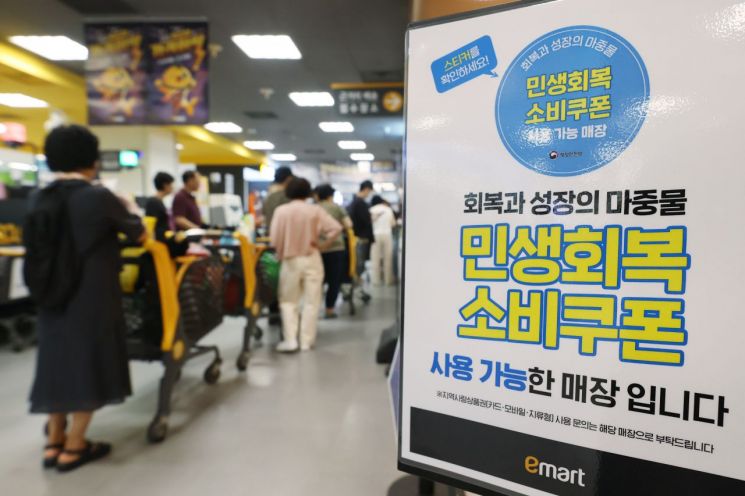 A notice about the use of the Livelihood Recovery Consumption Coupon is posted in front of a rental store inside an Emart in Seoul. Yonhap News
In the second week of implementation, the growth rate peaked at 10.1%, and the upward trend continued through the third week. However, in the fourth week, the growth slowed to 1.2%, indicating that the initial effect has somewhat diminished.
The effect of the consumption coupon policy was particularly pronounced at small business locations with annual sales of 3 billion won or less, where average sales increased by 6.9%. Contrary to concerns that demand might decrease at stores with annual sales exceeding 3 billion won when the coupons were distributed, these larger stores also saw a 1.1% increase in sales.
By business type, among stores with less than 3 billion won in sales, the distribution sector saw an 18% increase compared to the previous year, while the service sector and the restaurant sector rose by 5.7% and 3.6%, respectively. Even among stores with sales of 3 billion won or more, the distribution sector (2.7%), service sector (0.4%), and restaurant sector (1.3%) all recorded year-on-year sales increases.
Looking more closely at the distribution sector, optical shops saw the highest sales growth at 43.9%. This was followed by fashion and apparel (33.2%), toys (32.7%), electronic cigarettes (31.3%), and cosmetics (30.1%), all of which increased by over 30%. KCD analyzed that the consumption coupon policy spurred consumers to make purchases of relatively essential durable goods or self-satisfaction-oriented products that had been postponed.
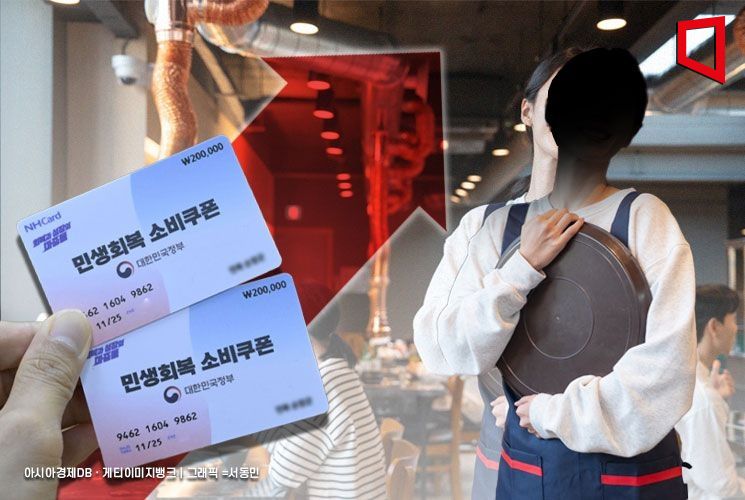
In the restaurant sector, small-scale businesses focused on value for money, such as pizza restaurants (18.8%), noodle restaurants (18.6%), and sushi and roll restaurants (13.2%), experienced notable sales growth. In the service sector, businesses related to health and appearance management, such as nail salons (29.4%), urology clinics (25.2%), and beauty and skincare services (16.1%), recorded significant year-on-year sales increases.
By region, the metropolitan cities of the Gyeongsang region, including Busan (10.9%), Daegu (10.5%), and Ulsan (9.0%), posted the highest growth rates. In Seoul, the average increase was 5.8%, with the northeastern districts such as Dobong-gu (13.2%), Dongdaemun-gu (11.7%), and Jungnang-gu (10.9%) showing relatively strong sales growth.
Kang Yewon, Head of Data at Korea Credit Data, stated, "The Livelihood Recovery Consumption Coupon policy has boosted small business sales nationwide through the fourth week of implementation, with a particularly clear effect at small businesses with annual sales of 3 billion won or less." She added, "As meaningful consumption has been observed in a variety of areas, including high-value durable goods, rational dining, and self-care, we hope this policy will further contribute to the recovery of local commercial districts."
© The Asia Business Daily(www.asiae.co.kr). All rights reserved.
![Clutching a Stolen Dior Bag, Saying "I Hate Being Poor but Real"... The Grotesque Con of a "Human Knockoff" [Slate]](https://cwcontent.asiae.co.kr/asiaresize/183/2026021902243444107_1771435474.jpg)

















