Department Store Duty-Free Sales Union Files for Relief Over Bargaining Neglect
Hotels and Franchises Also on Alert
In June of last year, the Central Labor Relations Commission rejected the collective bargaining request submitted by sales staff working at department stores and duty-free shops. The commission explained that there was neither a primary-subcontractor relationship nor any subordination between the employees of in-store vendors and the large retail corporations. At the time, the commission stated, "The working conditions of employees of in-store vendors are determined by their own companies, and the duty-free shops (the parent companies) do not directly supervise or manage them," drawing a clear line that the retail companies are not considered "employers."
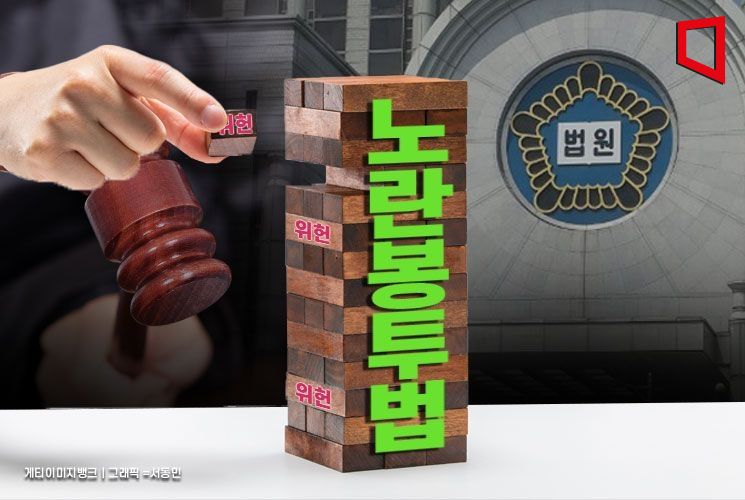
However, the situation has completely reversed in just over a year. This is due to the so-called "Yellow Envelope Act" (amendments to Articles 2 and 3 of the Trade Union Act), which passed the National Assembly on the 25th. The new law limits claims for damages related to illegal strikes and strengthens the parent company's employer liability for indirectly employed and subcontracted workers. The retail and franchise industries are closely monitoring the situation, saying, "Now, the parent company can be summoned as a direct party in labor-management disputes." There are also concerns that an increase in bargaining units could intensify conflicts.
According to industry sources on the 27th, the Department Store Duty-Free Sales Service Union issued a statement the previous day, asserting, "All working conditions, including business hours, store environment, customer service regulations, and break areas, are determined by the policies and management of the retail companies," and insisted, "The parent company can no longer evade responsibility." The union sent an official letter to the parent companies, adding the introduction of shared holidays and the resolution of parent company work delegation as new bargaining topics.
Department Store Duty-Free Sales Union Files for Relief Over Bargaining Neglect
The union has already filed lawsuits against 12 major retail companies-including Lotte, Shinsegae, Hyundai Department Store, Hotel Lotte, and Hotel Shilla-seeking relief for "neglect of collective bargaining." The final hearing was held at the Administrative Court on the 14th, and the verdict for the first trial is scheduled for October 30. If the scope of who is considered an employer expands, the union's justification for bringing the parent company directly to the bargaining table will be strengthened.
Concerns are growing within the industry. One retail industry official said, "If the parent company participates in negotiations, we may have to completely revise the contract structure with in-store brands," adding, "Labor-management conflicts could escalate further." Until now, employees hired by in-store brands could not negotiate directly with the parent company, but going forward, the parent company-which determines business hours and working conditions-is likely to be identified as the employer.
In the department store sector, unionization among fashion brands could have a significant impact, as store displays and customer service manuals are often governed by the parent company's standard operating policies. If negotiations with the parent company become a reality, it could lead to demands for changes in all aspects of working conditions. In duty-free shops, although many sales staff are employed by partner companies, the parent company actually manages staff allocation, sales targets, and promotional activities. Given the industry's high dependence on foreign tourists, if collective action coincides with peak periods, both sales losses and customer attrition could occur simultaneously.
 The Department Store Duty-Free Sales Service Union held a press conference on the 14th in front of the Seoul Administrative Court in Yangjaedong.
 [Photo by Department Store Duty-Free Sales Service Union]
Hotels and Franchises Also on Alert
The hotel industry is also on edge. Although many room cleaning, facility management, and security staff are outsourced, the parent company often manages service quality and work guidelines, making it difficult to avoid employer liability. The same applies to the franchise industry. Until now, part-time workers have only signed employment contracts with franchise owners, but if the parent company provides wage guidelines, business hours, or work manuals, demands to "negotiate directly with the parent company" could arise. In the structure where the parent company, franchisees, and part-time workers are all involved, the boundaries of employer liability and bargaining authority remain ambiguous.
The limitation on claims for damages is also expected to be a variable. Companies have used claims for damages and provisional seizures as legal tools to prevent business disruptions or property rights infringements caused by strikes. However, with the new amendments restricting these measures, the effectiveness of collective action is likely to increase, and companies may actually face higher business costs. If collective action occurs during peak seasons or promotional periods, the costs of securing replacement staff and compensating for business disruptions are also likely to rise.
An industry official emphasized, "If discussions on headquarters policies such as consumer prices, supply prices, and marketing cost-sharing spill over into collective bargaining or collective action, both the parent company and franchisees could be burdened." He added, "Since this could ultimately lead to consumer harm, supplementary measures reflecting industry characteristics are needed to ensure that the intent of the law does not result in excessive burdens in practice."
© The Asia Business Daily(www.asiae.co.kr). All rights reserved.
![Clutching a Stolen Dior Bag, Saying "I Hate Being Poor but Real"... The Grotesque Con of a "Human Knockoff" [Slate]](https://cwcontent.asiae.co.kr/asiaresize/183/2026021902243444107_1771435474.jpg)

















