Meritz Securities has assessed that while the Chinese government is expected to announce additional real estate stimulus measures between September and October, these actions are also likely to have only a short-term effect. The company also advised that, since the fundamental issue in China's real estate sector is "housing inventory," investors should closely monitor developments in inventory reduction and the month-on-month growth rate of housing prices going forward.
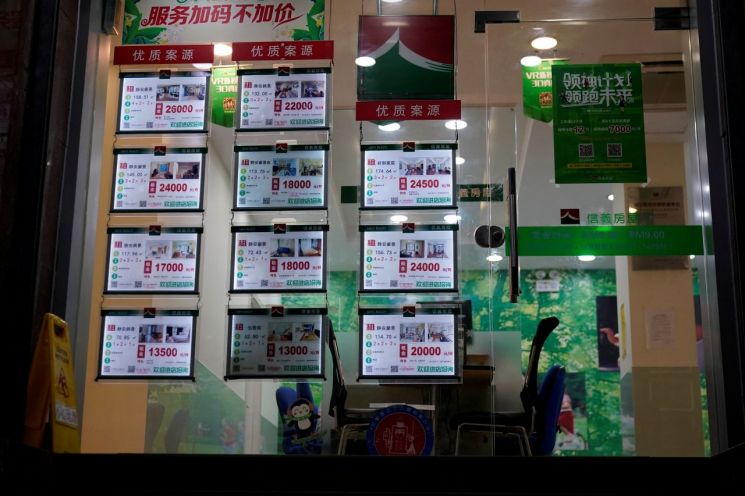
Choi Seolhwa, a researcher at Meritz Securities, stated this in her report titled "Can the Chinese Government Save the Real Estate Market?" released on August 26. She noted that expectations for further policy announcements following regional real estate stimulus measures have recently driven a surge in leading real estate stocks on the mainland Chinese stock market. Chinese Premier Li Qiang instructed at a State Council plenary meeting on August 18 that measures be taken to prevent further declines in the real estate market in the second half of the year and to ensure a stable recovery.
Accordingly, Choi outlined the following expected policy directions: ▲ easing of purchase restrictions and improvement of public housing fund usage systems in major cities such as Shenzhen and Guangzhou, following Beijing and Shanghai; ▲ promotion of shantytown and urban village redevelopment projects tailored to local conditions; and ▲ further reductions in mortgage rates if necessary.
She predicted, "These policies will partially mitigate downside risks in China's real estate market in the second half of the year." However, she pointed out, "As past cases have shown, the effects of stimulus measures tend to weaken within as little as one month or as much as six months, so this round of measures is also likely to have only a short-term effect."
Choi particularly emphasized, "The more fundamental problem in China's real estate sector right now is the increased housing inventory." She explained, "Despite various government measures to stimulate demand, housing prices continue to fall, which means households remain reluctant to invest in real estate." As of July this year, housing inventory in China is estimated at approximately 4.05 million units. While this does not reach the record high of 4.52 million units in 2015, it is an increase compared to the end of last year (3.91 million units).
Accordingly, she stressed that the most necessary stimulus measure in China is "the purchase of housing inventory by policy authorities." She argued, "The fundamental solution is for policy authorities to accelerate the purchase of housing inventory. If the government buys up part of the housing inventory and thereby induces a rebound in housing prices, household investment sentiment could improve and lead to a recovery."
Regarding the recent announcements of regional real estate stimulus measures, such as the removal of home purchase restrictions in suburban areas (Beijing) and expanded use of the housing provident fund (Suzhou), she commented, "While current measures to encourage household purchases are positive, in the second half of this year, it will be even more important to see whether the government is moving quickly to purchase housing inventory." She further recommended that investors "closely monitor the status of housing inventory reduction and the month-on-month growth rate of housing prices as key indicators."
© The Asia Business Daily(www.asiae.co.kr). All rights reserved.
![Clutching a Stolen Dior Bag, Saying "I Hate Being Poor but Real"... The Grotesque Con of a "Human Knockoff" [Slate]](https://cwcontent.asiae.co.kr/asiaresize/183/2026021902243444107_1771435474.jpg)















