President Lee Attends Korea-U.S. Business Roundtable Following Summit
Three Pillars of the Manufacturing Renaissance Vision
1. Safeguarding Future Security Through Stronger Industrial Cooperation
2. Enhancing Global Competitiveness via Advanced Industry Partnerships
3. Stabilizing Supply Chains for Key Products
President Lee Expresses Commitment to Korea-U.S. Shipbuilding Collaboration
Korean Companies Announce $150 Billion Investment in the U.S.
Business Leaders Including Lee Jaeyong, Chey Taewon, Chung Euisun, Koo Kwangmo, and NVIDIA CEO Jensen Huang in Attendance
After concluding a Korea-U.S. summit with President Donald Trump at the White House, President Lee Jaemyung attended the "Korea-U.S. Business Roundtable" held at the Willard Hotel in Washington, D.C. on the afternoon of the 25th (local time). There, he stated, "For a win-win manufacturing renaissance between Korea and the United States, let us advance cooperation in strategic industries such as shipbuilding and nuclear power, as well as in cutting-edge sectors like semiconductors, artificial intelligence (AI), and biotechnology, to enhance global competitiveness. At the same time, let us strengthen supply chain collaboration through strategic investments and procurement between our two countries."
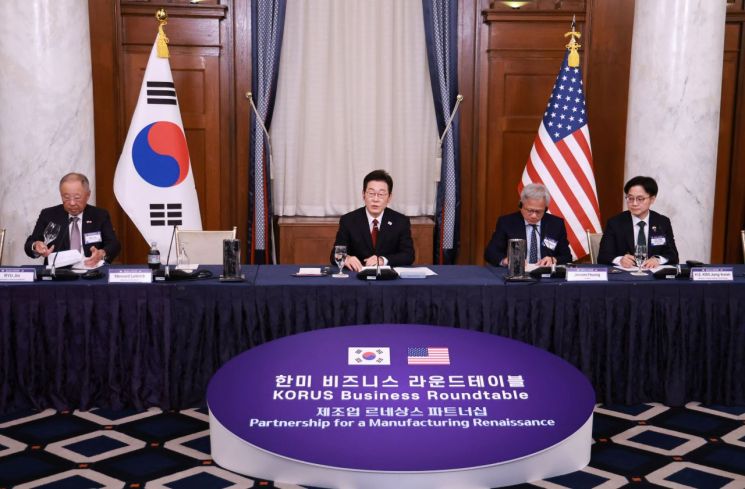
On this day, at the "Korea-U.S. Business Roundtable: Manufacturing Renaissance Partnership" event hosted by the Ministry of Trade, Industry and Energy in Washington, D.C., President Lee said, "Business leaders from both countries are the backbone of Korea-U.S. cooperation. Just as the United States contributed to Korea's rapid growth in the past, Korea, which possesses the world’s best manufacturing technology, is the optimal partner to help the United States achieve a manufacturing renaissance."
President Lee then outlined three specific directions for a win-win manufacturing renaissance vision between the two countries. First, he emphasized strengthening cooperation in strategic industries to safeguard future security. He stated, "We live in an era where national security determines the lives of the people and the future of the nation. In such times, robust security is the backbone of a strong economy. To help Korea reclaim the glory once enjoyed by the U.S. shipbuilding industry and to enhance military strength, Korea will pursue the MASGA project."
He continued, "Our companies, which operate the world’s top three shipyards, possess a broad portfolio ranging from commercial vessels to LNG carriers and icebreakers, and will play a decisive role in rebuilding the U.S. shipbuilding industry. We will also focus on expanding cooperation in the next-generation nuclear power sector, including the development and commercialization of small modular reactors (SMRs), to meet the power demands of the AI era and strengthen energy security."
He also pledged to further enhance global competitiveness through advanced industry cooperation. President Lee said, "As everyone knows, the Korea-U.S. semiconductor supply chain is a symbiotic structure based on our respective strengths. Korean-made HBM, which is essential for high-performance AI chip strategies, will play a key role in securing U.S. AI competitiveness." He added that companies such as SK and Samsung will build manufacturing facilities in the United States, including packaging, foundry, and fab plants, which will help the U.S. emerge as a core hub in the semiconductor supply chain.
In the field of biomedicine, President Lee emphasized that Korea is a trustworthy partner for the United States. He said, "During the COVID-19 pandemic, the Korean government provided diagnostic kits and medical equipment at the request of President Trump. Korean companies are already supplying high-quality biosimilars at affordable prices, contributing to the French government’s drug price reduction policy, and are currently producing and supplying U.S. biopharmaceuticals. Going forward, I hope our two countries will strengthen cooperation as leaders in the bio sector, including innovative research and development."
Finally, he announced plans to stabilize strategic investment relations and key supply chains, and to establish a sustainable trade relationship. President Lee explained, "Even during President Trump’s administration, Korean companies’ production in the United States and purchases of American products will continue. This will ensure the mutually balanced and sustainable trade that the United States expects."
The event, held in conjunction with President Lee’s first visit to the United States, was attended by 16 leading Korean business figures with significant partnerships with the U.S., including Ryu Jin, Chairman of the Federation of Korean Industries; Lee Jaeyong, Chairman of Samsung Electronics; Chey Taewon, Chairman of SK; Chung Euisun, Chairman of Hyundai Motor; Koo Kwangmo, Chairman of LG; Kim Dongkwan, Vice Chairman of Hanwha; Chung Kisun, Vice Chairman of HD Hyundai; Park Jiwan, Chairman of Doosan Enerbility; and Seo Jungjin, Chairman of Celltrion. On the U.S. side, 21 prominent business leaders attended, including Jensen Huang, CEO of NVIDIA; David Rubenstein, Co-Chairman of Carlyle Group; as well as representatives from Boeing, Danaher, and Applied Materials.
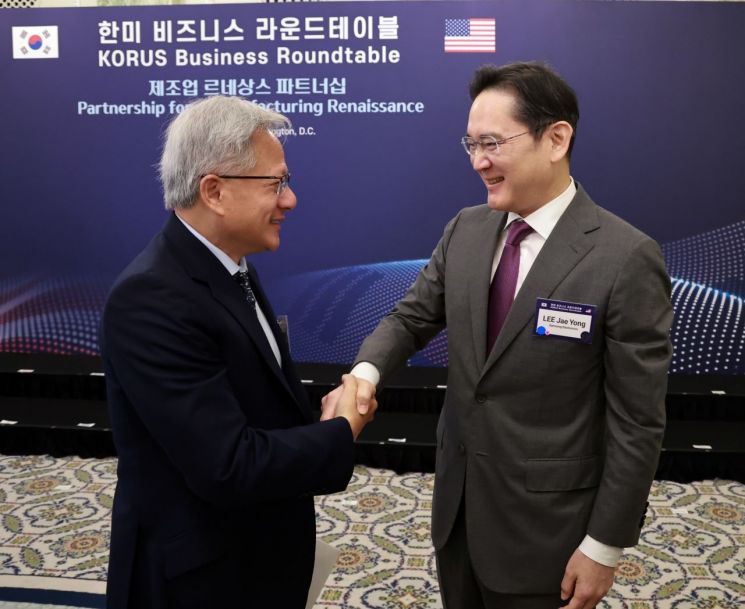
Business leaders from both countries discussed the changing global environment and ways to enhance industrial cooperation between Korea and the U.S., divided into sectors such as advanced industries (semiconductors, AI, biotechnology), strategic industries (shipbuilding, nuclear power, defense), and supply chains (mobility, batteries). They also discussed the importance of joint research, bilateral technology cooperation, and government support, agreeing that combining U.S. innovative technology with Korea’s manufacturing competitiveness could drive the global market. During the event, Korean companies announced plans for investments in the United States totaling 150 billion dollars.
President Lee cited the example of icebreaking LNG carriers, which only Korea can produce, and urged, "Just as icebreakers carve new routes through the ice, I ask that business leaders from both countries break through existing limitations and create new markets and opportunities for cooperation."
Meanwhile, Chairman Ryu Jin stated in his welcoming remarks, "Korean companies are planning a large-scale investment of 150 billion dollars in the United States to usher in a new era of manufacturing renaissance by jointly leading the U.S. and global markets. These investment plans and the cooperation discussed by our companies today will serve as a roadmap for realizing the ambitious vision of Korea-U.S. industrial cooperation."
He went on to quote the lyrics "Up Up Up" from the theme song "Golden" of the Netflix film K-pop Demon Hunters, saying, "I trust that both governments will actively support us. I hope today marks the beginning of a golden era of manufacturing renaissance and shared glory for Korea and the United States."
© The Asia Business Daily(www.asiae.co.kr). All rights reserved.


















