Strike Authorization Secured After 7 Years
Union to Launch Central Strike Committee on August 28
Future Plans to Be Discussed
The Hyundai Motor Company labor union has secured the legal right to strike following the breakdown of this year's wage and collective bargaining negotiations. If the union actually proceeds with a strike, it will be the first time in seven years since 2018.
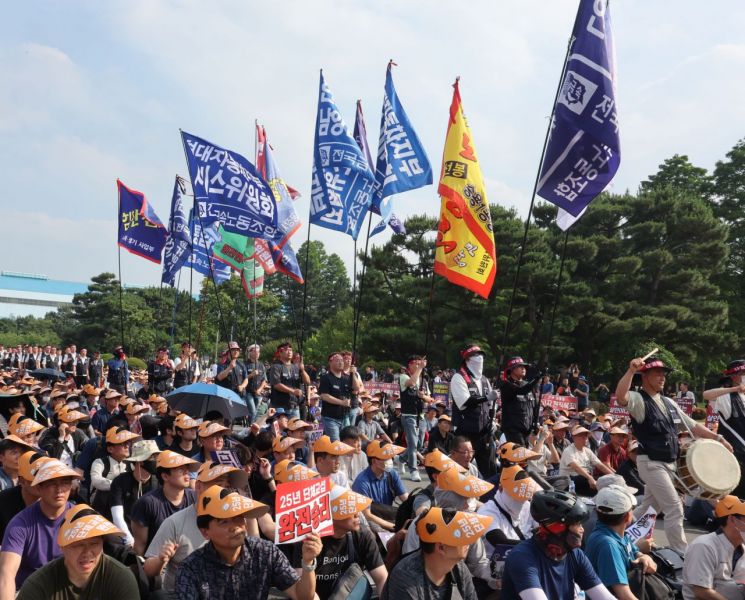 On the afternoon of June 26, the labor union held a kickoff rally for this year's wage and collective bargaining fight at Hyundai Motor Company's Ulsan plant. Photo by Yonhap News
On August 25, the Hyundai Motor Company union announced that, in a strike authorization vote conducted among all 42,180 union members, voter turnout reached 94.75%. Of the total eligible members, 86.15% (36,341 members) voted in favor of the strike. There were 3,625 votes against (8.59%) and 2,214 abstentions (5.25%).
On the same day, the Central Labor Relations Commission also determined that the gap between labor and management was significant and decided to halt mediation efforts, thereby allowing the union to legally begin a strike. The union plans to launch the Central Strike Countermeasures Committee on August 28 and will discuss whether to proceed with a strike and set a detailed schedule in the coming days.
Since the preliminary meeting for wage and collective bargaining negotiations on June 18, Hyundai Motor Company labor and management have held 17 rounds of negotiations but have failed to reach an agreement. On July 13, the union declared the breakdown of negotiations, immediately applied for dispute mediation, and began strike procedures.
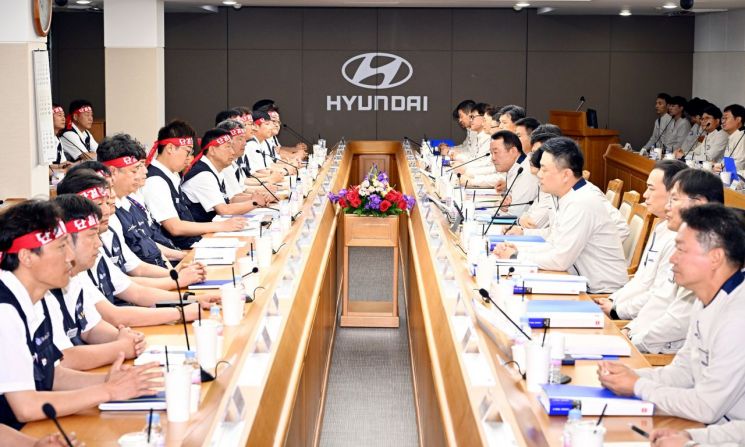 Hyundai Motor Company labor and management representatives held a preliminary meeting for this year's wages and collective agreement on June 18 at the Ulsan plant. Provided by Hyundai Motor Company. Photo by Yonhap News.
In this year's negotiations, the union is demanding: ▲ an increase of 141,300 won in base salary (excluding seniority raises); ▲ a performance bonus equivalent to 30% of last year's net profit; ▲ inclusion of various allowances in ordinary wages; and ▲ an increase or creation of new allowances by job group and duty. Additionally, the union has proposed: ▲ extending the retirement age from the current 60 to the end of the year before the start of national pension payments (up to 64); ▲ introducing a 4.5-day workweek; and ▲ raising the bonus from 750% to 900% of ordinary wages.
The union argues that there is sufficient justification for a wage increase, citing Hyundai Motor Company's operating profit of 14.2396 trillion won last year and a 7.3% year-on-year increase in sales in the second quarter of this year. In contrast, management has taken a cautious stance, pointing to the possibility of a decline in operating margin in the second half of the year due to tariff pressures from the United States and a slowdown in electric vehicle demand (the so-called "chasm").
The automotive industry expects that, under pressure from the union, management is likely to soon prepare a new proposal and resume negotiations.
© The Asia Business Daily(www.asiae.co.kr). All rights reserved.
![Clutching a Stolen Dior Bag, Saying "I Hate Being Poor but Real"... The Grotesque Con of a "Human Knockoff" [Slate]](https://cwcontent.asiae.co.kr/asiaresize/183/2026021902243444107_1771435474.jpg)
















