Underwater Search Began Last September... First Remains Discovered
Truth Remains Uncovered Even After 80 Years
Remains believed to belong to victims from the time, including 136 Korean laborers who died in a flooding accident during the Japanese colonial era, have been discovered at the Josei undersea coal mine in Japan.
The Japanese civic group "Association to Record the Josei Coal Mine Flooding Accident" (hereafter referred to as "the Association") announced that around 2 p.m. on August 25, they recovered objects believed to be human femur bones and other remains during an underwater investigation at the Josei coal mine accident site in Yamaguchi Prefecture, western Honshu.
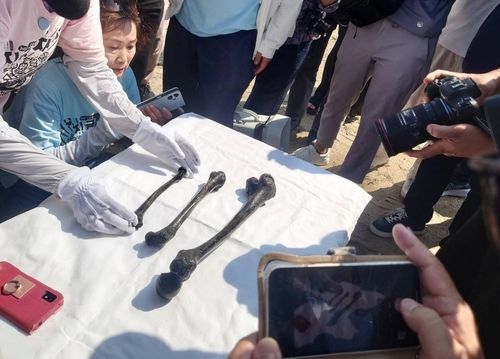 Human bone-like object discovered in a Japanese Josei undersea coal mine. Korean Buddhist Gwaneum Order, Yonhap News Agency
Three bone-like objects were found, with the longest measuring 42 centimeters. The Korean diver who discovered these objects told a local Yamaguchi broadcaster, "Three pairs of boots were found nearby," and added, "I was able to confirm the remains of four individuals."
Underwater investigation began in September last year... First discovery
The Association began underwater investigations at the Josei coal mine in September last year but had not found any human remains until now. The group handed the discovered objects over to the police for identification. As further investigations are scheduled for August 26, there is a possibility that more victims' remains may be found.
Song Jongwon, Secretary-General of the Korean Buddhist Gwaneum Order, said, "Through a joint investigation by Korean and Japanese divers, we found remains believed to belong to the victims," and added, "It was as difficult as finding a needle in a desert, so we were very surprised when the remains were discovered." The Gwaneum Order has been working for over 30 years to repatriate the remains of Korean victims of the Japanese colonial era scattered across Japan.
Truth remains unresolved more than 80 years later
The Josei coal mine disaster occurred on February 3, 1942, in an undersea tunnel about 1 kilometer off the coast of Ube City, Yamaguchi Prefecture, western Honshu. The flooding began with a tunnel leak, allowing seawater to enter the undersea mine and resulting in the deaths of 183 people, including 136 Koreans and 47 Japanese. More than 80 years have passed since the accident, but the recovery of the victims and a full investigation into the truth have yet to be properly carried out.
The Association, founded in 1991, has requested support from the Japanese government for excavation work, but the government has maintained that a state-led investigation is difficult due to the unclear burial locations and lack of ensured safety. As a result, the group has continued excavation efforts through citizen fundraising.
© The Asia Business Daily(www.asiae.co.kr). All rights reserved.
![Clutching a Stolen Dior Bag, Saying "I Hate Being Poor but Real"... The Grotesque Con of a "Human Knockoff" [Slate]](https://cwcontent.asiae.co.kr/asiaresize/183/2026021902243444107_1771435474.jpg)















