What Are the Core Technologies of Humanoids?
'Top Physical' Robots Have Started Learning
Collaborative Robot AI: FigureAI's "Helix"
Tesla's Autonomous Driving Technology Applied to Optimus
China's Genuine Commitment to Humanoids: Fastest Comme
The competition in humanoid technology is intensifying to the point where it can be described as a "war." Among new technologies hailed as "dream technologies" that could change human life-such as autonomous driving, quantum computers, and all-solid-state batteries-humanoids are currently considered to have the highest commercialization potential. Industry insiders agree that this year will mark the first year of humanoid commercialization. Starting this year, major robot manufacturers in the United States and China have begun small-scale mass production. Hyundai Motor Group is also planning to pilot humanoid robots developed by its affiliate Boston Dynamics on the production lines of its U.S. automotive plant as early as October this year. As of 2025, with Hyundai Motor Group and other global companies successively entering the humanoid commercialization race, what is the current level of technology at each company? Here is a look at the technological status of major companies.
What Are the Core Technologies of Humanoids?
The core technologies for developing humanoid robots can be broadly divided into three categories: △hardware technology for precise robot movement, △artificial intelligence (AI) that perceives and judges external environments and thinks autonomously, and △a control system that integrates these two technologies.
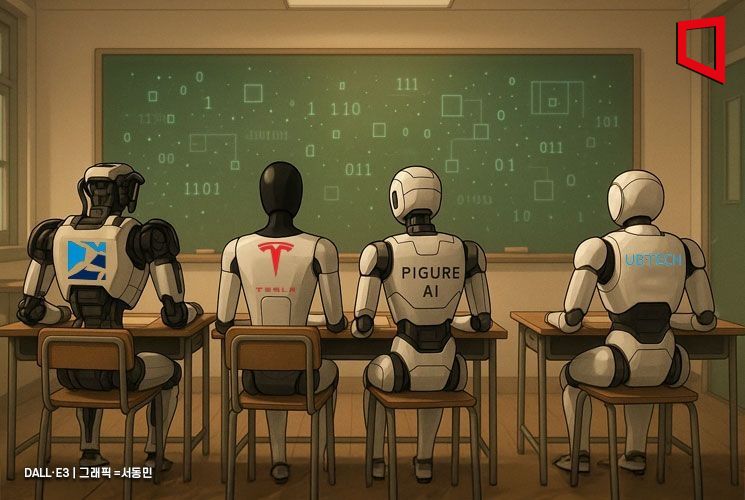
First, hardware technology requires a precise drive mechanism and advanced actuators. The actuator, a key component, serves as the "muscle" of the robot. It receives signals from the control system and converts electrical energy into physical movement. How closely a robot can mimic human movement is determined by its "degrees of freedom" (the number of directions or axes a robot's joints can move). The higher the degrees of freedom, the more complex and human-like movements the robot can perform. The most challenging area in hardware development for humanoid companies is the "robot hand." Humans perform the majority of tasks with their hands. Only when a robot can perform hand movements that require subtle force control can it become a true humanoid capable of replacing humans.
The second core technology is AI that thinks and reasons like a human. To understand the surrounding environment and make appropriate decisions and actions, it is essential to integrate data collected in real time from various sensors-such as vision, hearing, touch, and location-using advanced AI. In particular, "autonomy," where the robot learns and improves on its own through reinforcement learning without human instruction, is the essence of humanoid AI technology. The ultimate goal is to enable humanoid robots to make decisions and act independently even in unexpected situations.
The final core technology is the control system that connects the precise hardware and AI brain. This system transmits the AI's decisions to the actuator controller while simultaneously relaying various hardware information-such as sensor and motor status-back to the AI quickly. In human terms, it plays a role similar to the "central nervous system," linking the peripheral nerves and the brain.

'Top Physical' Robot Begins to Learn
The company currently demonstrating the fastest pace of technological advancement is Boston Dynamics (BD). In a video uploaded on the 21st, the current technological level of BD's "Atlas" can be observed. Atlas uses a gripper composed of three fingers-similar to a human hand-to pick up parts from one box and place them in another. If the box lid suddenly closes, Atlas notices, reopens the lid, and continues the task. When a part being moved falls to the floor, Atlas recognizes it, adjusts its posture, and picks up the dropped part. Atlas even folds long parts to fit them onto a shelf if the size appears mismatched. This video is significant as it is the first released since BD announced its collaboration with Toyota Research Institute (TRI), an advanced technology research subsidiary of the Toyota Group, last year.
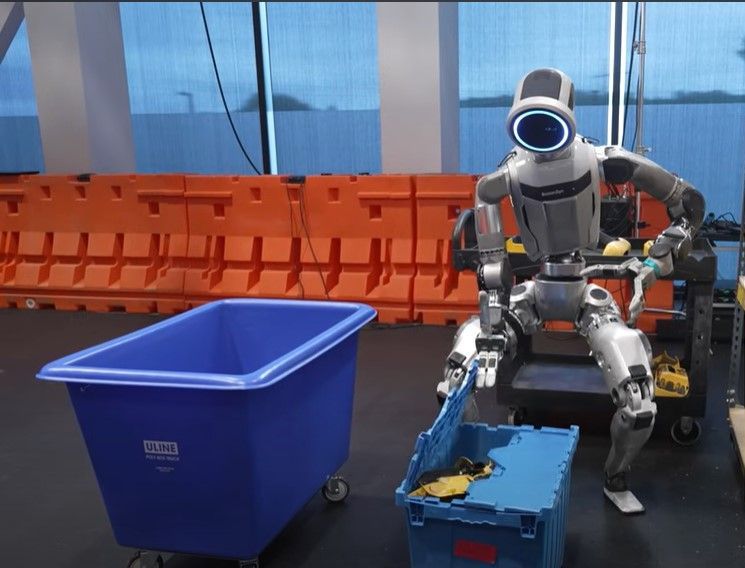 Boston Dynamics' humanoid robot Atlas is opening a closed box by itself and continuing the task of organizing parts. Photo by Boston Dynamics
Within the robotics industry, BD has long been recognized as the "industry leader" in hardware. The previous hydraulic version of Atlas demonstrated remarkable athleticism, performing backflips and high jumps. Such outstanding agility and balance indicate that the robot possesses control technology capable of perceiving its environment in real time and moving quickly and precisely. However, in production environments, a robot capable of backflips may be overengineered. This increases both the price and the equipment's weight.
To address this, BD introduced a lightweight, electric-powered new Atlas last year. By simplifying the equipment, they improved cost competitiveness and, through joint research with TRI, are enhancing AI and robot control technology. TRI applied its proprietary LBM (Large Behavior Model) to enable Atlas to make autonomous decisions and perform complex manipulations in various situations. If LLMs (Large Language Models) are massive neural networks that learn vast amounts of language data to understand and generate new sentences, LBMs are neural networks that learn and understand various behaviors and then execute new actions based on that knowledge. The combination of BD's outstanding hardware technology and TRI's LBM expertise has the industry on edge regarding Atlas's rapid technological progress.
Collaborative Robot AI, Helix
U.S.-based humanoid company FigureAI has introduced Helix, a machine learning AI model for humanoid robots. The core feature of this AI is that it enables two or more robots to collaborate on tasks. Previously, the company had developed humanoids in partnership with OpenAI, the creator of ChatGPT, but this year announced its intention to pursue an independent path. The first humanoid AI learning model unveiled as a result is Helix. Applied to the humanoid robot "Figure 02," Helix utilizes a VLA (Vision-Language-Action) model. The robot recognizes its surroundings with cameras, understands natural language commands from humans, and performs corresponding actions.
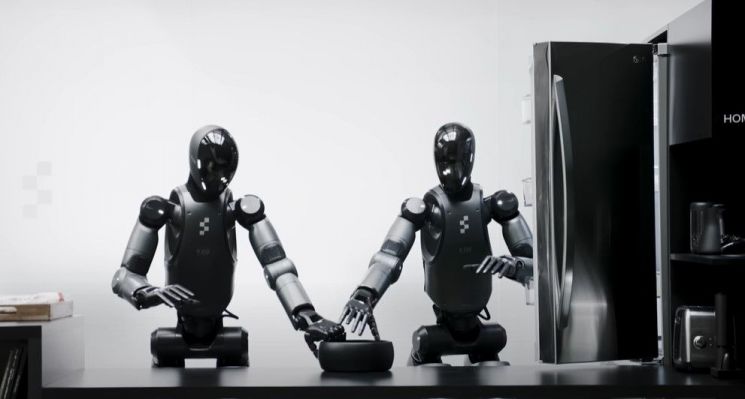 Humanoid robots equipped with FigureAI's machine learning AI model for humanoid robots, "Helix." Two robots are cooperating and performing tasks together. Captured from FigureAI YouTube.
For example, if you place eggs, ketchup, apples, cookies, and other items in front of a robot equipped with Helix and say, "Please organize these items," the two robots will begin sorting and organizing the items into refrigerated and room-temperature categories. The most impressive scene is when one robot hands an item to another. The two robots look at each other, as if making eye contact, and pass the item back and forth. When handing over fragile items like eggs, the robot adjusts the force of its grip and carefully places them in the refrigerator. If one robot is looking for a place to put an apple, the other robot hands it a bowl. After organizing, the robots close the refrigerator and drawer doors, concluding the video.
Robots equipped with Helix collaborate by exchanging visual information, action plans, and status data of their fellow robots in real time. To prevent communication delays, they use dedicated protocols and high-speed wireless communication technology, and a "fault-tolerant mechanism" is in place to allow the robots to adapt in the event of a network failure. Based on the currently released technology, humanoids equipped with Helix are considered among the smartest in terms of natural language understanding, situational awareness, and response performance. However, these robots can currently only move their upper bodies.
Tesla's Autonomous Driving Technology Applied to Optimus
Elon Musk is the figure who popularized the concept of humanoids as the next-generation innovation technology. Musk first announced the development of the humanoid robot "Optimus" at the "Tesla AI Day" in 2021. Tesla unveiled the prototype of Optimus in September 2022, released the first-generation Optimus in mid-2023, and introduced the second-generation Optimus in April 2024. The third-generation model is currently under development. What surprises people most is the speed of Tesla's development. When the project was first announced, it was regarded almost as a joke, but Tesla produced a finished product in just two years.
The greatest strength of Optimus is that Tesla's proprietary autonomous driving AI technology can be applied to humanoids. Through its Full Self-Driving (FSD) feature, Tesla has accumulated vast amounts of autonomous driving data and is considered one of the leading companies in the field. The core of autonomous driving AI lies in the ability to perceive the surrounding environment, assess the current situation, and appropriately control devices-a technological connectivity that is fundamentally the same as robot control technology.
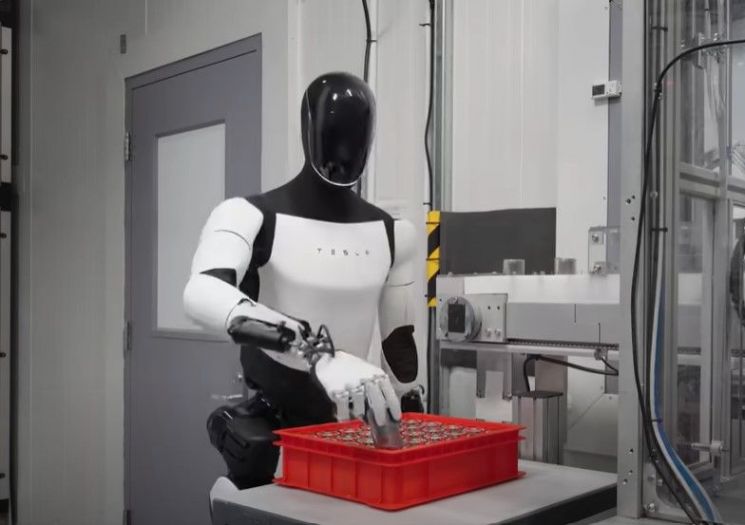 Tesla's humanoid robot Optimus is performing tasks using its hands. Photo captured from Tesla's YouTube channel.
Another strength of Tesla is its mass production capability. Leveraging manufacturing expertise accumulated through automobile production, Tesla is well-positioned to quickly establish a mass production system for robots. If some production lines at Tesla's global factories are converted to robot production lines, this could create various strategic opportunities, such as local production and exports to neighboring countries. However, this advantage is not unique to Tesla; it also applies to Hyundai Motor Group's affiliate Boston Dynamics, which possesses outstanding manufacturing capabilities.
In the most recently released video, Optimus walks smoothly around a factory, avoiding people and machines. It uses its hands to move small batteries into boxes and interacts with people, handing over items. When its battery runs low, it independently finds a nearby charging station, recharges, and resumes work. Tesla began small-scale mass production of Optimus this year. In the second half of the year, it plans to increase production to several thousand units and strategically deploy them in logistics centers and electric vehicle manufacturing sites. From 2026, the goal is full-scale mass production and commercialization. The primary challenge is to reduce the sales price to $20,000 (approximately 28 million won) per unit.
China's Commitment to Humanoids
With a high proportion of manufacturing in its national economy, China is fully committed to humanoids. Of the 236 humanoid-related companies worldwide, 140 are Chinese, accounting for a dominant share (59%). Of the 51 humanoid robot models unveiled last year, 35 were made by Chinese companies. Particularly, as manufacturing is a key industry and there is strong interest in robots and automation, China stands out in robot hardware technology. In contrast, the United States is focused on developing software technologies that enable robots to move autonomously. However, as China has recently concentrated on AI technology development, there is growing assessment that China could also excel in the humanoid sector.
Ubtech is the leading humanoid company in China in terms of commercialization. The company has already supplied its humanoid robot "Walker S" to the production lines of various automakers' Chinese factories, including BYD, NIO, Geely, BAIC, and Volkswagen. It is currently considered to have the largest number of clients among global humanoid companies. The first version, "Walker S1," is priced at around $70,000 (about 96 million won), and recently, a low-cost model called "Tiangong Walker" was unveiled at half the price.
The technical capabilities of Walker S are also impressive. In videos, the robot is seen picking up small stickers and attaching them to car bodies, and when lifting heavy boxes, two robots grab each end and work together as collaborative robots. The video of "Walker S2" released a month ago is even more impressive. When the robot's battery runs out during work, it walks to a battery station, removes the battery mounted on its back, and inserts a fully charged battery by itself. This technology is designed to minimize charging wait times and maximize work efficiency.
 The humanoid robot "Walker S2" from Chinese company Ubtech is replacing its self-charged battery. Captured from Ubtech YouTube video
© The Asia Business Daily(www.asiae.co.kr). All rights reserved.



















