PPP: "President Lee Should Exercise His Veto"
DP: "Watching for Supplementary Measures Before Implementation"
The Yellow Envelope Act (the amendment to Articles 2 and 3 of the Labor Union Act) passed the plenary session on August 24, led by the Democratic Party of Korea, sparking ongoing repercussions in the political sphere. While the People Power Party has announced plans to file a constitutional complaint, the Democratic Party has shown a flexible stance regarding supplementary measures.
On August 25, the People Power Party held a general assembly of its lawmakers and began discussions on follow-up responses to the Yellow Envelope Act. The party plans to review the constitutionality of the bill, which was pushed through by the ruling party, and take additional actions such as filing a constitutional complaint. Song Eon-seok, the acting chairman and floor leader of the People Power Party, stated at the assembly, "The collapse of the people's livelihoods and the economy due to this bad law is entirely the responsibility of the Lee Jae-myung administration and the Democratic Party," adding, "President Lee Jae-myung should exercise his veto even at this stage."
The People Power Party's indication of further action stems from its assessment that the Yellow Envelope Act will have a significant impact on the domestic economy. Acting Chairman Song noted, "The business community has warned that companies will quietly leave Korea," and criticized the bill as an "economic rebellion law" that undermines companies' willingness to invest and reduces job opportunities for young people, thereby shaking the foundations of the Korean economy.
The party attempted to block the bill by launching a filibuster (unlimited debate), but only managed to delay proceedings for 24 hours. According to the National Assembly Act, if debate time such as a filibuster exceeds 24 hours, the debate can be ended and the bill put to a vote with the approval of three-fifths (180 seats) of all lawmakers. Since the filibuster, as the final means of protest, failed to have an impact and did not sway public opinion, the party believes further action is necessary.
In contrast, the Democratic Party maintains that there are no issues with the bill, as sufficient public opinion has been gathered. The party stated that it will monitor supplementary measures to be discussed between the government and the business community during the six months remaining before implementation. Park Ji-hye, spokesperson for the Democratic Party of Korea, said after the bill's passage, "Since the bill was first proposed in April 2015, it has undergone thorough deliberation among various stakeholders," adding, "Nevertheless, we deeply regret the behavior displayed by the People Power Party during the legislative process."
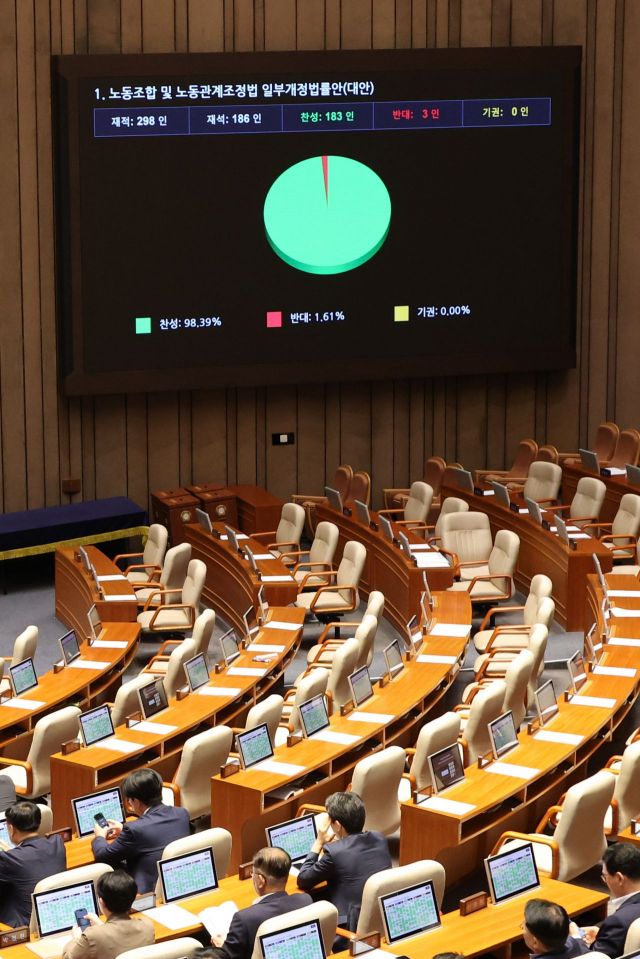
On August 24, the National Assembly passed the Yellow Envelope Act in a plenary session, with 183 votes in favor and 3 against out of 186 lawmakers present. The Democratic Party led the passage of the bill as People Power Party lawmakers did not participate. The core of the law is to expand the definition of 'employer,' granting subcontracted workers the right to negotiate directly with the principal company. In addition, if restructuring or overseas relocation conducted for managerial reasons affects working conditions, industrial action will be permitted. The bill also includes provisions to limit damage claims against striking workers.
© The Asia Business Daily(www.asiae.co.kr). All rights reserved.

















