Thousands of Navy Personnel Mobilized for Drug Crackdown
Severe Economic Crisis Raises Risk of Maduro Regime Collapse
Chinese Military Intervention a Variable... "Chances Are Slim"
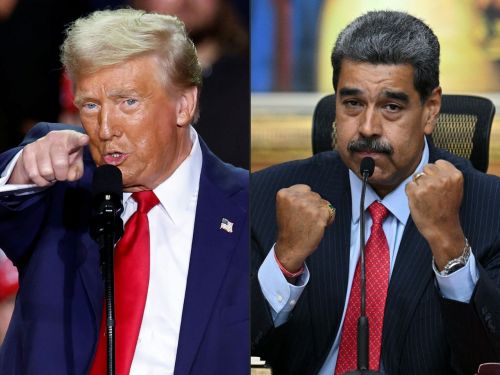
The US government has rapidly deployed thousands of Navy personnel, warships, and submarines to Venezuelan waters under the pretext of cracking down on drug trafficking, with the force capable of launching amphibious operations. Given the size and capabilities of the deployment, there is even talk of a possible military operation against Venezuela. While there are concerns that President Nicolas Maduro's regime could collapse if Venezuela, whose warfighting capabilities have effectively been lost due to a prolonged economic crisis, were to enter into a full-scale conflict with the United States, some analysts believe that the US is more likely to use a show of force to negotiate rather than pursue an all-out war.
Thousands of US Navy Dispatched for Venezuela Drug Crackdown... Intentions Unclear
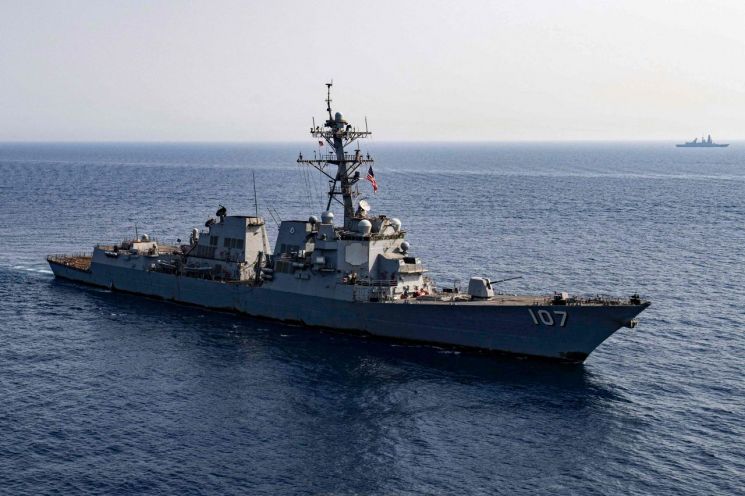 On the 18th (local time), the USS Gravely, a US Navy destroyer dispatched to the Caribbean Sea to block drug trafficking in Venezuela. Photo by AFP Yonhap News
According to the New York Times (NYT), as of the 28th (local time), eight US military vessels-including seven warships and one submarine-have been dispatched to Venezuelan waters. Previously, the US Navy sent three missile destroyers to the Venezuelan coast. The USS Jason Dunham and USS Gravely, both of which participated in operations against Yemen's Houthi rebels in the Red Sea, are en route to the Caribbean, and the USS Sampson, previously deployed in the eastern Pacific, is also expected to join the fleet in the Caribbean soon. The entire fleet is projected to gather in Venezuelan waters by next week.
Along with these warships, the US Navy's Iwo Jima Amphibious Ready Group (ARG) with 4,500 personnel, three escort ships, the 22nd Marine Expeditionary Unit specializing in amphibious operations with 2,200 troops, and one amphibious assault ship carrying these marines are all converging on Venezuelan waters. A P-8 reconnaissance aircraft and a submarine are also expected to join the other units in the area. The combined force is assessed as being capable of not only attacking coastal batteries but also launching a ground amphibious assault.
The US government has stated that these units have been dispatched to eliminate Venezuela's drug trafficking organizations. In February, the US State Department designated Venezuela's 'Tren de Aragua' as a terrorist organization, citing national security threats. However, both inside and outside the Department of Defense, there are evaluations that the US military force dispatched is sufficient for an independent military operation rather than just a drug crackdown. The NYT quoted a Pentagon official as saying, "Deploying such firepower for a drug crackdown is like bringing a cannon to a knife fight," and added, "Seizing a vessel suspected of drug smuggling could be handled by a patrol boat led by a Coast Guard officer."
Generally, US military attacks on foreign countries require congressional approval, but engagements with armed groups such as drug and terrorist organizations can proceed with only presidential authorization, making the nature of any future operation uncertain. The NYT noted, "Exceptionally strict security is being maintained regarding the specific operational intent," and pointed out that "Secretary of State Marco Rubio recently argued that attacks on terrorist groups such as drug cartels can proceed without congressional approval."
Venezuela Lacks Warfighting Capability Due to Prolonged Economic Crisis... Shortages of Both Weapons and Food
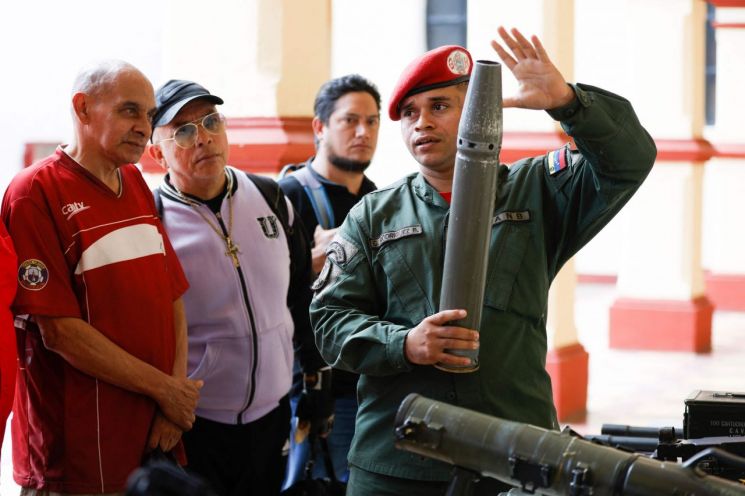 On the 23rd (local time), citizens who volunteered for the Venezuelan government's militia are being instructed on how to use weapons. Photo by AFP
The Venezuelan government has taken a hardline stance, declaring it will mobilize millions of militia members to counter the US military, but it is expected to be difficult to defend if the US actually launches an attack. This is because Venezuela is suffering from severe shortages of food and oil due to the prolonged economic crisis, and even its aging Soviet-era weapons are in such short supply that they cannot be distributed adequately.
According to the international military strength assessment firm Global Firepower (GFP), as of 2025, Venezuela's standing army numbers about 109,000, with around 8,000 reservists. In 2020, the standing army reached 340,000, but this number has dropped significantly due to the worsening economic crisis. The country has only 13 warships and about 40 fighter jets, but it is reported that almost none of the aircraft are operational due to aging and lack of maintenance.
The exact number of militia members President Maduro claimed he would mobilize-4.5 million-is unknown. According to CNN, while the Venezuelan government claims its militia numbers 4.5 to 5 million, the actual number registered for militia training is about 340,000, and the number reportedly receiving annual training is around 160,000. The militia includes not only men, but also women, children, and the elderly, but it is reported that even basic firearms, let alone heavy weapons, are not being adequately supplied.
Venezuela is currently facing such a severe economic crisis that a significant portion of the population is suffering from food shortages. According to the World Food Programme (WFP), about 9.3 million people-30% of Venezuela's population-are in a state of 'food insecurity', unable to secure sufficient food. In 2011, the country's per capita GDP was $12,000, but due to US sanctions and falling oil prices, it plummeted to $4,500 last year.
"US Likely to Show Force Rather Than Wage All-Out War"... Chinese Intervention Unlikely
Diplomatic relations between the United States and Venezuela were officially severed in 2019. At the time, the US government recognized former National Assembly Speaker Juan Guaido as interim president and planned military aid, but after the coup attempt led by Guaido and some military factions failed, US intervention in Venezuela was restrained. Guaido has since gone into exile in the United States.
Experts believe that, for now, the US government is more likely to use a show of force to negotiate rather than launch an immediate military attack on Venezuela. Jeff Ramsey, a senior fellow at the Atlantic Council, a US think tank, explained, "The US does not seem to want to provoke Venezuela militarily to the extent that it would affect its oil and energy interests or immigration policy," adding, "Rather than short-term military action, it appears that President Trump is trying to demonstrate strength as he recalibrates relations with Venezuela."
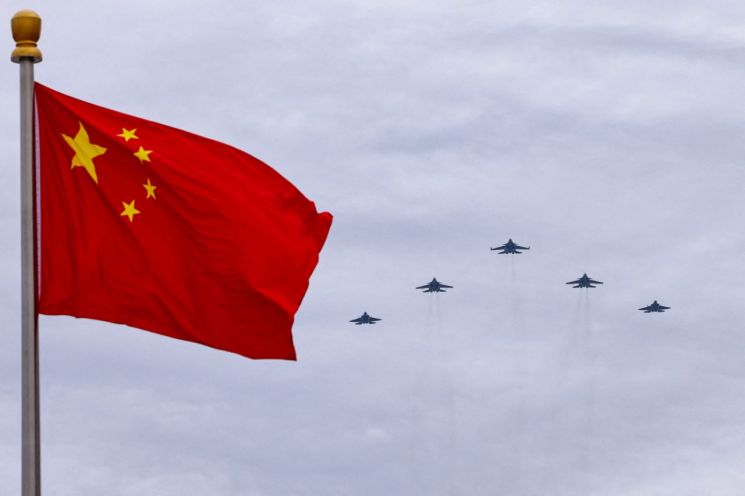
The possibility of Chinese intervention, which the Venezuelan government is hoping for, is considered low. The Chinese government established an economic cooperation relationship with Venezuela after 2000 and has provided around $67 billion in financial support, including oil imports and loans. However, experts point out that engaging in military conflict with the US in the Caribbean-a region close to the US mainland and very far from China-would be too great a risk for Beijing.
Guo Chunhai, a researcher at the Latin America Institute of the Chinese Academy of Social Sciences, said in an interview with the South China Morning Post (SCMP) in Hong Kong, "The Chinese government has strengthened economic ties with Venezuela through expanded oil trade and technology transfers, and is likely to continue doing so," but added, "However, as military tensions with the US rise and the risk of conflict increases, the Chinese government will not provide military support and will avoid any measures that could lead to direct confrontation with the US."
Indeed, while the Chinese government has issued statements condemning the possibility of a US attack on Venezuela, it has shown no signs of military support. On the 21st, Mao Ning, spokesperson for China's Ministry of Foreign Affairs, stated, "China opposes any moves that violate the purposes and principles of the UN Charter and the sovereignty and security of states," and urged, "Under no pretext should external forces interfere in Venezuela's internal affairs, and the US should do more to promote peace and security in Latin America and the Caribbean."
© The Asia Business Daily(www.asiae.co.kr). All rights reserved.



















