President Lee Holds 50-Minute Press Conference Aboard Presidential Jet
"My Duty Is to Protect National Interests and Create a Better Situation... I Believe It Will Happen"
Multiple Issues Including Trade and Security Expected on the Table; Worki
On the 24th (local time), ahead of his first South Korea-US summit with US President Donald Trump, President Lee Jae Myung acknowledged that the international trade, diplomatic, and security landscape has changed significantly, making South Korea's position more challenging than in the past. However, he stated, "My job is to protect the national interest of the Republic of Korea and to create better circumstances, and I believe that will happen. I will do my best." President Lee predicted that a range of issues, including security, defense spending, and tariff negotiations, would be on the table at the summit. He added, "Even if we cannot fully meet the expectations of our people, I feel a responsibility to ensure that they are not disappointed."
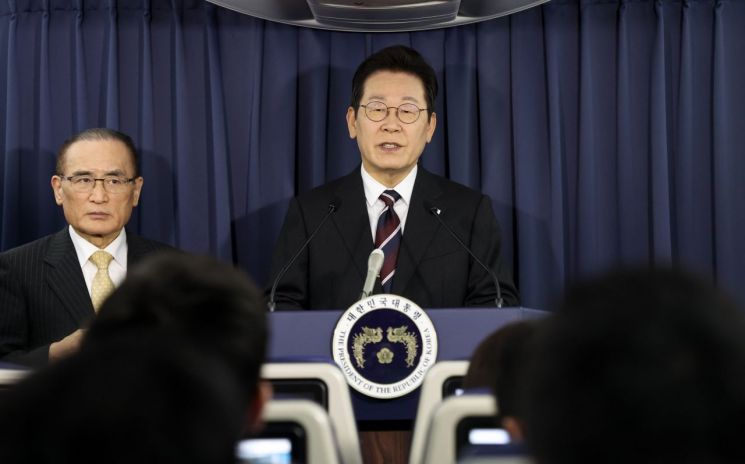 President Lee Jae Myung held a press briefing on board Air Force One en route to Washington DC for the South Korea-US summit after departing Haneda Airport in Tokyo, Japan, on the 24th (local time). Photo by Yonhap News
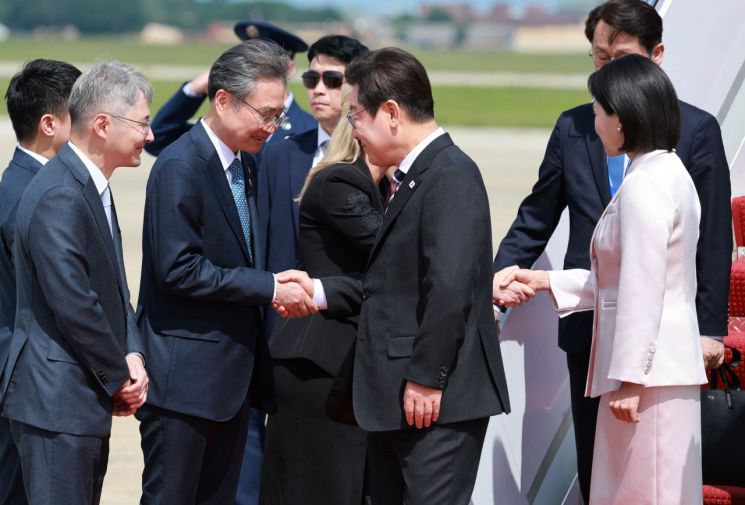
President Lee made these remarks during a 50-minute press briefing aboard the presidential aircraft en route from Tokyo Haneda Airport to Washington D.C. after completing his South Korea-Japan summit schedule. He said, "The world is now excessively focused on national and self-interest, so it takes several times more effort than before to protect our national interest." President Lee entered the United States via Andrews Air Force Base near Washington D.C. in the afternoon, beginning his two-night, three-day summit schedule. Due to ongoing construction at the official guesthouse, Blair House, he plans to stay at a hotel near the White House instead.
Prior to the summit, South Korean government officials continued working-level consultations with their US counterparts. Minister of Foreign Affairs Cho Hyun, Minister of Trade, Industry and Energy Kim Jung Kwan, and Trade Negotiation Head Yeo Han Goo arrived in Washington D.C. ahead of President Lee and are making last-minute adjustments to the agenda on trade and security issues. Unusually, all three key presidential aides-Chief of Staff Kang Hoon Sik, Policy Chief Kim Yong Bum, and National Security Chief Wi Sung Rak-will accompany President Lee during the summit to provide support.
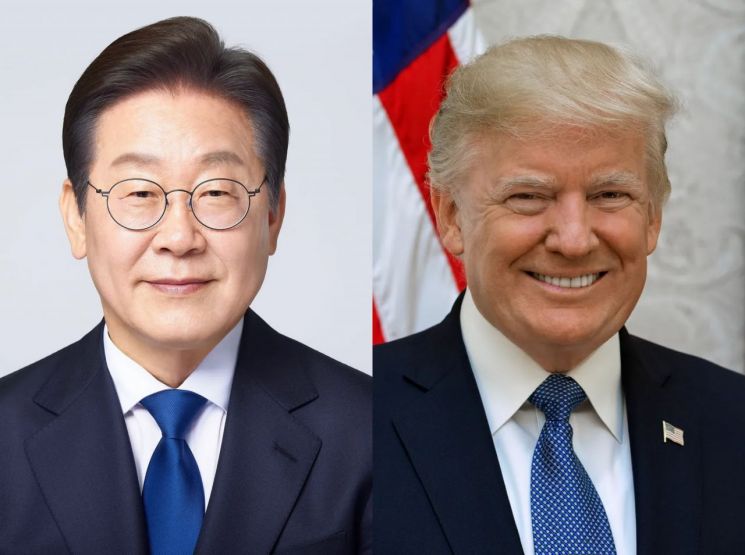
President Lee predicted that the outcome of this South Korea-US summit would ultimately be a practical and reasonable conclusion. While some have described the Trump administration as unpredictable and haphazard, President Lee disagreed, saying, "Isn't President Trump the most successful individual in America? If he had acted as recklessly as people assume, how could he have succeeded?" He also referenced President Trump's book, The Art of the Deal.
Regarding the perception in some US circles that he is "pro-China," President Lee responded, "If it benefits the national interest, we maintain close relations; if not, we keep our distance." He added, "There is no such thing as pro- or anti-China in diplomacy. Korea is not a country that can survive by conducting diplomacy with only a few specific nations." He emphasized, "The South Korea-US alliance and the South Korea-US-Japan alliance are fundamental and very important, but that does not mean we should sever or antagonize relations with other important countries."
Discussion on 'Denuclearization of the Korean Peninsula,' Including the North Korean Nuclear Issue, Possible: "Open to Unrestricted Dialogue"
President Lee also stated that, if possible, North Korea policy issues could be brought to the table for discussion. He expressed his willingness to discuss any topic without restriction, as long as it is not unnecessary or negative. "Whether it is the North Korean nuclear issue or any matter related to North Korea, issues concerning peace and stability on the Korean Peninsula are the most important security matters for South Korea," he said. "Regardless of who initiates the conversation, we should try to open a path for dialogue on North Korea policy."
President Lee also reiterated that the "complete denuclearization" of North Korea, as included in the joint press statement following the South Korea-Japan summit, is the path that must ultimately be taken. He previously proposed the "three-stage approach of freeze-reduction-denuclearization" in an interview with Japanese media before the summit. "This three-stage approach was at the core of the agreement reached between President Trump and Chairman Kim Jong Un," he said. "Complete denuclearization of North Korea is the path we must take for peace and stability on the Korean Peninsula, in Northeast Asia, and ultimately for world peace."
On the other hand, if the issue of "non-tariff barriers" in the agricultural and livestock sector-which was not conclusively resolved in last month's mutual tariff negotiations-comes up for discussion, President Lee plans to reiterate his firm opposition. "The mutual tariff announcement was made directly by the US President and mutually approved by both the Korean and US Presidents, so we cannot simply agree to change it unilaterally," he emphasized. "We believe it is not desirable to easily overturn or alter an agreement."
South Korea-Japan Leaders Focused on US Tariff Issue in 'Small-Group Summit'
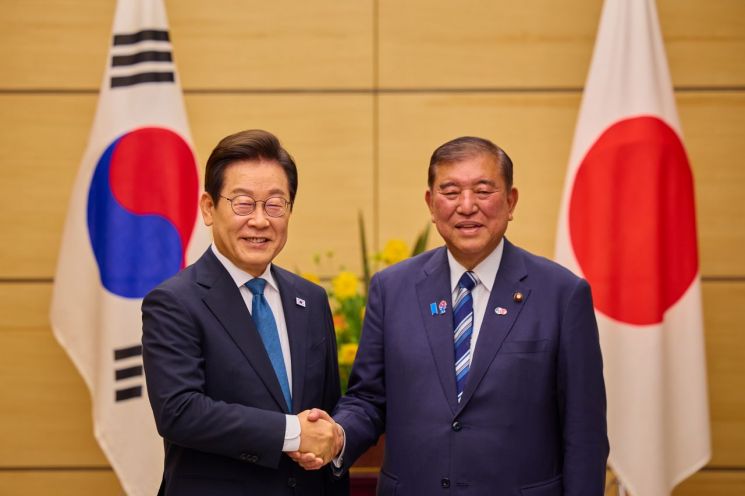
President Lee also revealed that, during his summit with Japanese Prime Minister Shigeru Ishiba prior to the South Korea-US summit, there was a focused discussion on the US tariff issue. The "small-group summit," which was initially expected to last about 20 minutes, drew attention for extending over an hour during the South Korea-Japan summit, which included a small-group meeting, an expanded meeting, and a joint press statement.
"Prime Minister Ishiba provided a great deal of friendly advice regarding the US tariff negotiations," President Lee explained. "He also promised to offer specific and detailed cooperation on points to watch out for and potential advantages for Korea in negotiations with the US. This is why the small-group summit lasted longer than expected."
Regarding the fact that solutions to historical issues between South Korea and Japan were not included in more detail in the joint press statement, President Lee said, "These issues can only be resolved by increasing mutual understanding and consideration. Although we are starting small now, I believe that as understanding and consideration deepen, much more forward-looking measures will become possible." He added, "If you give us a little more time, we will achieve much better results, and we will be able to deliver more tangible outcomes on historical and territorial issues as well."
© The Asia Business Daily(www.asiae.co.kr). All rights reserved.



















