Powell: "Balance of Risks Has Shifted... Policy Stance May Be Adjusted"
A More Cautious Tone Than Last Year's Jackson Hole Speech
85% Probability of a September Rate Cut... Uncertainty Over the Extent of Cuts This Year
August Employment Report Ho
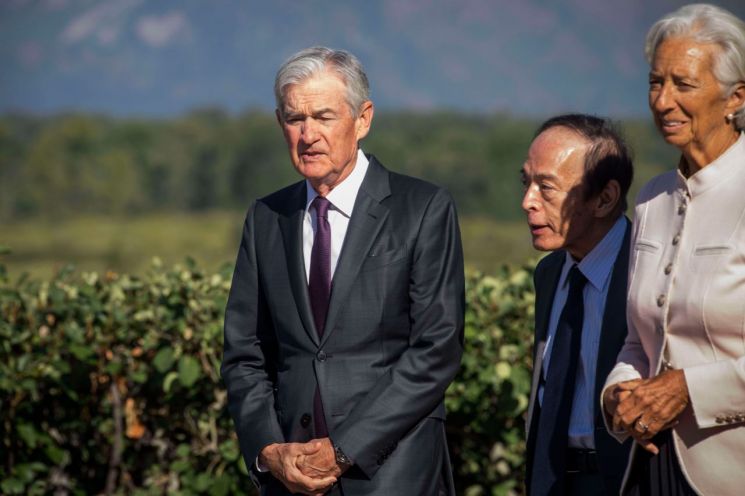
Jerome Powell, Chair of the U.S. Federal Reserve (Fed), delivered a more dovish-than-expected speech at Jackson Hole, signaling the possibility of an interest rate cut. While Wall Street is increasingly optimistic about a rate cut in September, Powell maintained a cautious tone, leading to divergent forecasts regarding the extent of cuts within this year. Amid expectations that the Fed's monetary policy stance may shift from 'Wait and See' to 'Move and See,' market attention is now focused on the July inflation data to be released this week.
According to the Chicago Mercantile Exchange (CME) FedWatch on the 24th (local time), the federal funds futures market is currently pricing in an 84.7% probability that the Fed will cut rates by 0.25 percentage points in September. This figure had surged to the 90% range from 75% before the Jackson Hole meeting, before settling back down. The probability of a total 0.5 percentage point cut within the year stands at 48.4%, while the likelihood of a 0.75 percentage point cut is at 37.7%, reflecting mixed expectations.
In his speech at the Jackson Hole Symposium on the 22nd, Powell emphasized the risks of a slowdown in employment over inflation risks, leaving the door open for a rate cut. He stated, "Policy is in a restrictive zone, and we may need to adjust our policy stance depending on changes in the baseline outlook and the balance of risks," referencing downside risks in the labor market. He added, "Both labor demand and supply have slowed significantly, putting the labor market in a peculiar equilibrium. This unusual situation suggests that downside risks to the labor market are increasing. If these risks materialize, it could lead to a sharp rise in layoffs and unemployment." However, while he left the possibility of policy adjustments open for this year, his tone was more cautious than last year's Jackson Hole statement, "The time for policy adjustment has come, and the direction is clear." This caution reflects lingering concerns about inflation risks stemming from tariff policies.
The market responded accordingly. Immediately after the Jackson Hole speech, expectations for a September rate cut soared to the 90% range, but subsequently fell back to the 70-80% range. As a result, there are now forecasts that the Fed may depart from its previous wait-and-see stance and adopt a 'Move and See' strategy, cutting rates once in September and then monitoring the situation.
Although the risk of a slowdown in employment is more significant, persistent inflationary pressures are also a concern. Wall Street is closely watching the core Personal Consumption Expenditures (PCE) price index for July, which the U.S. Department of Commerce will release on the 29th. The core PCE price index, which excludes food and energy, is expected to have risen 2.9% year-on-year, higher than June's 2.8% and the highest in five months. Personal spending during the same period is projected to have increased by 0.5% from the previous month, up from 0.3% in June, indicating that consumer spending remains resilient.
Anna Wong, an economist at Bloomberg Economics, commented on the July core PCE inflation rate, saying, "It is expected to be the highest since February," and added, "As economic activity picks up, companies may be able to pass more tariff costs on to consumers. This increases the risk that the August Consumer Price Index (CPI) and employment report may not necessarily support a rate cut in September."
Caution is also evident within the Fed. Beth Hammack, President of the Federal Reserve Bank of Cleveland, said in an interview on the 21st, "Inflationary pressures are moving in the wrong direction," and assessed that "the current labor market is quite healthy."
Ultimately, employment data appears to be the key factor. Even if inflation rises slightly, as long as it remains limited or within expectations, it is not a significant concern. However, if employment data unexpectedly deteriorates rapidly, pressure for a rate cut could intensify. In particular, the August employment report from the Department of Labor, which will be released just before the September Federal Open Market Committee (FOMC) meeting, is expected to be a decisive factor in determining the extent of rate cuts within the year.
Ryan Sweet, Chief U.S. Economist at Oxford Economics, stated, "If a rate cut occurs in September, it will be similar to a 'precautionary' measure," adding, "Powell appears to be preparing a gradual normalization plan for rates, assuming the economy proceeds as expected and risk factors do not change significantly. In other words, there is a possibility of a rate cut at each of the remaining meetings this year."
Additionally, the White House's moves to reshape the FOMC are another variable. President Donald Trump has nominated Stephen Miran, the White House National Economic Council Director and his so-called 'economic adviser,' to replace Fed Governor Adriana Kugler following her early resignation. Recently, he has also increased pressure for the dismissal of Fed Governor Lisa Cook, citing allegations of mortgage fraud.
© The Asia Business Daily(www.asiae.co.kr). All rights reserved.

















