Shuttle Diplomacy Resumes in Earnest with Korea-Japan Summit
Large-Scale Historical Agreement Unlikely
All-Out Effort in Washington, D.C.
'Trump-Style' Trade and Security Challenges
President Lee Aims to Put 'Three-Stage Denuclearization' and
President Lee Jaemyung will hold a summit with Prime Minister Shigeru Ishiba in Tokyo, Japan, on the 23rd. This marks their first meeting in about two months since they first met on the sidelines of the G7 Summit in June. President Lee plans to maintain the 'two-track' approach of separating historical issues from future-oriented relations, using this occasion to signal the official start of 'shuttle diplomacy.' On the following day, the 25th, a summit with U.S. President Donald Trump is scheduled, where challenging issues in trade and security are expected to be widely discussed.
Wi Sunglak, Director of the National Security Office, held a press briefing at the Yongsan Presidential Office on the 22nd, stating, "Visiting Japan and the United States consecutively is a rare and new attempt in our summit diplomacy." He added, "We aim to make trilateral cooperation among South Korea, the U.S., and Japan the central axis, based on the Korea-U.S. alliance and Korea-Japan partnership, and to further develop relations with China and Russia on this foundation."
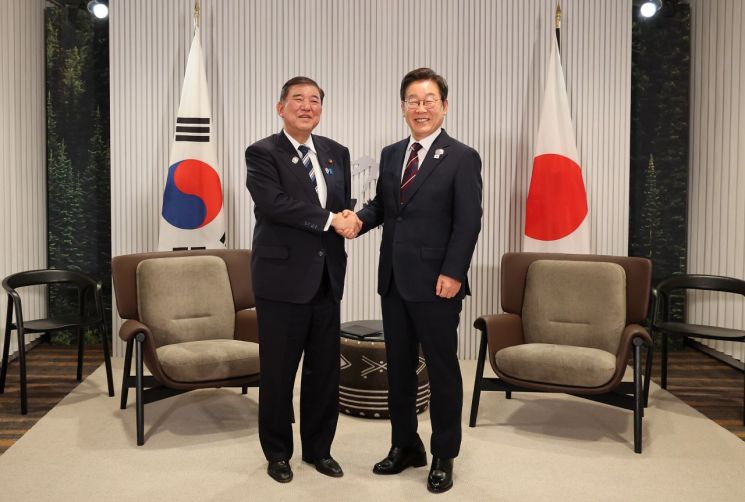
Shuttle Diplomacy Resumes in Earnest with Korea-Japan Summit... Large-Scale Agreement on Historical Issues Unlikely
The Korea-Japan summit is expected to prioritize strategic communication amid rapidly changing international dynamics, cooperation in response to shifts in U.S.-led trade order, and practical collaboration in supply chains and advanced industries. President Lee will emphasize that Japan is a neighboring country with a similar market and a cooperative partner, making this meeting an opportunity to share new strategies and responses from the perspective of national interest and practical benefit.
In an interview with Japan’s Yomiuri Shimbun published on the 21st, President Lee stated, "Korea and Japan need to establish a groundbreaking economic cooperation relationship," adding, "It is time to seriously discuss building a solid economic cooperation organization among Pacific Rim countries, including East Asia." Accordingly, discussions may include South Korea’s accession to the Comprehensive and Progressive Agreement for Trans-Pacific Partnership (CPTPP), development of Arctic routes, and cooperation among South Korea, the U.S., Japan, China, Russia, and possibly North Korea.
Regarding historical issues, most observers agree that a 'large-scale agreement' comparable to the Kim Dae-jung-Obuchi Declaration is unlikely. The two leaders plan to issue a joint statement, but given the working-level nature of the summit, it is unlikely that dramatic language on historical issues will be included. Director Wi also said, "It is unlikely that a declaration of great significance similar to the Kim Dae-jung-Obuchi Declaration will be made at this Korea-Japan summit," explaining, "The preparation period was short, and this meeting primarily serves as the first step in resuming shuttle diplomacy."
However, Director Wi left room for optimism, stating, "Currently, Korea-Japan relations are proceeding more smoothly than expected," and, "If the positive momentum grows, it will help address more difficult issues."
All-Out Effort in Washington, D.C.... 'Trump-Style' Trade and Security Challenges
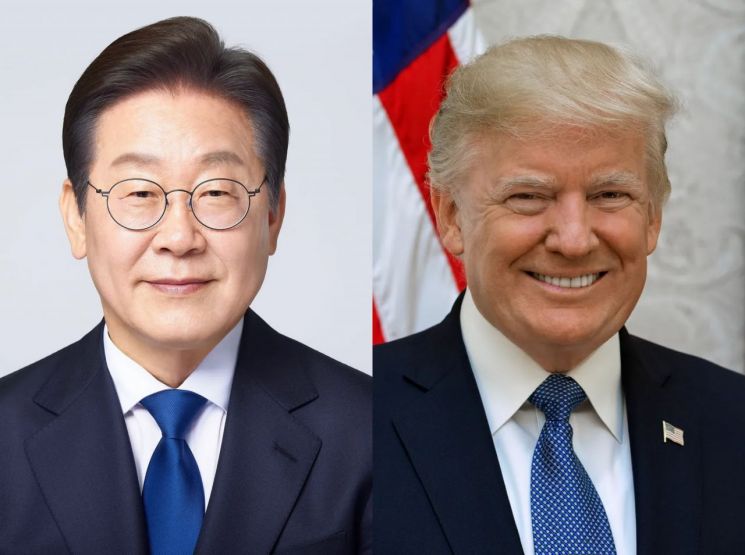
President Lee will arrive in Washington, D.C., on the 24th local time and hold his first Korea-U.S. summit with President Trump at the White House on the 25th. Notably, Director Wi, Chief Policy Secretary Kim Yongbeom, and Chief of Staff Kang Hunsik-the so-called "three chiefs"-will all be present. Foreign Minister Cho Hyun and Minister of Trade, Industry and Energy Kim Jeonggwan have already traveled to the U.S. for consultations with their counterparts. The summit aims to achieve three main goals: stabilizing Korea-U.S. economic and trade relations, modernizing the security alliance, and pioneering new areas of cooperation. Director Wi remarked, "The Korea-U.S. alliance currently faces new challenges in both economic/trade and security aspects."
On the trade front, the key is to solidify at the summit level the follow-up implementation of the tariff agreement reached at the end of July. The U.S. government has resumed pressure to open Korea’s agricultural and livestock markets, which seemed to have been settled in previous tariff negotiations. The summit may also see the U.S. requesting a more concrete 'roadmap' regarding the Korea-U.S. shipbuilding cooperation issue and the so-called MASGA project, as well as investment funds for the U.S. If working-level discussions between both sides do not proceed smoothly until the summit, instability could increase, contrary to the Korean government’s expectations. Regarding the pressure to open the agricultural and livestock markets, Director Wi stated, "Agricultural and livestock issues have always been part of Korea-U.S. trade negotiations. The talks are ongoing, but there has been no significant progress. The U.S. is indeed raising the issue, but we are responding in line with our established position."
The core of the security agenda is 'alliance modernization.' This encompasses the operation of U.S. Forces Korea, increases in South Korea’s defense budget, and the transfer of wartime operational control. The Korean government aims to modernize the alliance to further strengthen the joint defense posture with the U.S. without raising regional tensions. Director Wi said, "With the growing instability in the region due to North Korea’s nuclear and missile threats and North Korea-Russia cooperation, we aim to strengthen the alliance and enhance our military capabilities."
Regarding the 'strategic flexibility' of U.S. Forces Korea, Director Wi denied that detailed scenarios, such as U.S. Forces Korea’s involvement in Taiwan, are currently being discussed, stating, "Strategic flexibility is being discussed within the broad framework of the 2006 agreement, but we are not negotiating details like U.S. Forces Korea’s intervention in Taiwan." On the transfer of wartime operational control, he said, "We are pursuing the transfer, but it will not be a deeply discussed agenda at this summit. While cost issues may arise, we are maintaining our direction." Regarding the increase in defense spending, he added, "It is being discussed in the context of alliance modernization, but it is too early to mention specific figures."
President Lee Seeks to Address 'Three-Stage Denuclearization' of North Korea and Amend Nuclear Agreement
President Lee’s roadmap for North Korea’s denuclearization-consisting of 'Stage 1: Freeze nuclear and missile activities, Stage 2: Reduction, Stage 3: Denuclearization'-is likely to be brought to the summit table as a phased approach. Director Wi said, "There is a general consensus between South Korea and the U.S. on the basic approach. There may be differences regarding the timing and specifics of what to exchange with North Korea, but the overall approach is similar."
Efforts are also expected to be made to amend the Korea-U.S. nuclear agreement to secure policy autonomy for uranium enrichment and spent nuclear fuel reprocessing in South Korea. If the agreement is revised, restrictions on uranium enrichment for South Korea could be eased, and reprocessing of spent nuclear fuel could become possible. Director Wi said, "We aim to achieve progress on this issue through the summit."
However, the adoption of a joint statement remains uncertain. Director Wi said, "It appears that the agendas and issues between South Korea and the U.S. are being sorted out ahead of the summit," but added, "While it is true that both sides are currently negotiating the wording, the Trump administration is more unpredictable than previous governments, so it is difficult to say for certain."
© The Asia Business Daily(www.asiae.co.kr). All rights reserved.
![Clutching a Stolen Dior Bag, Saying "I Hate Being Poor but Real"... The Grotesque Con of a "Human Knockoff" [Slate]](https://cwcontent.asiae.co.kr/asiaresize/183/2026021902243444107_1771435474.jpg)
















